



Marine insurers issue EV fire guidance
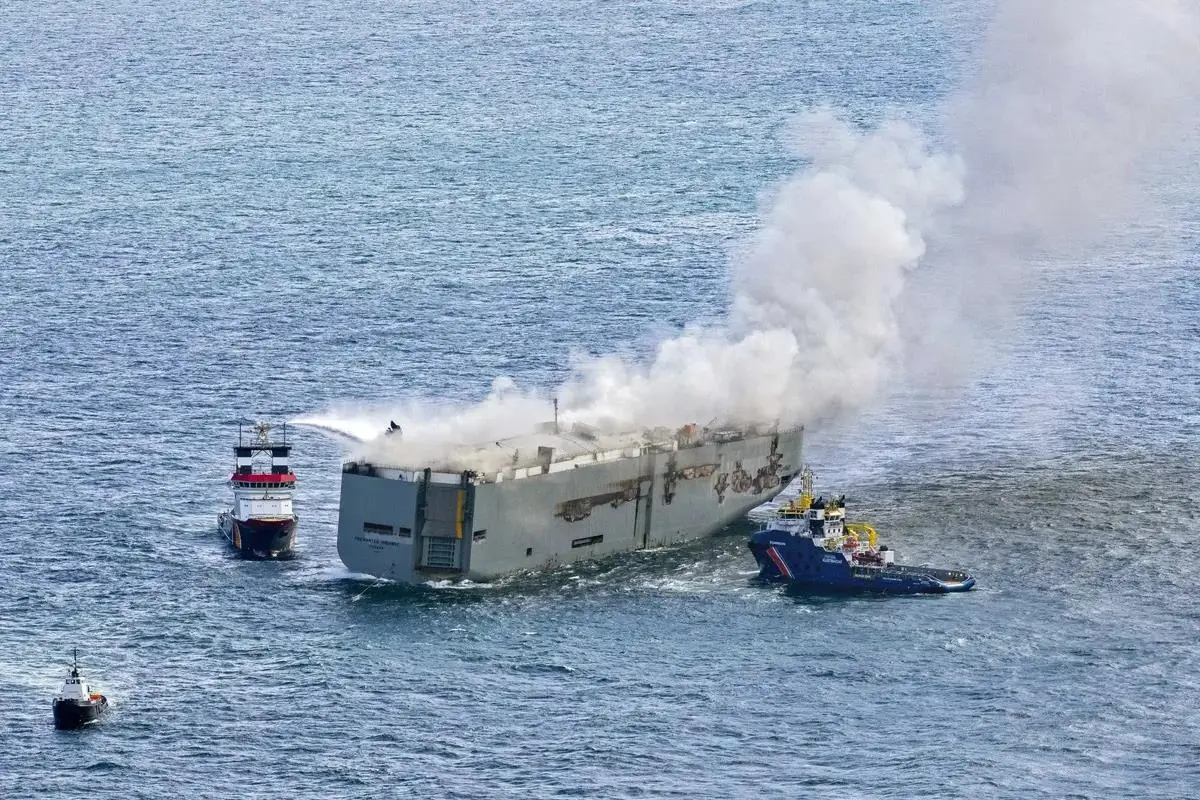
The advice comes in response to growing concerns within the shipping industry about fires breaking out on carriers and RoRos that are believed to start on EVs.
In July this year fire broke out on a cargo ship carrying nearly 3,000 vehicles off the Dutch coast killing one person and injuring several others. The ship’s owner said an electric car was suspected as the possible cause.
But the latest research from the IUMI has found that the risk posed by EVs is no greater than with internal combustion engines.
“Our paper draws on a body of scientific research which demonstrates that fires in battery EVs are not more dangerous than fires in conventional vehicles, nor are they more frequent,” said Lars Lange, IUMI Secretary General.
“Although statistics continue to be gathered, they currently estimate that, in general, there are fewer fires from EVs compared with fires from conventional vehicles when driven over the same distance.”
The research also proves that EV fires are no more intense that ones relating to internal combustion engines, as much of the blaze is fuelled by the car body and interior rather than the propulsion system.
However, the potential for the battery to suffer an unstable chemical reaction is a factor and can make fires hard to extinguish.
The IUMI has made a number of recommendations following its research, namely:
- Early fire detection is critically important and AI and thermal imaging cameras could help with this.
- Drencher systems should be installed alongside video monitoring systems on RoRo and RoPax vessels, for both EV and ICEV fires.
- The capacity of CO2 extinguishing systems should be doubled. High-expansion foam fire extinguishing systems are also effective.
- On board PCTCs, fixed systems should always be applied before manual fire-fighting is employed.
- A clear policy is required on which cargo is accepted or rejected.
- Charging onboard RoPax vessels should be permitted subject to relevant risk assessments and control measures.
The IMO’s Sub-Committee on Ship Systems and Equipment will start work on the ‘Evaluation of adequacy of fire protection, detection and extinction arrangements in vehicle, special category and RoRo spaces in order to reduce the fire risk of ships carrying new energy vehicles’ beginning in March 2024.
Related Articles
 METHANOL
 MONITORING, CONTROL & DIGITALISATION
 MONITORING, CONTROL & DIGITALISATION