



Market and regulators call for action, says GL
“Energy efficiency will be the factor determining the future competitiveness in the global shipping industry,” said Dr Jan-Hendrik Hübner, FutureShip, in a recent presentation in Hamburg attended by The Motorship.
FutureShip, a GL company with offices in Europe, China and Singapore, specialises in energy efficiency consulting, offering technical and management support from conceptual design to ship operations, with special focus on efficiency. “The freight rates are very low at the moment, and on the other hand costs are high, which caused significant losses for many shipping companies last year,” says Dr Hübner. Considering the large orderbook in most segments, the situation will not significantly improve over the next two years, he adds. “All major players have started cost saving programmes. The main improvements are basically already harvested, but the efforts have to be increased to improve the cost structure.”
For a container vessel. 30% to 60% of the overall costs are for fuel, depending on factors such as the segment and vessel speed. Consequently the share of capital costs is also dependent on the speed. “Everybody talks about charter rates and so on but people should rather talk about consumption and bunker costs because this is a larger problem,” according to Dr Hübner. For example, a 4.250TEU mid-size container vessel is currently chartered at $8,000-9,000/day. Daily bunker costs can be$40,000 even with speed reductions.
Future developments in fuel prices depend on several different scenarios. “No one knows exactly how bunker prices will be developing, but with a bunker cost model taking in account the crude oil development based on official forecasts, the markup for CO2, the markups for sulphur, then we have different scenarios,” says Dr Hübner.
We pointed out the steady price curve for LNG in his example. Dr Hübner notes that future LNG prices are uncertain, particularly with regard to distribution cost. “What we definitely can say is it will be lower than the others, it will be increasing.” He concludes that there is a clear upward trend visible. “It is quite likely that a vessel built today will see a bunker cost nearly doubled over its lifetime. We will see this sooner rather than later.”
New regulations
Apart from costs, there are regulatory considerations. Dr Hübner points out that the IMO’s recently-adopted energy efficiency design index (EEDI) sets a design cap for new ship designs from January 2013 onwards for most types of new ships, while the ship energy efficiency management plan (SEEMP) looks at operations, encouraging shipping companies to adopt management processes to reduce emissions and bunker costs. The SEEMP applies to both new and existing vessels.
Dr Hübner adds:”There are more regulation under discussion, the market based instruments now discussed by IMO on a global level, and on EU level, and discussed in other regional areas.”
He mentions three measures: emission trading, emission taxation and GHG-Fund coupled to bunker surcharges. “The interests in the shipping community are quite diverse in this area too. Most favour emission trading, some emission taxation and many greenhouse gas funds, so it is not totally sure what will come. It is sure that one of these instruments will come. There will be more pressure from the regulatory side in the future.”
He notes that beyond the regional level we have already seen Flag States and Port States taking action. “Singapore is one example, starting to differentiate tonnage tax and fees according to the EEDI for ships under the Singapore flag.”
It is anticipated that years 2012 to 2015 will see a redistribution of shipping markets, with a decrease in transportation costs. Dr Hübner’s believes that today’s ships will have to compete against vessels that are 30% more fuel efficient in the future. “The economical lifetime of merchant vessels will not be 25 years any more. It will be shorter,” he said, due to pressure from more efficient newer vessels. “We see already now with the market over-capacity we have today that many vessels are scrapped which have not reached an age of 20 years, as re-investments or retrofits would not pay off anymore.”
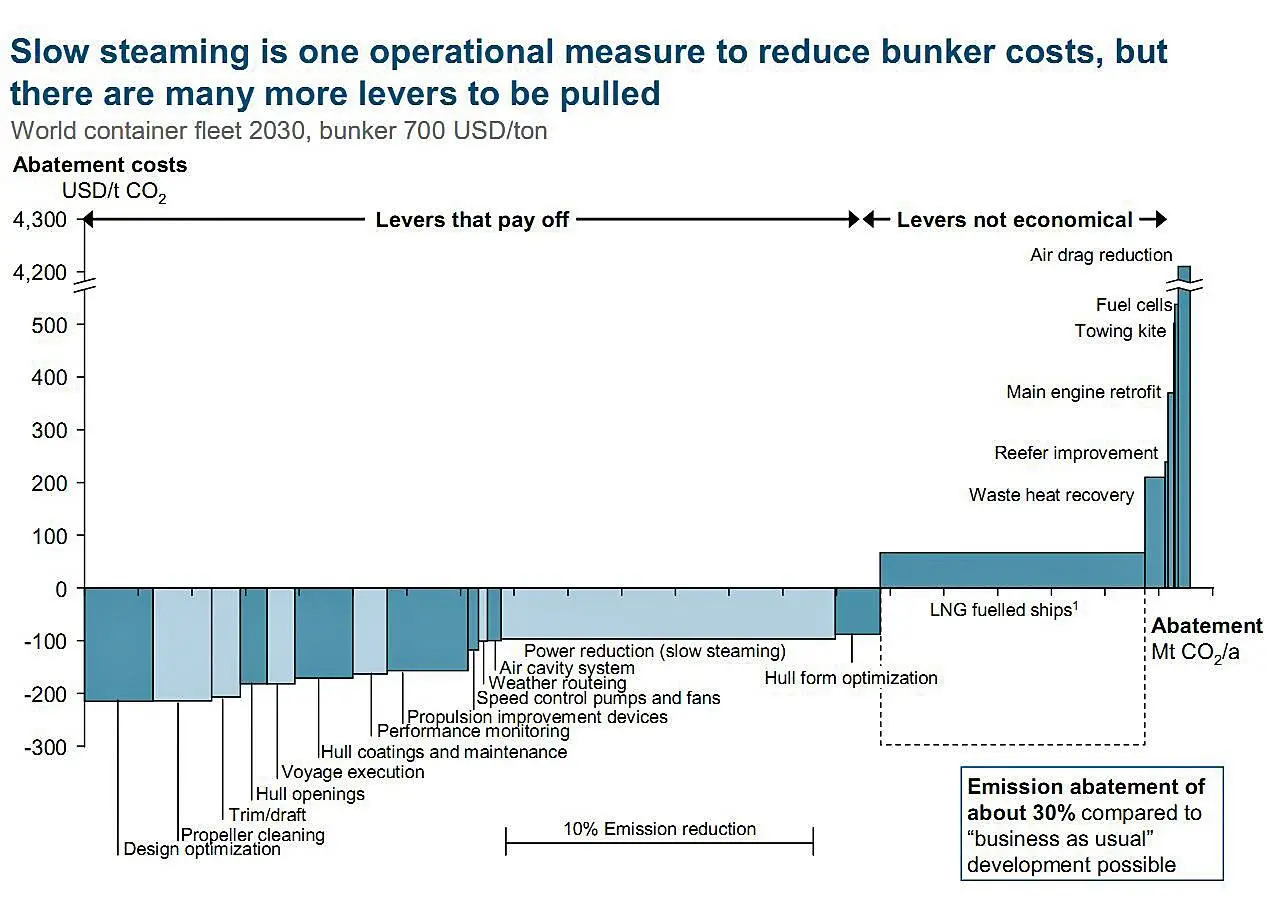
GL’s strategic research and development suggests that of many measures that can be introduced to save bunker costs, not all will pay off. So-called ‘abatement cost curves’ have been calculated for the container fleet expected in 2030. In this, LNG fuel may not be presently viable, but its beneficial value will sharply increase once global sulphur limits are introduced, requiring fitting of scrubbers. Other technologies like waste heat recovery show up less favourably because of the system costs.
Finally, energy performance management consulting, as offered by FutureShip, can prove effective. Experience shows that effective energy performance management benefits clients in other ways beside an average up to 10% saving in fuel costs.
Related Articles
 METHANOL
 MONITORING, CONTROL & DIGITALISATION
 MONITORING, CONTROL & DIGITALISATION