



Mass flow metering systems offer improved transparency
Commercial interest in mass flow metering systems (MFMS) has steadily increased since ExxonMobil first introduced the first MFMS in Singapore, before extending it to Hong Kong in 2016. The system was then brought to NW Europe in 2018, where ExxonMobil was the first to supply fuel via a 3rd party accredited MFMS in 2018.
The steady growth in interest in such systems has accelerated since Singapore’s MPA introduced requirements for the use of MFMS for bunkering, while the widely followed trials in connection with the Southernpec (Singapore) Pte case have raised perceptions of risk.
Armelle Breneol was keen to emphasise that the majority of such disagreements about quantity shortage were probably due to human error or measurement discrepancies, customers did see disagreements about bunkering deliveries as a disruption to business activities.
Breneol noted that errors can be introduced simply by mistakes in measuring temperatures, which has a direct impact on the volume you are measuring, the density unit, or simply when converting the volumes into tons. “This can happen when a crew has been rotated – sometimes discrepancies are introduced inadvertently.”
“The real problem is that without a mass flow meter, disagreements between bunker barge crew and a vessel’s crew become a case of one crew’s word against another’s. Certainly, we hear at ExxonMobil occasional stories about disagreements and claims. This is similar to the situation we used to see in Singapore before the mandatory introduction of the mass flow metering system.”
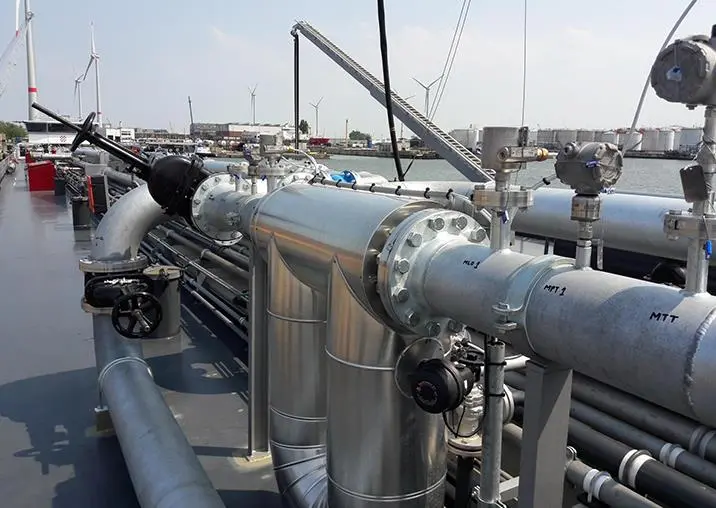
The MFMS eliminates these steps, calculating directly the delivered volume in tons. The system also offers the facility to provide a full digital receipt, listing temperature, density and delivered quantity in tons, on request.
A mature technology
While the use of MFMS is comparatively recent in maritime bunkering, it is a mature technology which has been successfully used in the oil and gas sector for some time, Breneol noted. However, there were specific challenges in the bunker barge segment that needed to be overcome.
The first was ensuring that operational procedures minimised the risk of air entering the pipe. “Given that a 3,000 ton stem might require 10 to 12 tanks to be emptied, and that there is a risk that air entering the pipe can contribute to the cappuccino effect, this was a real focus.”
The second was related to finding a location upon the vessel that minimised the effect of movement (swell & vibrations) upon the system itself. “Bear in mind that this system was originally developed for stationary, land-based applications, such as in the food industry”.
Operational benefits
The use of MFMS offers significant operational advantages for the crew of the bunker barge, which might see the overall delivery time for a larger stem reduced by up to three hours, compared with conventional tank dipping.
The current requirement for crews to open tank lids to conduct dip tests on each of the tanks is eliminated if an MFMS is installed.
“Maintaining a sealed system helps improves the safety for both crews as it removes any physical contact with the fuel and additionally saves on the use and disposal of cleaning rags normally required to clean the dipping equipment.” Breneol noted.
The benefits are also shared by the receiving vessel, although the benefits take the form of improved peace of mind, and the receipt of a simplified ticket from a system that has been certified by a third party, rather than an increase in potential uptime.
A further advantage of the MFMS used in ARA and elsewhere is that they are calibrated in line with OIML R 117 and ISO 17025 standards, ensuring accuracy to within +/- 0.5%.
Future proofing
Turning to the future, Breneol noted that the bunker sector was undergoing a transition, with digitalisation also altering the relationship between bunker suppliers and customers. Improved access to data is also leading to an increased demand for transparency and product quality.
This was also seen in concerns about off-spec products, given the need to demonstrate compliance. Breneol noted that the company had taken the decision to supply initially ExxonMobil Premium HDME 50TM marine fuel through an MFMS in ARA and has now extended this to other products.
Looking further ahead, some market observers have discussed the possibility that fuels may become more expensive in the future. “I don’t have a crystal ball,” Breneol said, before adding that there had been a correlation between rises in bunker prices and letters of protest for shortage in the past.
“We think MFMS is a technology that offers advantages to both vessel operators and bunker suppliers, and would encourage all segments of the market to get behind the technology”, Breneol concluded
Related Articles
 CONVENTIONAL FUELS & OILS
 ALTERNATIVE FUELS & LUBRICANTS
 AMMONIA