



Need for compact performance drives turbo technology
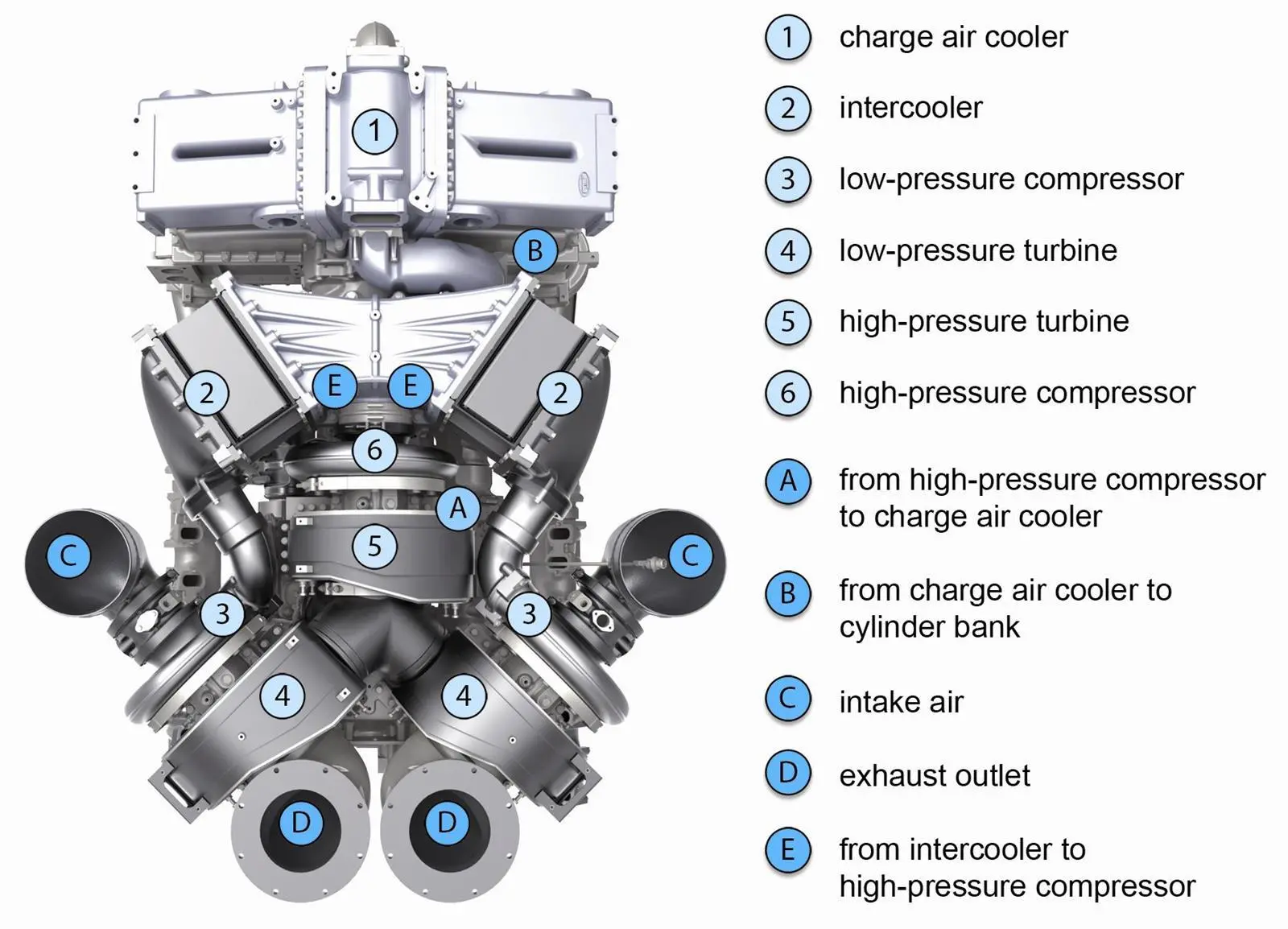
MTU’s ongoing development of engines and turbochargers is defined by the continual tightening of emissions standards to reduce. For MTU, turbocharging is central to the issue because a common feature of all emissions-reducing technologies is that they diminish the effect of the turbocharging, says Dr Johannes Kech, head of turbocharging development at MTU. “The Miller process, exhaust gas recirculation and diesel particulate filter create higher exhaust backpressure. Exhaust gas recirculation increases the air mass that has to be delivered to the cylinder. To put it simply, the turbocharger has to compress the air at a higher rate, i.e. it must force more air into the combustion chamber to provide the same amount of oxygen for combustion as before.”
Research by MTU has shown that the single-stage turbocharging previously used will no longer be sufficient for most applications in the future and the company is now developing regulated two-stage turbocharging. This ensures a constantly high rate of intake air delivery to the engine at all operating points and even under extreme ambient conditions of intake air temperature and backpressure. It involves pre-compression of the intake air by low-pressure turbochargers followed by further compression in high-pressure turbochargers. Control of the turbocharger system is integrated into MTU’s in-house developed electronic engine management system.
The regulated two-stage turbocharging system works with two intercoolers. The first is located between the low pressure and the high-pressure stage, and the second downstream of the high-pressure stage. “Intercooling provides more efficient compression in the following high-pressure stage, which leads to a higher efficiency level of the turbocharging system. In the case of all MTU engines, the intercoolers are highly integrated into the engine unit and have a very small space requirement,” says Kech.
In order to upgrade the series 1163 engines for IMO II and IMO III requirements, the two-stage sequential turbocharging technology will be applied. Future versions of the engines will continue to use three (on the V12), four (V16) and five (V20) pairs of turbochargers. The maximum combustion pressure will be raised to enable more efficient combustion and, consequently, lower fuel consumption.
The new engine designs will feature the Miller combustion process to reduce NOx emissions. However, this requires a higher turbocharger boost pressure, which is effected by optimised-geometry and low-inertia turbochargers. They are brought into play according to engine load so that vessels are able to accelerate quickly and manoeuver easily thanks to the large torque reserves.
LARGEST MEDIUM SPEED TURBOCHARGERS
In 2011 ABB released the two largest radial turbine turbochargers in its A100-M range for medium speed engines. The new turbochargers are designated A150-M and A155-M and target medium speed engines with bores of 32cm, a class which includes both upper to mid sized engines for marine propulsion applications and auxiliary generator sets on a range of vessels, including the largest container ships.
As such, these large radial turbochargers are addressing an engine size previously the domain of smaller axial turbochargers. This represented new challenges, leading to a number of new solutions. For example optimized compressor cooling is used on the A150-M and A155-M to achieve high turbocharging efficiencies, as are reduced turbine tolerances and gas-flow optimized exhaust gas outlet housings. As with all A100 turbochargers for high and medium speed applications, the A150-M and A155-M offer compressor pressure ratios up to 5.8 at very high turbocharging efficiency.
In this way the A150-M and A155-M give engine builders the scope for power uprates on the targeted size of engine and enable compliance with IMO Tier II NOx emissions to be achieved in combination with optimized specific fuel consumption – which also means lower CO2 emissions. In addition, the A150-M and A155-M achieve reduced noise emissions via the use of a new high efficiency filter silencer design at the compressor inlet. Another issue addressed has been HFO fouling during operation and has resulted in a more effective turbine washing system including an increased number of water injection nozzles. ABB Turbocharging points to the rapid, three year development time of new turbochargers which, at this size and performance levels, represent a new departure in radial turbocharger engineering.
HIGH SPEED TURBOGENERATOR
As part of the Hercules-B project, MAN Diesel & Turbo has successfully completed performance tests of a high-speed generator with an electric power take in/ power take out (PTI/PTO) system attached to a TCA55 turbocharger with variable turbine area (VTA). Initial commissioning of the unit was achieved on a burner rig at MAN Diesel & Turbo, Augsburg and tests are now underway on a 4S50ME-C9 engine at Mitsui Engineering & Shipbuilding, Tamano, Japan.
A core component of the technology is the Synchrony NovaDrive 400/NovaGen 400 with a rating of 380kW at 20,000rpm. This synchronously operating generator features a permanent magnet rotor which is supported by active magnetic bearings, implying minimum intrinsic losses. The system is directly linked to the runner inside the TCA55 by a flexible rigid coupling, the endurance of which has been validated throughout the performance tests. The tests have shown that the system has the potential to increase overall efficiency by recovery of excess exhaust gas energy and it has the capability to replace auxiliary blowers required to start-up low-speed marine diesel engines.
Related Articles
 PROPULSION
 GENERAL NEWS
 GENERAL NEWS