



NES adds energy storage to Quadro drives
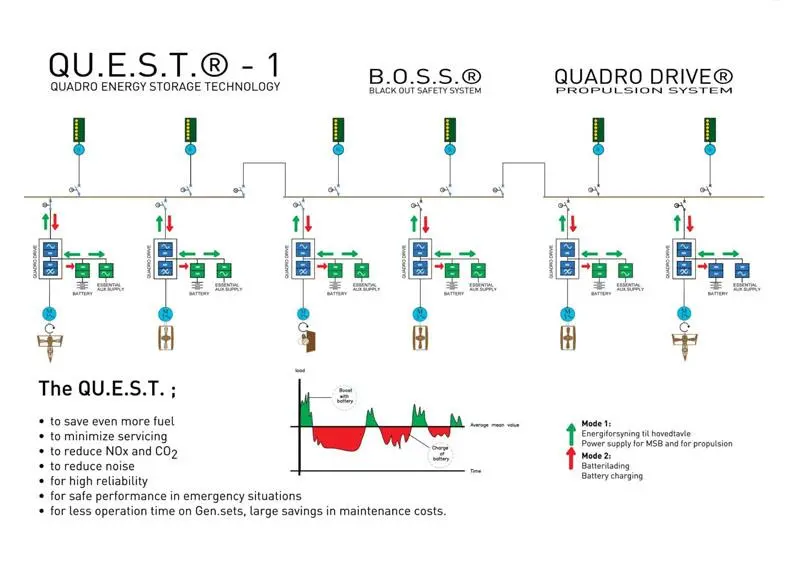
The new systems are marketed under the name ‘Quest’, or ‘Quadro energy storage technology’. NES says that it has been working to refine its Quest systems since 2010, when the basic technology was finalised. The reason for the extra work, according to NES CEO Jan Berg, was the need to ensure that the technology was properly prepared for the future – he says that the company’s philosophy has always been to prepare all NES diesel electric and hybrid electric systems with modular ‘add-on’ capability. The approach has proved correct; despite the poor economic climate in general, the comparatively young NES has managed to grow, and maintain its global market, showing an increase in turnover since 2012 of over 20% and an EBIDTA growth of more than 30%.
At the heart of the new Quest system is the NES Quadro Drive, a proven diesel-electric drive system, which now has more than 18 examples in operation. The operational systems have, according to NES, all performed with total reliability. In common with other high-quality conventional diesel electric systems the Quadro Drives have been found to cut fuel consumption by between 15% and 55% compared with normal mechanical drive systems, with corresponding savings in emissions of NOx and CO2. Diesel electric drives also contribute to significant improvements in dynamic operation of the vessels, as well as offering the potential to cut maintenance costs by up to 30%.
The Quest systems add the advantage of full hybrid operation by adding a battery pack, with either a DC/AC converter or a DC/DC converter. And, says NES, because they use readily-available off-the-shelf products and components, there are far fewer risks involved than would exist if gambling on prototypes or early examples of new technology.
In addition, NES has used its software development experience to study various vessel types and operational patterns, modelling power demands and fuel consumption. The company applied the knowledge gained from these studies to establish the necessary criteria with which to calculate the average level of power requirement, together with the amount of any subsequent power boost required from the battery to supplement the generated power, as shown in the graph, which demonstrates the power to and from the batteries, with green curves indicating boost and red curves indicating charging.
The two versions of Quest are:
- Quest 1, a newbuild system that is supplied fully integrated with Quadro drives, supplemented by the NES BOSS (black out safety system); and
- Quest 2, designed for retrofitting to an existing Quadro system.
NES says that when developing its hybrid system it, like other companies, considered a DC grid, but rejected the idea, because it is based on outdated and obsolescent technology, and far too expensive, particularly for installation.
The additional benefits claimed by NES for its Quest 1 and Quest 2 over its non-hybrid drive systems are:
- An additional fuel saving of more than 15%;
- Less demand for running multiple diesel gensets;
- Because generating set engines can run for fewer hours, this will add up to further significant savings in maintenance costs;
- Further reduction in NOx and CO2 emissions; and
- Increased redundancy for the total system.
Additionally, NES says that the Quest systems offer safe operation in DP2 mode with closed bus tie, and all the advantages add up to Quest being “possibly the safest operating electrical system in the world”.
Future plans from NES include the launch of a new system for reducing harbour power requirements by up to a factor of five by greatly reducing the onboard power supply demand.
Related Articles
 PROPULSION
 GENERAL NEWS
 GENERAL NEWS