



New generation car carrier unveiled
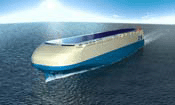
Mitsui OSK Lines has announced that the company has formed the concept for its next-generation vessels, which it belives could become reality in the near future, by building on and refining technologies it has already developed and adopted.
The first is a next-generation, environment-friendly car carrier. MOL says that it is continuing to work on concepts for other next-generation vessels such as ferries, bulkers, tankers, and container ships. It says it will continue working to stay in the vanguard of technological developments in the global ocean shipping industry.
MOL named the first concept: Car Carrier ISHIN-1 which stands for ‘Innovations in Sustainability backed by Historically proven, INtegrated technologies’. The company describes the two main features as follows:
(1) While in port, and during loading and unloading: achieve zero CO2 emissions. Further develops the use of renewable energy for conventional car carriers. Realises zero emission goal by adopting large-capacity solar-power panels and rechargeable batteries. Similar solar panels have already been partly adopted on the car carriers Euphony Ace and Swift Ace, on all areas of the upper deck on both vessels. The large-capacity rechargeable batteries (lithium ion) would be combined with an electric propulsion system.
(2) Under way: Reduce CO2 emissions by 50%. Adopts multiple new technologies to greatly reduce the vessel’s burden on the environment. The ship achieves a 41% reduction, in comparison (per unit) to conventional vessels (PCTC with a capacity of 6,400 standard passenger cars). When needs for larger vessels arise in the future, CO2 emissions can be reduced by 50% on that assumption. Other CO2 reducing measures include optimisation of propulsion efficiency thanks to contra-rotating propeller drive system, using a combination of a diesel engine with an electric propulsion system, and a pair of propellers facing each other at the stern. The propellers share the burden of powering the ship and spin in opposite directions, allowing the rear propeller to absorb the rotation energy of the front propeller. As a result, the system greatly increases efficiency.
The propellers will benefit further from advanced propeller boss cap fins (PBCF), a MOL-developed energy-saving device, which has been adopted on more than 1,700 vessels. The most advanced model will be installed on the ISHIN-I vessels. CO2 emissions can be further reduced through an advanced low wind resistance design also developed by MOL, with a refined hull shape, reducing wind pressure from the bow and sides. The shape of the stern also smooths the flow of the wind. This is augmented by reduction of friction drag, though use of ultra-low friction ship bottom paint. By trapping water on the coated surface, this paint eliminates friction drag caused by minute patterned indentations formed on conventionally painted surfaces.
An optimised voyage support system will rely on the latest marine weather information while monitoring voyage conditions, and search for the shortest, most fuel-efficient routes while taking into account the differences in various types and hull forms of ships.
The engine and propulsin system will be further optimised by electronically controlled and optimised fuel supply. Thermal energy conventionally lost with exhaust gas will be efficiently recovered for reuse.
The optimised hull design with improved hull form should offer further improvements in fuel efficiency. A larger hull can be used, compatible with the new Panama Canal.
When needs for larger vessels arise, adoption of twin-shaft propellers will allow greater improvement in propulsion performance and fuel efficiency. This will reduce CO2 emissions per unit transported by up to by 50%, compared to current vessels.
A new web site has been developed (in Japanese) to offer a detailed look at ISHIN-I and MOL’s technological innovation.
Related Articles
 ALTERNATIVE FUELS & LUBRICANTS
 GENERAL NEWS
 GENERAL NEWS