



New wind turbine ship concept developed
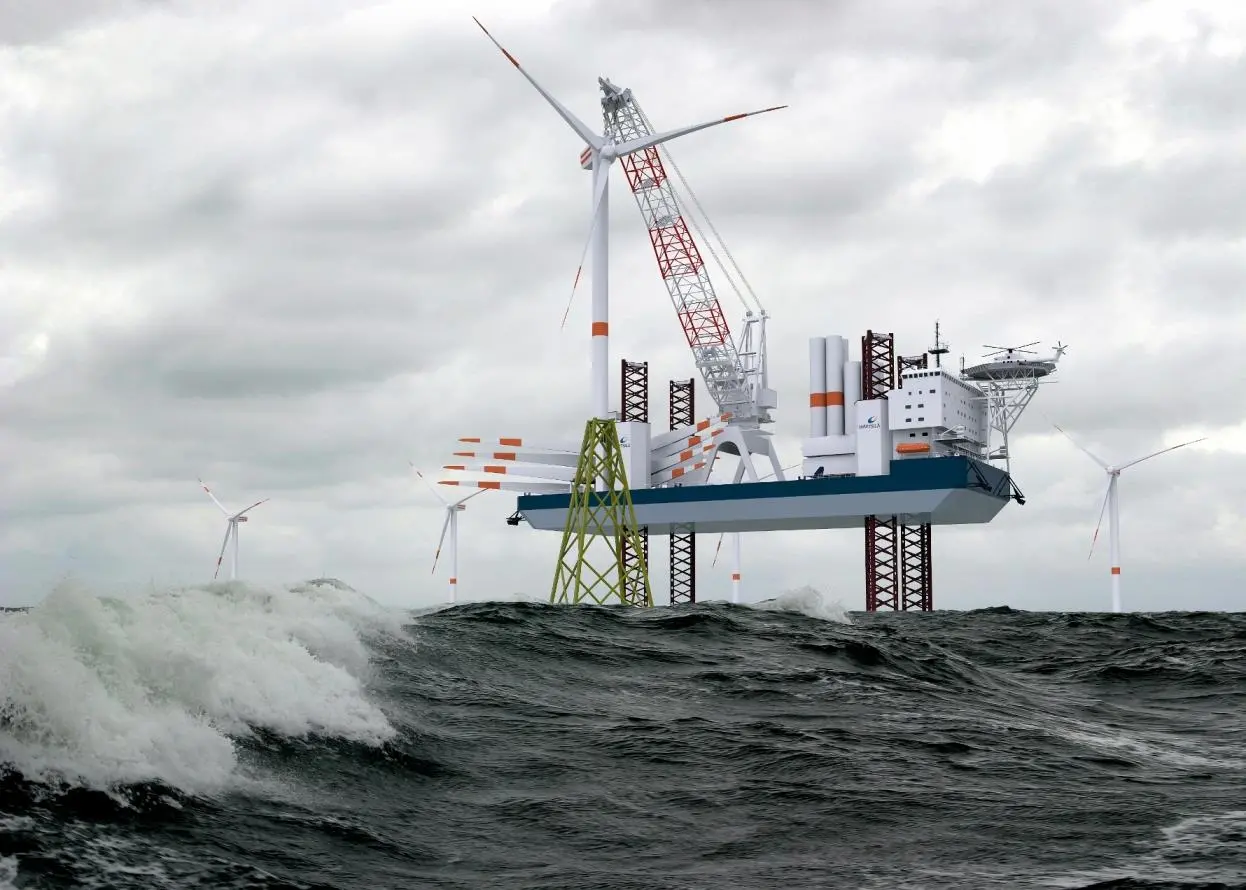
Under the agreement Wärtsilä will provide the new installation vessels with the ship design, electrical power generation, propulsion machinery and high-end automation, whilst Aker Solutions will supply the jacking system. The two companies intend to offer a 24/7 global support service for maintenance, repairs, and component supply to the vessels.
The two companies have selected technologies to enable a highly efficient way of setting up offshore wind power generation. The three Wärtsilä 6L34DF and two Wärtsilä 9L20DF dual-fuel engines, that will provide main and auxiliary power for the vessel, can operate on LNG. Heat from the engine cooling system will generate drinking water, and to supply hot water for use by the crew. The accommodation heating will use the same heat source, while absorption chiller units will provide air conditioning.
Aker Solutions has developed a continuous hydraulic jacking system for truss legs, for which benefits are claimed in regard to redundancy, and which is robustly designed for harsh environments.
The new vessel concept will be marketed as a complete package. Wärtsilä says that it will fulfil the industry’s requirements for large deck space, sufficient crane capacity, year-round and all-weather operational capability and cost-efficient operating systems. It is designed to be able to operate in ECAs.
“This new concept is already generating significant interest among that segment of the industry involved with the installation and maintenance of offshore wind farms. There is a notable demand for a high technology, and fully integrated installation vessel design having significant environmentally sound features. We are delighted to be in co-operation with Aker Solutions to fill this need that is especially significant in the North Sea area. We expect to get the first orders this year,” says Riku-Pekka Hägg, vice president, Wärtsilä Ship Design.
The market for offshore wind farms is said to be rapidly developing as demand for renewable energy sources increases. Since Northern European offshore wind farms tend to be in shallow waters of 50m or less in depth, so-called jack-up vessels are used for the installation work. At the installation site, the vessel lowers massive legs to the seabed on which the vessel is jacked-up until it is above the waves. A hydraulic grip system is used for the jack-up operation.
Related Articles
 ALTERNATIVE FUELS & LUBRICANTS
 GENERAL NEWS
 GENERAL NEWS