



Nippon Paint Marine’s biocidal-free coating
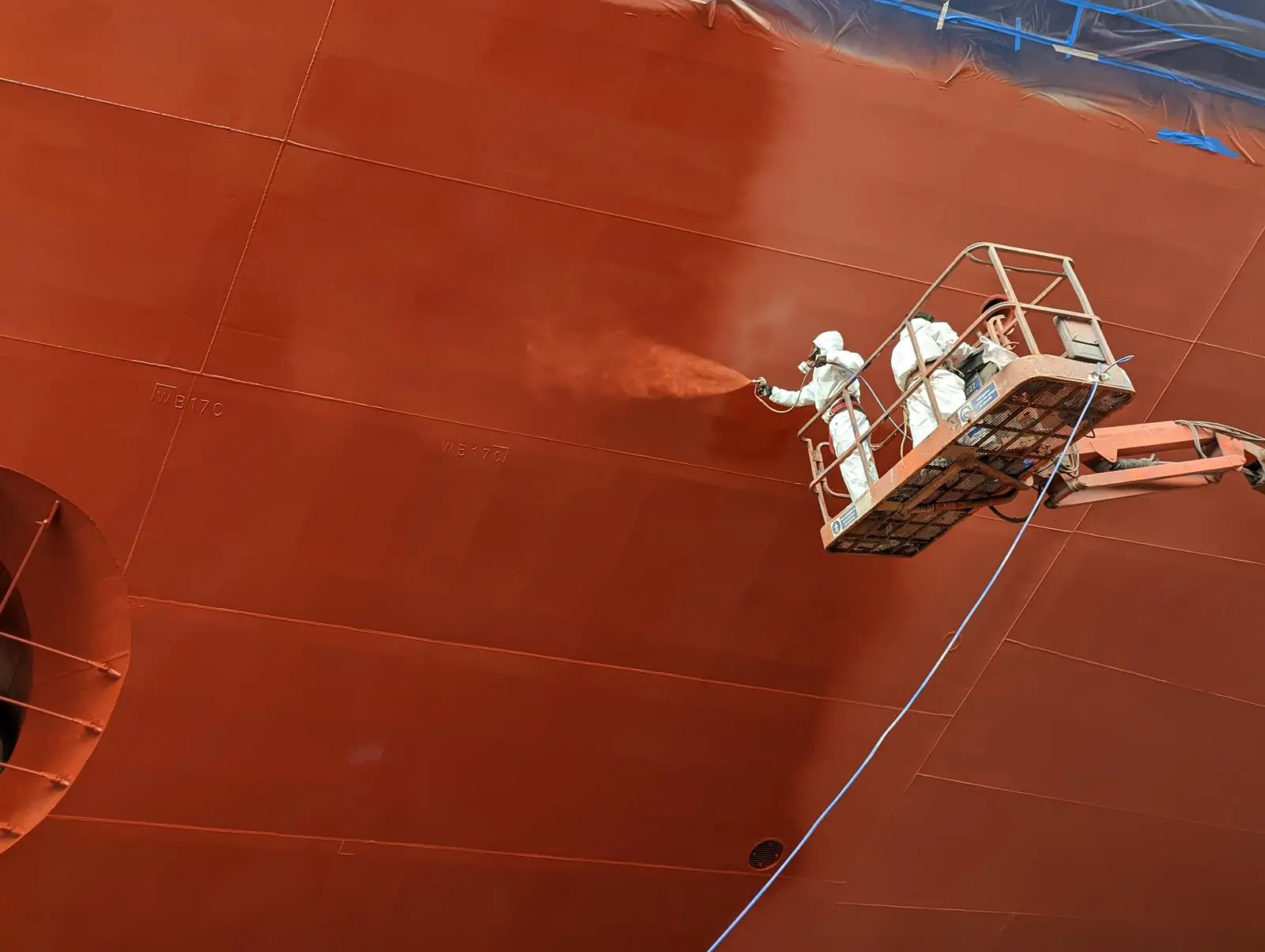
We spoke to Kazuaki Masuda, corporate officer in the technical division of Nippon Paint Marine about its AQUATERRAS solution, a biocide-free coating applied to ships to stop barnacles and other obstructions attaching and thereby reducing vessel speed.
Question: How does AQUATERRAS contribute to environmental sustainability compared to traditional biocidal antifouling paints?
A: Our AQUATERRAS solution is a pioneering development in coatings technology from our R&D team. It represents the world’s first hull coating that provides industry leading protection, whilst remaining 100% biocide-free. Taking inspiration from innovation in wider sectors, our research team developed AQUATERRAS’s biocide-free self-polishing coating with technology and material originally developed in the pharmaceutical sector, by using medical anti-thrombogenic polymer technology.
Our R&D team developed a new form of hydrolysis by combining hydrophilic and hydrophobic micro-domain structure on the coating’s surface to prevent biofouling. As a result, AQUATERRAS naturally repels any biological adhesion onto its surface through the constant exposure of its active micro-domain structure that is realised by the fine-tuned continuous self-polishing.
1. What performance data can you share regarding fuel savings and fouling prevention achieved with AQUATERRAS?
The combination of a hydrophilic and hydrophobic micro-domain structure creates a unique reaction which continually smooths the water flow around the hull surface as it travels in the sea, which has been found to reduce emissions by up to 14.7%, thanks to an average speed loss of just 1% over a 60-month period. The market average speed loss over a similar time period is 5.9%.
We have conducted extensive testing of the AQUATERRAS product to ensure its credentials as truly a biocide-free solution. Our research team studied its impact on marine fish, bivalves, crustaceans and seaweed, we found that none were impacted by the coating, which confirmed that AQUATERRAS posed no negative impact to marine life.
2. Are there any specific considerations or challenges when applying AQUATERRAS compared to conventional coatings?
No, one of the key characteristics of our AQUATERRAS coating is its ease of application. The coating has good workability and doesn’t require any special application apparatus or technical painting practices.
3. How has the market responded to AQUATERRAS since its launch, and what feedback have you received from shipowners and operators?
Since its release in 2017, through testing and application on more than 100 vessels, AQUATERRAS has received a fantastic response from our customers and the wider industry. In fact, in 2021, AQUATERRAS was announced as the winner of the SAFETY4SEA’s Technology Award as well as the Seatrade Maritime Award, in 2023. The awards recognised the coating’s contribution to improving efficiencies, lowering operating costs and reducing emissions for the shipping industry.
An example of the trust that the market has in the technology was demonstrated in 2024, when we applied AQUATERRAS to Mitsui OSK Lines Ltd’s (MOL) 36,030 GT carrier, the Courageous Ace. Due to the vessel having to operate in multiple conditions around the world, the customer required a coating that could optimise performance in the harshest environments, which meant that AQUATERRAS was the ideal solution.
The coating was applied to the flat bottom, vertical bottom, and boottop of the vessel, which represented the first time MOL has used AQUATERRAS, and although it’s too soon to share detailed results, the initial feedback from the client is extremely positive.
4. Does AQUATERRAS comply with international regulations, such as the IMO’s AFS Convention, and have you obtained certifications from classification societies?
Yes, our industry leading research and development teams are committed to innovating our product lines to ensure that our coating systems adhere to the highest industry standards. Our AQUATERRAS series complies with the IMO-AFS2001 Convention on the Control of Harmful Antifouling Systems on Ships as a tin-free coating system, and has received certification from leading class societies, including the Japan Paint Manufacturers Association, DNV, Lloyd’s Register, and Korean Register.
Related Articles
 NEWS
NEWS
 ALTERNATIVE FUELS & LUBRICANTS
 ALTERNATIVE FUELS & LUBRICANTS