



No-loss electric propulsion selected for gas-fuelled ships
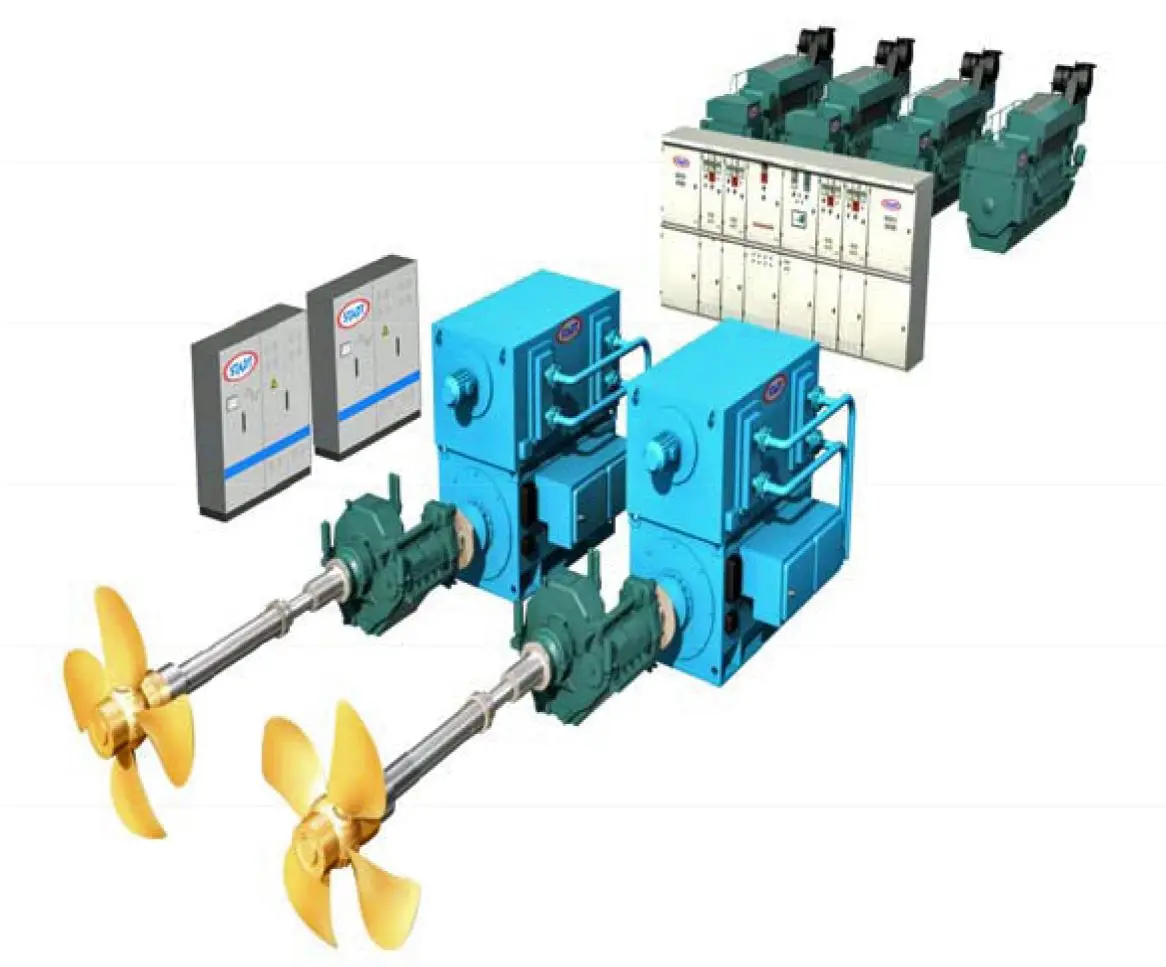
Samsung Heavy Industries of Korea, which with 197 ships in its order book is the largest shipbuilder anywhere, has ordered Stascho electrical propulsion systems from Stadt. The order comes as a result of a joint development between Samsung and the Korean government, to increase the focus of the country’s shipbuilding industry on development of sustainable ship propulsion technology. The main aims of the project are to reduce emissions of CO2 and NOx and to reduce consumption of fossil fuel. In fact, reductions in fuel use of up to 60% are claimed for Stadt’s technology. The joint industry project regards conversion from oil to natural gas as a significant means of achieving these goals.
The use of electric propulsion, using power generated by an LNG-fuelled plant, is seen as offering a sustainable solution. Such a configuration enables the power production to be separated from the propeller system. Compared with conventional oil-fuelled mechanical propulsion systems, LNG-powered generators can be operated at a more steady load, independent of propeller power demands. The Stadt electric no-loss drive system is employed to drive the propellers, rather than direct mechanical drive from the engines.
Stadt’s no-loss drive system has been developed over the last 10 years or so, and represents the company’s fifth-generation drive technology, in 25 years of development experience. According to Stadt director Hallvard Slettevoll, the no-loss drive product range is comprehensive, with power handling capabilities covering a range from 100kW up to 100MW, operating at voltages between 220V up to 15kV. Because the system does not need large power transformers, it saves significant space and weight, while at the same time reducing power losses.
“It is pleasing to see that the work can give a global meaning to the environment, and at the same time make international shipping more sustainable and gives better payback for the ship-owners,” says Slettevoll.
Slettevoll points out that among the technological benefits of the no-loss drive system is its freedom from disturbances, such as EMI (electromagnetic interference), acoustic noise and vibrations. These properties are highly valuable for virtually all ship types. But Slettevoll believes that growing markets for military projects using commercially-available technology and components may provide significant international interest in the systems.
Stadt says that, on reliability grounds, it is continuing to favour alternating current (AC) technology over the direct current (DC) systems which seem to be re-gaining favour in some marine drive applications. Over many years the company has observed major unpredicted failures, and, in extreme cases, even explosions, in systems that incorporate large DC capacitor systems as part of the drives. Such capacitors and the associated low-inductance DC switching circuits incorporate minimal insulation creepage distances, often less than 1mm, while operating at voltages up to 1,000V DC. This has been the root cause of most of the failures in DC drive products, which have, in Stadt’s opinion, demonstrated inadequate system lifetimes and a greater number of failures than should be tolerated. Stadt says that its Stascho drives make only very limited use of capacitors, and then these components are only used during short transient periods, which effectively eliminates capacitor-based problems from its systems.
Although the Samsung cooperation is based on LNG-fuelled generators, Stadt points out that its no-loss drives are also applicable to diesel-powered generating plant, and the drives can be applied to shaftline or azimuthing thruster drive trains.
Related Articles
 PROPULSION
 GENERAL NEWS
 GENERAL NEWS