



North Sea partners commit to rapid expansion of offshore wind capacity
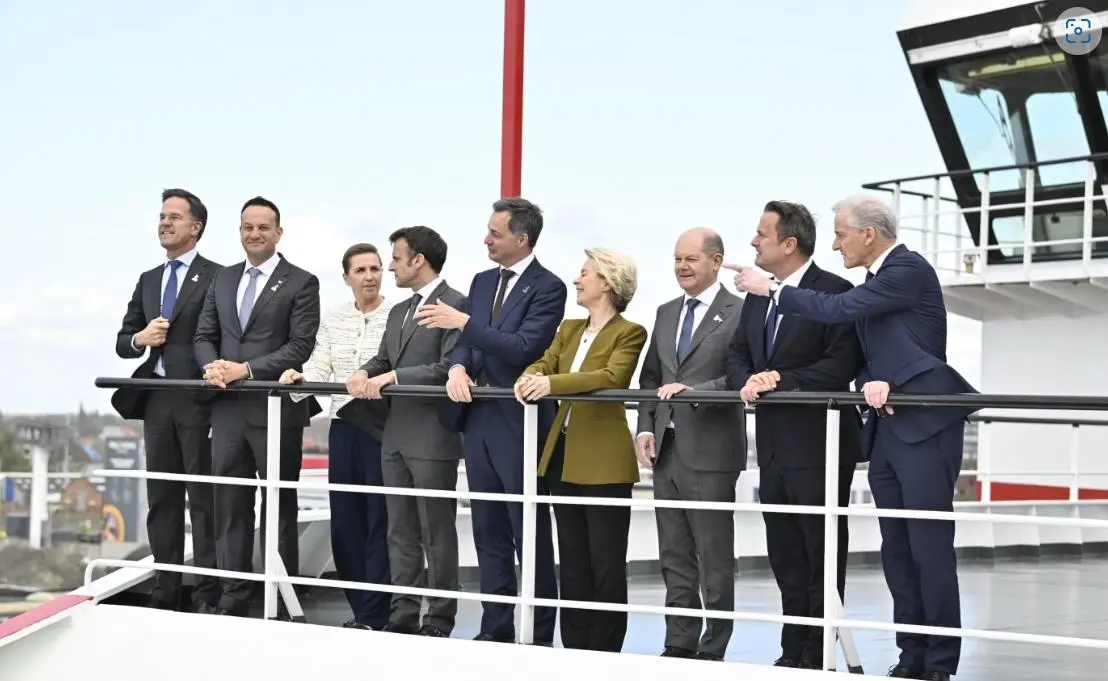
The announcement almost doubled the ambition of a 2022 announcement in Esbjerg, Denmark between four EU member states (Denmark, Belgium, the Netherlands and Germany) that established a target of 65GW.
UK has also increased its own ambitions for offshore wind generation since 2022, most recently targeting 50GW by 2030, including 5GW of floating offshore wind capacity. To put the targets into context, the UK currently accounts for almost half (14GW) of the 30GW of offshore wind capacity installed in the North Sea.
The announcement follows after the European Union raised its own target for renewable energy generation from 32% in 2030 to 42.5% in 2030 at the end of March 2023, following an agreement between the European Parliament and the governments of EU member states.
The Motorship notes that a number of Baltic and central European EU member states increased their ambitions for offshore wind production in the Baltic Sea to 20GW by 2030 in August 2022.
The announcement lifted the long-term target for offshore wind generation from the North Sea from 150GW to 300GW in 2050.
The announcement’s immediate impact upon wind turbine installation vessel capacity and the offshore service vessel sector is likely to attract the most attention. A UK technology accelerator, ORE Catapult, estimated in March that around 150 Surface Operation Vessels (SOVs) will be needed to serve rapidly expanding offshore wind developments in Europe by 2030, and 310 by 2050.
Hydrogen and CCUS
The announcement is expected to contribute to an expansion of renewable hydrogen production “at massive scale” as well as a significant expansion in electricity and hydrogen interconnectors.
Given existing renewable hydrogen production targets of 30GW by 2030 by Germany, Denmark, the Netherlands and the UK, the announcement expects the expansion of offshore wind energy to support higher renewable hydrogen production by 2050.
Interestingly, the agreement also notes that there is a need for greater coordination of storage and offshore infrastructure planning between signatories around the North Sea’s carbon capture, utilisation and storage (CCUS) potential.
Circularity and recycling
By comparison with detailed references to bilateral and multilateral agreements to govern the development of cross-border electricity interconnectors, and energy islands, there was no explicit reference to end of life recycling commitments for the wind turbines and components themselves.
Given the scope and scale of the ramp up of offshore wind capacity, as well as the need for regular replacements of turbines every 20-25 years, it is likely that the expansion will create a permanent sector installing, servicing and decommissioning offshore wind turbines.
Circular economy considerations (as well as concerns to reduce overdependence upon suppliers outside Europe) is likely to lead to the expansion of domestic European supply chains supplying offshore wind turbines and their associated supply equipment.
The announcement’s coded references to “safeguarding the supply of relevant critical raw materials” and “the enhanced circularity of offshore renewable energy and grid infrastructure” can be understood as indicating that the initiative will seek to stimulate local manufacturing and recycling chains.
Unlike Europe’s emerging cleantech sector, there was no explicit reference in the Ostend Declaration to the potential for an expansion of European specialist shipbuilding to meet the growth in demand for vessels installing, servicing and ultimately dismantling the expansion in offshore wind generation capacity.
Here too, The Motorship understands that siren voices within the European Commission are calling for a significant expansion in domestic European shipbreaking and recycling capacity, perhaps by using the revision of the EU’s Ship Recycling Regulations as a demand-driver.
It remains to be seen whether European shipyards will be able to narrow production costs disparities against Asian competitors for larger specialist vessels without the introduction of policy instruments, such as carbon credits for recycled materials and components.
However, given the significant EUR1 trillion+ scale of investments in offshore wind envisaged over the coming 25 years, there will be strong political incentives to minimise the cost of installing and maintaining offshore wind generation capacity.
| Country | 2030 | 2050 |
|---|---|---|
|
Belgium |
6GW |
8GW |
|
Denmark |
5.3GW |
35GW |
|
France |
2.1GW (North Sea and Eastern Channel) |
4.6-17GW (North Sea and Eastern Channel) |
|
Germany |
26.4GW (North Sea) |
66GW (North Sea) |
|
Ireland |
4.5GW |
20GW |
|
Luxembourg |
– |
– |
|
Norway |
3GW (inc. 1.5GW floating) |
30GW (by 2040) |
|
Netherlands |
21GW |
50GW (by 2040), 72GW (2050) |
|
UK |
50GW (inc. 5GW floating) |
100GW (ambition in March 2023 Offshore Wind Plan) |
Related Articles
 ALTERNATIVE FUELS & LUBRICANTS
 GENERAL NEWS
 GENERAL NEWS