



Offshore wind vessels: the design basics
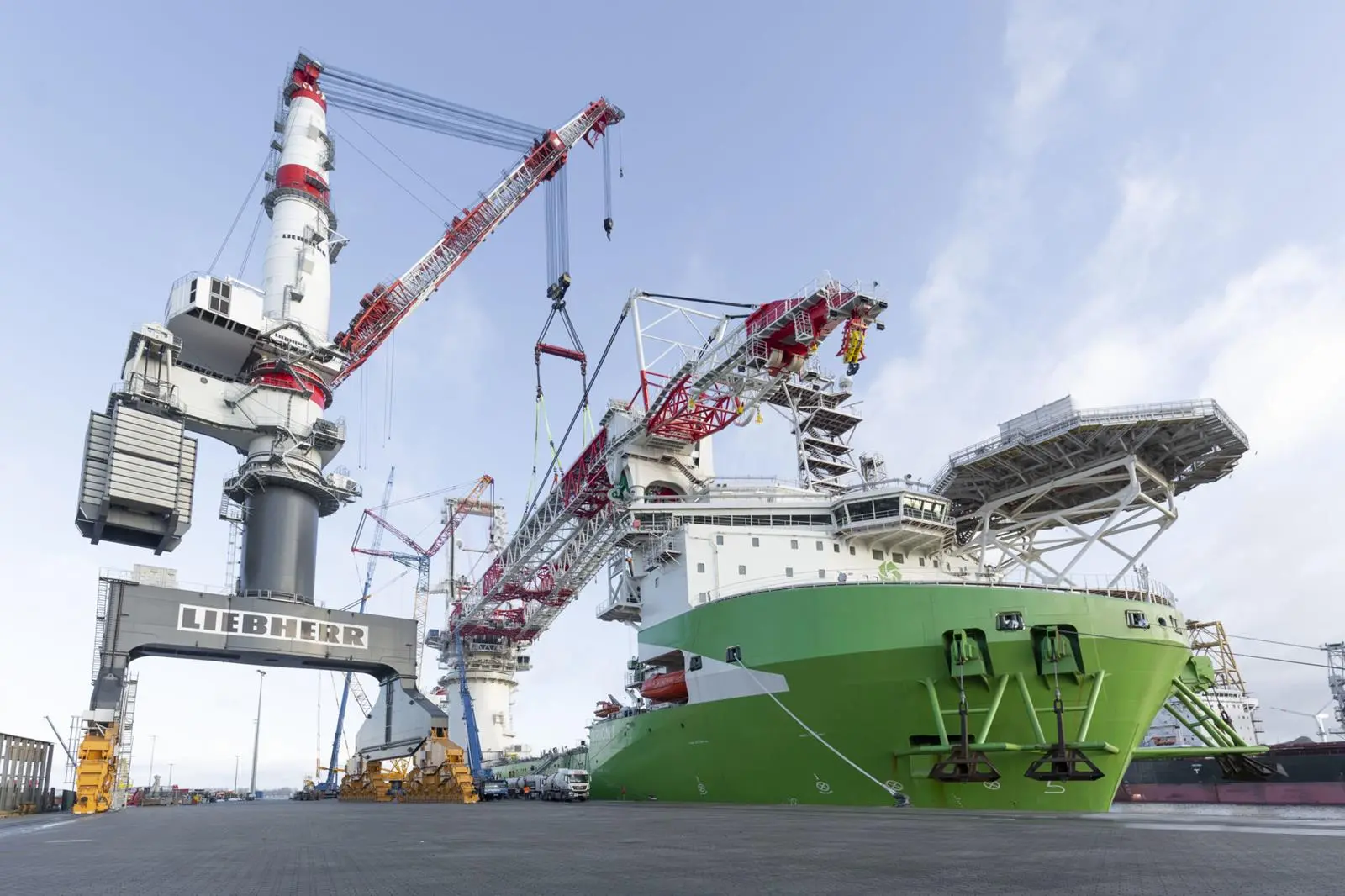
He is also project manager for C-Job’s involvement in the 5,000 tonne-lift crane vessel Orion which will go into service with Belgium’s Dredging International (DEME) following repairs to damage caused when its crane collapsed on 2 May 2020 during trials at crane-supplier Liebherr’s facilities in the port of Rostock in Poland. The COSCO-built ship is one of the highest lift-capacity purpose-built offshore wind construction vessels and its crane is the first HLC295000 model that Liebherr has supplied.
Liebherr quickly blamed the failure on the hook, supplied by Ropeblock, which broke when the test load reached 2,600 tonnes. Ropeblock itself issued a statement at the time acknowledging that it had designed the hook but said that it had subcontracted its manufacture. “We are appalled at the impact that this incident has on our customer Liebherr, but certainly also on the industry as a whole,” it added. No updates have been issued since then.
C-Job was not responsible for the crane design and is not involved in the investigation or repair work following the accident, but the incident illustrates an important design parameter for the vessels: they must be able to survive a ‘loss of load event’.
This needs to be considered carefully, Mr Veldhuizen explained, because if the load is suddenly lost, the vessel will roll to the other side. That is what happened in the Orion incident and videos available online seem to suggest that the momentum from this roll caused the crane to fold over backwards.
Bearing in mind that this could happen at maximum load, maximum outreach and in the open sea, the ship must be designed with enough ‘uprighting energy’ to prevent it from capsizing and although Orion’s incident happened at part-load, with the crane nearly vertical and alongside, Mr Veldhuizen said that the ship “did what it needs to do” during the incident.
Two other design features that are uniquely combined in wind turbine installation vessels are size and speed. Unlike installation vessels for oil and gas projects, those that support wind farm construction must also transport the jackets and other large components, which requires them to have a large empty deck space, he said.
They also need to be fast, which means high installed power, which is also essential for dynamic positioning (DP) when the vessel’s crane is in use, putting these vessels alongside large crane vessels and drillships in terms of power requirements, he said.
For a vessel such as Orion, “you need to make sure that if anything fails you still can operate the ship”, although that may be at a lower capacity. The crane might operate at a lower speed and the DP system might have a lower performance, but they must both still function.
For the DP system, it should be rated at DP 2 or higher, Mr Veldhuizen said, which is defined in IMO circular MSC/Circ. 645 as requiring that “no single fault in an active system will cause the system to fail.”
With both DP and crane operations demanding power at the same time, a vessel’s machinery installation and control systems must be able to cope with fluctuating power demands, which is more difficult with larger engines, he said; Orion’s engines, for example, are rated at 44MW.
In a statement to The Motorship, Wärtsilä – which supplied Orion’s engines – said that its integrated machinery set-up for that project consists of genset and propulsion configurations together with automated electrical, energy storage and DP systems to meet those fluctuating load demands “in every operation mode of the vessel.” Energy and power management systems give the engines have a good load pick-up capability, the company said.
Uniquely for an offshore service vessel, Orion’s power comes from dual-fuelled LNG engines, but Mr Veldhuizen does not expect this to set a trend for future vessels. That will depend to a great extent on fuel infrastructure; in some regions, LNG may not be as readily available as it is in Europe, he said. The ship also features exhaust waste heat recovery equipment to improve its efficiency and reduce fuel consumption, although Mr Veldhuizen declined to say by how much.
Related Articles
 ALTERNATIVE FUELS & LUBRICANTS
 GENERAL NEWS
 GENERAL NEWS