



Phase in global sulphur cap, study urges
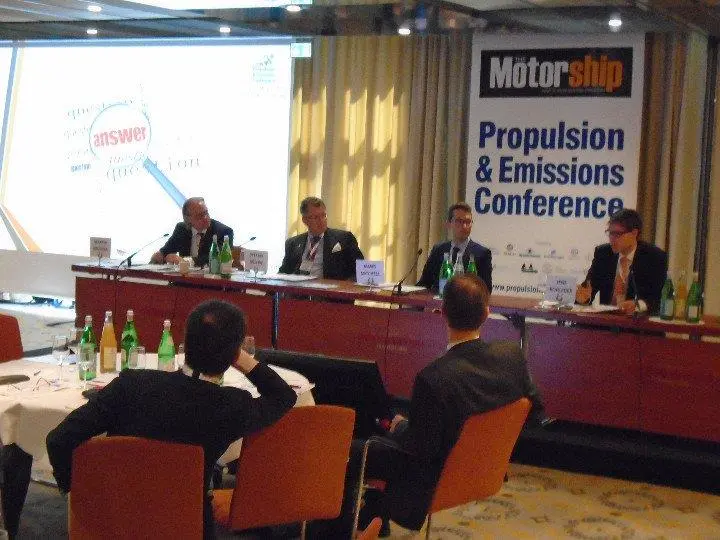
The IMO should consider phasing in the global 0.5% fuel sulphur cap set to be introduced in either 2020 or 2025, the consultant behind a major study – supplementary to the IMO’s own marine fuel availability study – has proposed.
David St Amand of Navigistics Consulting revealed the recommendation – which the study’s sponsors will likely put to the IMO’s Marine Environment Protection Committee in October – as part of his keynote presentation. Using the IMO’s third Greenhouse Gasses (GHG) Study as a base, St Amand remodelled demand for compliant fuel based on the likelihood of slow steaming becoming less common, the potential uptake of scrubbers, alternative fuel uptake and changes to the design efficiency of vessels.
With no speeding up of vessels, the study predicted that added demand for 0.5% sulphur fuel in 2020 would be 3.6 million barrels per day, rising to 4.4 million barrels a day if scrubber uptake is lower than the IMO anticipates. Given that the International Energy Agency anticipates that a demand increase of 2 million barrels a day would put refiners under enormous pressure, St Amand proposed a staggered introduction for the global cap.
“The IMO should consider a phased approach by staggering the sulphur limit reduction, or by phasing in the new limit geographically or by ship type,” St Amand concluded.
Enforcement issues
The global sulphur cap, due to be introduced in either 2020 or 2025 under Marpol Annex VI, is currently the subject of another, official study being conducted by CE Delft for the IMO. It is due to be completed by MEPC 70 in October. Meanwhile the global cap was the subject of much discussion on the first day of the conference on 11 May at the Grand Elysee hotel in Hamburg.
Enforcement of the cap was also considered by several speakers. Captain Wolfram Guntermann, director environmental fleet management, Hapag-Lloyd, suggested that haphazard port state control enforcement of the 0.1% sulphur cap in ECAs (introduced on 1 January 2015) did not bode well for enforcement of a global rule.
Lars Robert Pedersen, deputy secretary general, BIMCO, also pointed out the challenges of enforcing the cap – particularly on the high seas. He suggested that Article 218 of the UN Convention on the Law of the Sea may provide a means for port state control to engage in this issue. The article enables port state control to launch an investigation if they suspect the contravention of an IMO instrument beyond territorial waters. But some national legislation may need to be updated – in the case of Denmark for example, such an investigation can only be launched if the actions are likely to damage the country’s interests.
The IMO’s Tier III NOx emission limit, introduced in the North American and Caribbean ECA on 1 January 2016, was also a key subject. Among several interesting discussions was a report from Tor Øyvind Ask, fleet director, Solvang, who described a project that combined a scrubber with exhaust gas recirculation in order to provide commercially viable NOx compliance while operating on heavy fuel oil. The system successfully trialled on ‘Clipper Harald’ was installed at just an additional 10% cost on top of the scrubber, and with the addition of a more powerful fan is expected to achieve Tier III this year.
Efficiency improvements
Elsewhere, a more general examination of improving vessel efficiency was well received. Captain Stefan Bülow, managing partner of the Hamburg Bulk Carriers Group, revealed how the company had worked with ship designer Deltamarin on a new handymax bulk carrier design, the B.Delta 43, that has resulted in fuel (and CO2 emission) savings of 30% over comparable vessels, and a 28.6% reduction in its Energy Efficient Design Index rating. The company currently has five of the vessels, with a further five under construction, while Deltamarin will use the learnings to improve designs further in future series.
Among the highlights of the afternoon session, Martial Claudepierre, Business Development, Bureau Veritas Marine & Offshore and Hans Wevelbergh from Evergas jointly presented a case study on the first of a series of eight 27,500m3 multi-gas carriers ordered by Evergas and classed by Bureau Veritas. The ships can be powered by liquid ethane gas, LNG or diesel.
The first day of the conference was chaired skillfully by Dr Martin Kroeger, managing director of VDR (the German shipowners association). It concluded with a relaxed evening of fine dining and networking at the Schönes Leben restaurant in Hamburg’s Speicherstadt.
The conference continues on 12 May. Live coverage is available on Motorship.com and a full conference report will be featured in the June issue of The Motorship magazine.
Related Articles
 ALTERNATIVE FUELS & LUBRICANTS
 GENERAL NEWS
 GENERAL NEWS