



PODCAST: MARPOL fuel regulations need to reflect market changes: WinGD’s Weisser

It may seem a trivial subclause of a subclause of a subclause, but Marpol Annex VI Regulation 18.3.2.2 poses a problem for engines using biofuel that its original drafters probably never foresaw.
German Weisser, senior advisor emissions, research and development at WinGD described one of its potential implications for biofuels to The Motorship as “completely excessive [and] impractical.”
Regulation 18 covers fuel quality and assumes that fuels will generally be derived from petroleum refining. Its Clause 3.2.2 says that fuel oils derived by other methods shall not “cause an engine to exceed the applicable NOx emission limit”. Dr Weisser said that this could be interpreted such that each ship owner wishing to use a biofuel on one of his vessels would need to demonstrate for each and every engine that this requirement is satisfied. For existing engines, this might ultimately call for measurements on board.
In contrast, for engines not yet in service, the regulation could be read as requiring every individual engine to be tested with every possible fuel formulation to the satisfaction of a certifying body, with the results noted in the engine’s technical file. “This is not realistic either”, he said.
Instead, he urges a pragmatic approach and he suggested that one solution would be to incorporate an allowance into Marpol Annex VI.
Another option he proposed would allow test-bed measurements on sample engines to be applied to whole classes of engines. For example, engine models with similar design principles and control concepts – or even two-stroke or four-stroke engines of the same make or brand in general – might be treated as single classes with one test on a representative engine providing results for the whole class that would be accepted as proving that all similar engines did not exceed the regulation’s NOx limit.
NOx emissions from biofuels will vary, too, depending on a number of factors, including the origin of its raw material, its calorific value and its combustion characteristics, but these, too, could be tested as groups of fuels sharing similar characteristics, rather than individually, Dr Weisser proposed.
He also referred to the NOx Technical Code, which relates to Annex VI and which allows a 10% variation from the emission limits for ships when performing tests using residual fuels. There is no similar allowance available when alternative fuels are used, so this “puts a stricter requirement on alternative fuels than on traditional fuels,” he said.
If extensive engine testing is required, the burden will not fall on engine designers such as WinGD but on their licensee manufacturers, he added. They would have to set up infrastructure to be able to check all the various fuels that are being developed now or might be produced at any time in the future. “That’s disproportionate,” he said.
This is not a new concern. IMarEST raised its concerns with the regulation as long ago as MEPC 70 in 2016 and MEPC 76 in June received two submission on the topic, but discussion on them was deferred until MEPC 77, which is expected to take place in November.
Informal trials back biofuel in WinGD engines
Trials of biofuels in WinGD engines have not shown any negative impact, according to its senior advisor emissions, research and development, German Weisser. Exactly how many tests have been conducted is not clear but he told The Motorship that WinGD has received “dozens” of requests for letters to support such work.
These trials typically use a blend of biofuel and conventional fuel and are generally run over only part of a voyage, rather than over a period of thousands of hours that would normally be achieved in a formal trial, “but they are very important because they create confidence in the industry,” he said.
Multiple suppliers of such biofuels and their blends have conducted a number of such trials on ships fitted with WinGD engines. Dr Weisser could not comment on specific details of that work, but did say that they had been conducted on ships fitted with its X or RT-Flex engine and that the feedback from them means that the company is “quite well advanced” in its understanding of its engines’ operation on biofuels.
This feedback contributes to the advice it provides whenever customers plan such trials. “We provide clear recommendations about what should be looked at and what should be considered during the course of the trials,” Dr Weisser said. “We provide the guidance that should keep the operator on the safe side.”
It was clear from his comments that there are still aspects of biofuel use that remain to be fully explored. Asked about the effect of different concentrations of biofuel in a blend, he said that it was difficult to make general statements because it depends on the kind of biofuel being used. “You need to carefully assess the compatibility of the blend components and then look into the behaviour of the resulting blends,” he said.
Even when blending components from the same chemical family, such as fatty acid methyl esters (FAMEs), “they may vary considerably” in important operational parameters such as acid number.
One operator – Containerships; a subsidiary of CMA CGM – is already using a biofuel, biomethane, on a regular basis in WinGD engines on its ships. Since 1 May, customers who use its ‘ACT with CMA CGM+’ services, which were introduced in November 2020 to give shippers an option to reduce their environmental footprint, can choose to have their goods transported on ships using the non-fossil fuel, which is made from European sourced, organic and plant waste.
In a short video posted on LinkedIn in April, Containerships’ CEO and senior vice president of CMA CGM in Europe, Jesper Stenbak, said that the fuel reduced CO2 emissions by 67% and contributed to CMA CGM’s “ambitious goal of carbon neutrality by 2050.”

Biofuel waste has a role in future fuel
Lignin-based fuels “can be a part of the future fuel landscape,” believes German Weisser, senior advisor emissions, research and development at WinGD, but their use in operational engines is still a long way off.
It has been involved in two EU-funded projects – FALCON, which ended in December 2020, and IdealFuel, which started in May 2020 – both of which are focused on creating useful fuel from lignin, which is itself a waste product from various processes producing e.g. pulp and paper or even biofuel. As WinGD explains on its website, although biofuels are a promising alternative to fossil fuels, large amounts of waste are generated in their production, including lignin, so there are attractions to using this waste to make biofuel production more profitable and sustainable.
Lignin is found in cell walls and gives wood its stiffness; it represents about 20-30% of a tree’s mass and the IdealFuel project aims to find an efficient and low-cost way of using it as the basis for an ultra-low sulphur biogenic heavy fuel oil that can be used as drop-in fuel for ships.
Dr Weisser said that it has the potential to be part of a “more fragmented and more diverse” future fuel landscape, some of which may only have niche applications, “and this is what makes us participate in such ventures.”
From WinGD’s perspective, IdealFuel is a successor to FALCON, in which marine applications formed only a small part of its focus. It produced only limited amounts of fuel for testing in WinGD’slaboratories so it was not possible to use it in typical fuel systems and testing cycles. But some experiments were done in WinGD’s spray combustion chamber and Dr Weisser said this was instrumental in developing its fuel validation process, which was the subject of a white paper – Future ready: Extending the engine research toolbox to validate clean shipping fuels – that it published in May.
So although FALCON “did not lead us to what the shipping industry might have hoped for … the production technologies and the chemistry development was advanced quite considerably.”
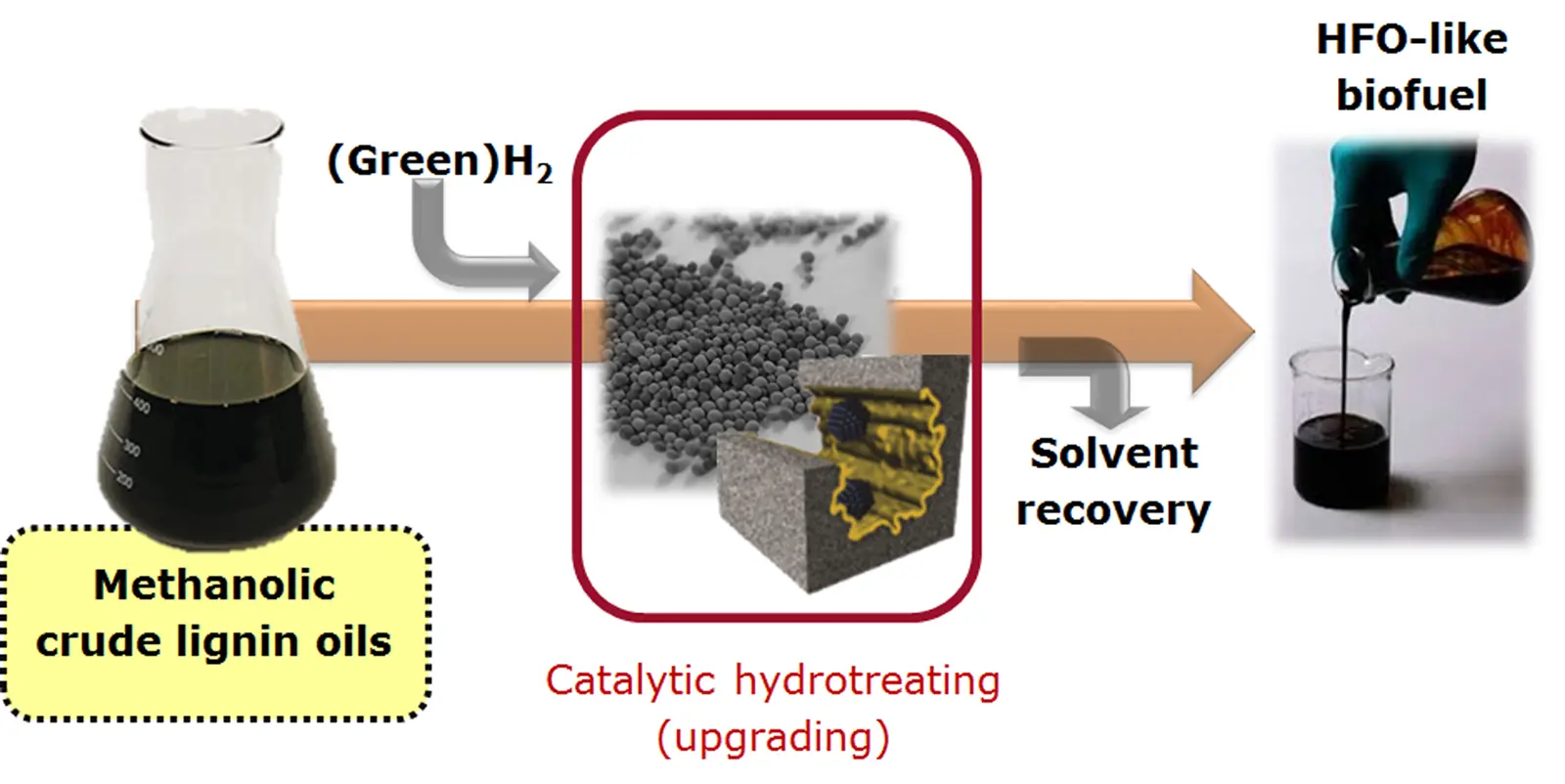
A significant learning point taken forward into IdealFuel was that “the tailor made production pathway (in this case with enzymes) to solely produce a marine fuel was not the most viable option,” Dr Weisser said, so this project is exploring catalytic and hydrotreating processes to break down the lignin into crude lignin oil (CLO), which can then be treated further. That step will be “very similar to the processing of crude oil into something that is usable on marine engines,” he said.
This is a four-year project and the goal is to produce enough fuel to conduct tests on WinGD’s fuel-injection and ultimately on its single cylinder engine. That will show whether any adjustments or modifications are needed before trying the fuel in a production engine.
But that is in the future: combustion tests are due to start later this year but the single-cylinder trials are not expected to begin until towards the end of the project, he said, by when fuel could be produced in sufficient quantities.
Many technologies fail at the scaling-up stage, he said, and “there is a risk that this may ultimately not materialise,” he said.
Related Articles
 ALTERNATIVE FUELS & LUBRICANTS
 ALTERNATIVE FUELS & LUBRICANTS
 ALTERNATIVE FUELS & LUBRICANTS