



Predicting wind power
Accurate prediction of the fuel saving capacity of wind propulsion is difficult. To optimise a ship for sailing with a load in the hold, there are a lot of variables: different types of rigs or wind propulsion installations will provide different driving forces, along with different heeling angles that on their account also influence overall ship performance. Then, the hull shape needs to be considered. Modern cargo vessels are optimised for navigating in design conditions, which are often comprising of flat water and maximum load capacity at maximum engine output. Hulls are designed to have the most loading capacity for their deadweight. When re-entering wind propulsion in seaborne trade, alterations to the hull design of cargo vessels will likely prove profitable.
With the first trials of wind assistance in ship propulsion now going on, there is not enough information on the real-life performance of different systems and hull variations. All of today’s experiments still see squared cross section hulls for optimal holding capacity. As experiments continue, data collection is key to develop reliable wind power prediction models.
UPCOMING WIND VESSELS
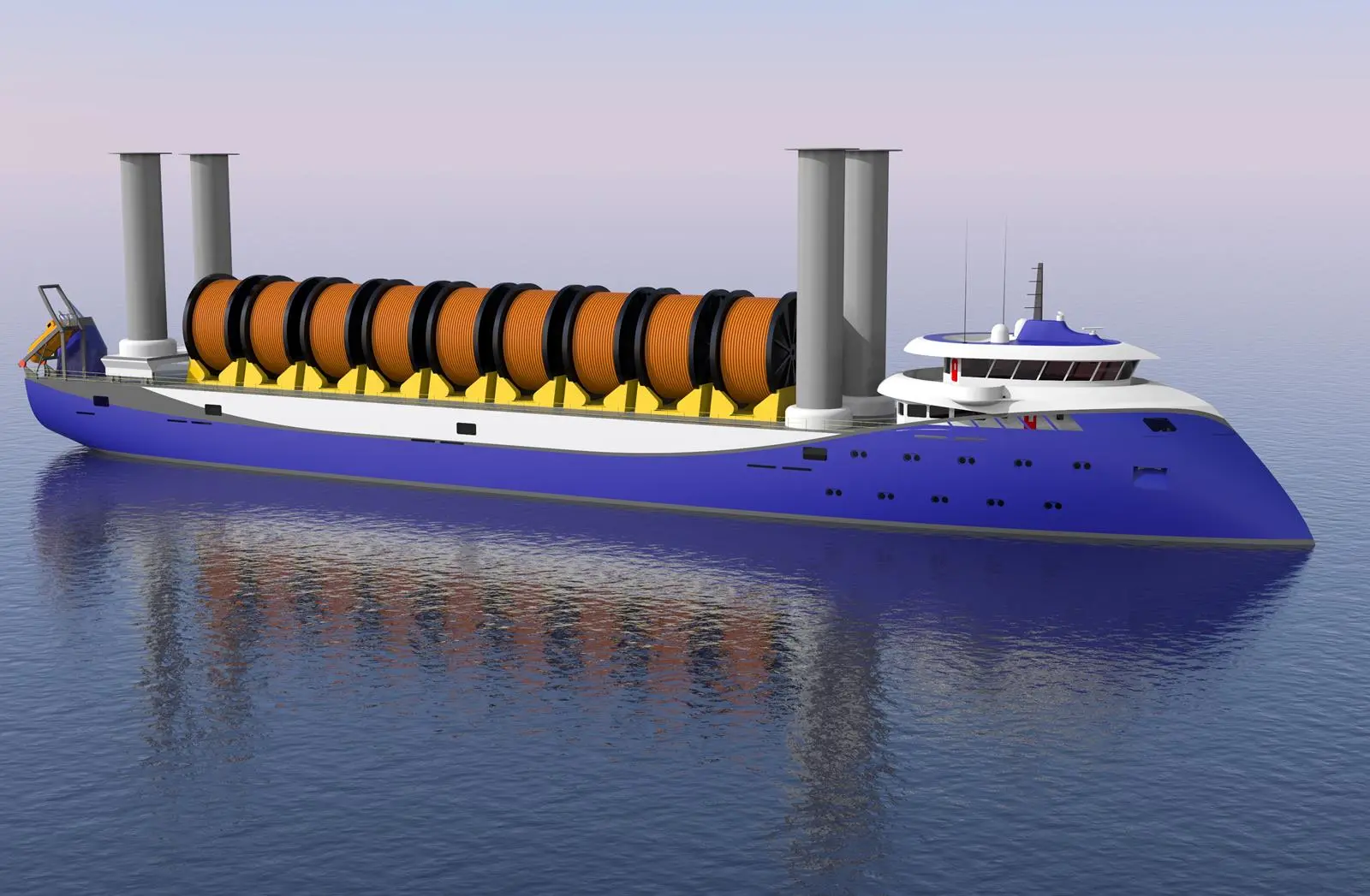
C-Job naval architects has announced that the Hybrid Flettner Freighter they designed in a study project, will be built. When this vessel starts operations, it will join today’s fleet of three fully operational Flettner Rotor driven cargo ships. The designers plan to study its performance, as operational results of the existing vessels are not available in detail. C-Job does expect at least 25% fuel savings.
C-Job’ s colleagues from Conoship have presented a convincing case study for an open-top general cargo vessel operating between Finland and the Netherlands, persuading a ship owner to build the vessel and test their feasibility calculations. Conoship looked into the performance and fuel consumption of a 4,500dwt vessel navigating the Baltic and North Sea. Then they gathered information about prevailing winds, waves and currents and projected Turbo Sails on the same vessel. For the best result, hull hydrodynamics were optimised for the sailing operational profile. Different variations of the Turbo Sail design were studied and tested in wind tunnels.
“This was a difficult job,” Conoship naval architect Guus van der Bles reveals. “Part of the aerodynamic principle that makes Turbo Sails provide lift is that air is pumped into the tubes through small suction holes in the surface. It was difficult to downscale these suction holes.”
The end result of all these design, testing and calculating exercises by Conoship was a predicted annual fuel saving of €50,000-€70,000. Conoship plans to do a wind tunnel test with a model of the whole ship this year, and hopes to have a full-scale model ready for testing in 2017.
GROWING REFERENCES
These two vessels should add to the existing fleet of vessels using wind propulsion. According to International Wind Ship Association secretary Gavin Allwright, eight SkySail kites have been installed in recent years, at least two of which are still in active use. Breaking the usual secrecy of national armies, Allwright reveals that the Irish Navy is looking to test kite propulsion to be installed on their ships.
Then there are at least three reference vessels equipped with Flettner rotors together with numerous yachts and Greenpeace’s sail-powered Rainbow Warrior III that may provide useful data needed to set up a reliable performance prediction model.
“Still, there is a lack of commercial demonstration vessels,” Allwright stresses. “Hopefully this will change in the near future as more wind assisted vessels are being built.”
ACADEMIC MODELS
Starting from the kind of general cargo ship we are familiar with today, the first thing to determine is the actual driving force that wind propulsion can deliver. The field of rig aerodynamics has been studied intensively by yacht designers. Translating their findings into the particulars of a cargo vessel, researcher Giovanni Bordogna of the Delft Technical University studied the driving capacity of a Dyna Rig and the way multiple masts will influence each other’s aerodynamic performance.
Not to the surprise of experienced sailors, his findings pointed out that on a course with apparent wind coming in forward, multiple masts will influence each other positively. Sail area spread out over the length of a ship, will induce ‘upwash’ – an effect that diverts the wind and have the flow of air seem to come in at a more moderate angle of attack at the forward sails. This results in more propulsion power with multiple masts at an upwind course then would be generated with the same sail area on a single mast.
At downwind courses however, multiple masts negatively influence each other. Aft masts block projected wind area of the forward ones. When a combination of wind and engine propulsion is used, apparent wind will come in from a more forward angle than with only sails. Bordogna finds that while the theoretic thrust of a Dyna Rig can be calculated, the performance of sails is also influenced by the behaviour of the hull. Heeling angle and drift reduce driving force in the desired direction.
Bordogna’s colleague Nico van der Kolk is studying the effects wind propulsion will have on ship hydrodynamics. Heeling angles and the sideways movement known to sailors as drift will induce resistance. Drifting can be partly compensated by steering slightly windward, causing even more resistance. Calculating the amount of added resistance with a Damen Multi Freighter that Van der Kolk took as an example, he constructed a formula to determine induced resistance. Taking this formula to make calculations for three different hull types, it became clear that a wide and short hull will face a large increase in resistance while a high aspect ratio hull will suffer less from this.
While the scientific approach of these researchers will prove valuable as it can be used for performance prediction models for wind propulsion, their findings point towards the return of the type of sailing cargo vessels that were used in the late days of the sailing era: the clippers.
LARGE SCALE NEED
Michael Traut, reseacher with the Tyndall Centre for Climate Change Research at the University of Manchester, wants to stretch the perspective from experimenting with individual vessels towards fitting the whole bunker fleet with wind propulsion. “This would make a large contribution to reducing greenhouse gas emission in Europe,” he says, “and for the next years create a lot of jobs at retrofitting shipyards.
“Forecasts are that shipping volumes will increase. Thus, the impact of significant fuel savings will be even greater. Yet, in today’s market with low oil prices and business-to-business deliveries, there is not enough incentive for ship owners to make the investment in fitting wind propulsion. In niche markets where consumers buy directly from the ship owners, wind propulsion is highly valued. Change will have to come, and wind power is totally emission free and renewable.”
Traut believes that either the maritime industry will have to change its propulsion approach or face huge emission taxes. And he hopes that innovative entrepreneurs will emerge to lead the way. “We need demonstration projects,” he explains. “Recently, rumour was that Volkswagen will order a car carrier propelled by wind. Even if this is only to polish their dented identity, it may still show that wind propulsion is economically viable. Apart from such multinational companies that can take the industry a step forward, I also hope that wealthy individuals might want to show the industry the way. Because to prove that it works, we need sailing vessels today.”
Related Articles
 PROPULSION
 GENERAL NEWS
 GENERAL NEWS