



Reducing engine bore size to boost existing vessel efficiency
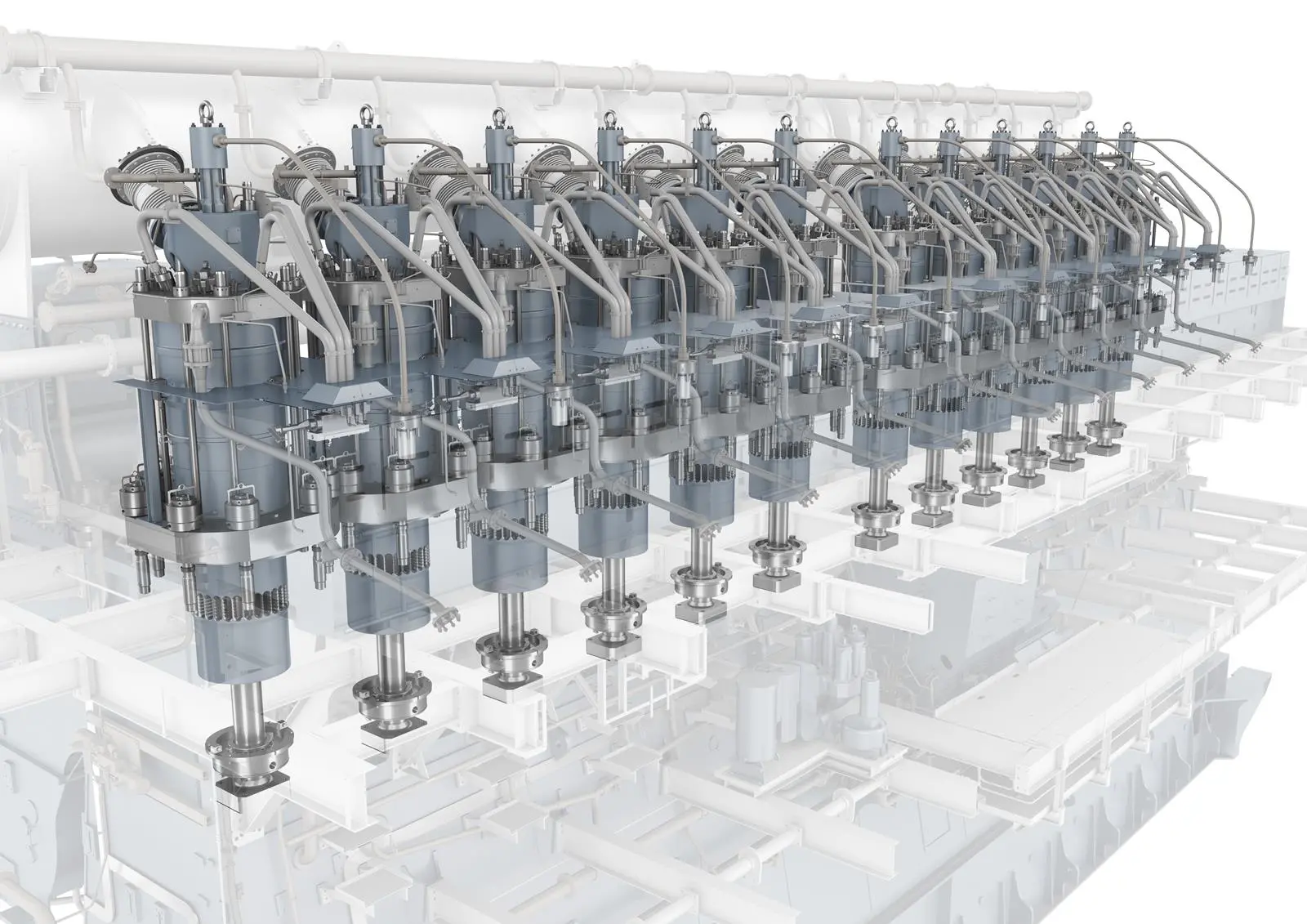
In 2022, Wärtsilä concluded one of its most significant vessel conversion projects to date; the pilot project for a radical derating solution designed to keep mid-life two-stroke engine powered vessels in compliant service for longer. The conversion involved reducing the bore size of a 12RT-flex96C-B engine to become a 12RT-flex72R. That is a 25% reduction on one of the biggest engines in the market.
The scale of the operation was considerable, with 26 engineers putting in more than 11,500 engineering hours and using 15 containers worth of parts. But the results were remarkable. Such a retrofitted engine can deliver annual fuel savings of up to 2,000 tonnes and a reduction in CO2 emissions of 6,400 tonnes. In financial terms, this translates to potential yearly savings of €2.18 million in operational expenses, based on current fuel costs and carbon levies. Add to this the €140,000 annual savings in parts, and the economic case for the conversion was compelling.
Since then, further projects have shown that Fit4Power can cut fuel consumption and emissions by 10-15%. Across the 14 vessels retrofitted between late 2022 and the end of 2024, Wärtsilä has saved operators a total of 25,000 tonnes of fuel, translating to 80,000 tonnes of CO2 emissions. In this time, the retrofit execution has been refined, allowing the current conversion to be completed in less than four weeks – comparing favourably to other technology installations and allowing operators to plan their regulatory compliance less than a year into the future.
Slow steaming challenges
Fit4Power was developed in direct response to an emerging mode of operation among shipowners. Looking down the barrel of the International Maritime Organization’s (IMO) energy efficiency regulations for existing ships, it is no surprise that many are choosing to sail slower in order to save fuel. The Energy Efficiency Index for Existing Ships (EEXI) demands that older vessels are as efficiently powered as today’s newbuilds, while the Carbon Intensity Indicator (CII) requires further improvements in operational efficiency each year.
But simply running the same big engines at lower speed is, ironically, an inefficient solution. Operating at low loads, well below those for which they were designed, is not an ideal scenario for engines. As a result, an overall reduction in fuel consumption and emissions can carry a significant penalty in efficiency. Less fuel is used overall, but more fuel is needed to generate similar power output. And because engines that run outside their design range are more prone to wear, maintenance costs can also increase with slow steaming.
Nor does slow steaming on its own help comply with EEXI, where it is available power rather than fuel use that is limited. That means using mechanical or software-based measures to ensure that the lower power is maintained (with an exception for emergencies), adding both cost and complexity.
The market has seen solutions to make slow steaming more efficient, generally requiring a change of turbocharger components and engine tuning. Indeed, this is a service that Wärtsilä offers. But we also took a different approach focused on improving inherent engine efficiency.
A radical approach
Fit4Power enables ship owners to reduce the bore size of two-stroke engines by 25%. This means that the resulting smaller engine can be run at a more optimal, higher load when sailing at slower speeds. EEXI benefits are achieved simply by reducing installed power, and the maintenance benefits of a smaller engine deliver further operational cost advantages on top of optimised fuel use.
This is achieved with no changes to the engine frame and only matching part replacements on turbocharger installations. This simplifies the conversion process, limiting it to cylinder, piston and fuel injection components alongside an update to the engine automation system.
While Fit4Power is a significant project, it does not represent what IMO classes a ‘major conversion’, meaning that the derated engine does not need a new nitrogen oxide (NOx) certification. The engine’s original tier rating can be maintained and is confirmed by Wärtsilä after the project using its approved ‘shop test at sea’ methodology. This process avoids the time-consuming and costly process of running an equivalent engine on a testbed.
A retrofit project of this scale is an exercise in teamwork. Across the many vessel projects already completed, Wärtsilä has developed close relationships with partners across the supply chain and with repair yards. The retrofit process has been continuously optimised, enabling the current conversion to be completed in less than four weeks. As repair yard slots come under pressure to meet growing retrofit demand, less time needed at drydock will help owners find space for their projects.
Staying ahead of the curve
Translated into regulatory compliance terms, a Fit4Power conversion gives operators a further three to five years of compliance with CII, giving them time to plan the next stage of their decarbonisation investment strategy. But the environmental benefits extend beyond improved emissions performance. By upgrading existing engines rather than replacing them wholesale, the process significantly reduces the need for new materials and parts. This aligns neatly with broader sustainability goals and minimises the carbon footprint of the retrofitting process itself.
Looking to the future, radical derating could form part of a broader strategy for ship owners to meet increasingly stringent emissions targets. Our roadmap suggests that vessels might transition to alternative fuels like methanol, LNG or ammonia with our fuel-flexible Fit4Fuels retrofit technology platform following (or combining with) a radical derating retrofit, with the possibility of incorporating bio-fuel blends further down the line.
As the shipping industry charts a course towards decarbonisation, solutions like radical derating offer a practical and immediate step towards improved efficiency and reduced emissions. By providing a means to extend the life of existing vessels and enhance their environmental credentials, this approach can play a crucial role in the industry’s sustainability journey.
With its potential to deliver significant fuel savings, slash emissions, and prolong vessel lifespans, radical derating presents an attractive option for ship owners looking to future-proof their fleets. At a time when the maritime sector faces increasing regulatory pressures to improve its climate impact, innovations like Fit4Power deliver the efficiency improvements and flexibility needed to keep existing vessels in compliance, and in profitable service, longer.
Related Articles
 METHANOL
 MONITORING, CONTROL & DIGITALISATION
 MONITORING, CONTROL & DIGITALISATION