



Reforming LNG provides clear path to H2 operations

There’s a long-standing tradition to view shipowners as conservative, but Antonios Trakakis, Technical Director, Marine at RINA, doesn’t see them that way. In the current context, he sees any caution to adopt new fuels as a reflection of health and safety issues and the enormous financial risk and that it is. Many new fuel proponents describe a potential solution but don’t really offer a business plan, he says. “It’s not that shipowners are refusing to go green, it’s that they have sincere concerns.”
A joint patent held by RINA and Helbio is the answer, he says, and the multi-year development project which includes Helbio (subsidiary of Metacon AB), Wärtsilä and ABB is gaining momentum as a solution. Key is that the design that enables shipowners to work towards IMO 2050 with confidence, as it does not rely on the availability of new fuels or additional technological developments to maintain the ship’s A rating going forward.
The main quest to transfer cargo safely between two locations remains the same, says Trakakis, but now, rather than shipowners wanting specifically to minimise fuel consumption, the calculation is focused on meeting environmental regulations with the minimum cost. The new system is a reflection of that need.
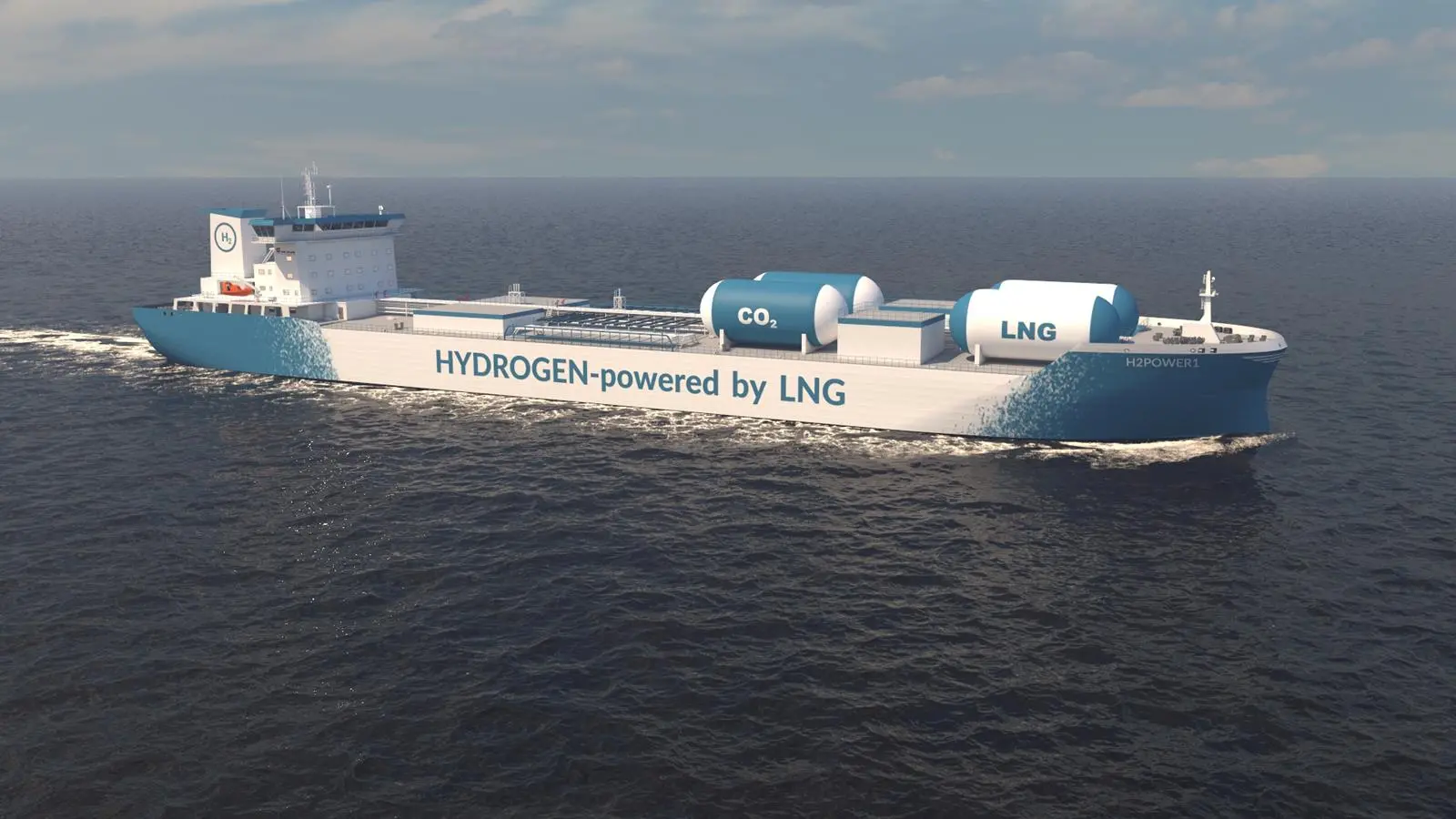
The concept is based on combining the ship’s fuel (natural gas) with steam to produce hydrogen and CO2. Hydrogen will then be used directly in internal combustion engines or fuel cells, without the need to be supplied and stored on board. The CO2 will be liquefied by the cryogenic stream of LNG that would be used as fuel anyway and stored on board for later disposal ashore for carbon storage and use. In case of tankers, the stored CO2 can also be used as inert gas.
“The concept is built on the capability that LNG offers us to produce the alternative fuel onboard,” says Trakakis. “While the industry must keep researching all alternative fuels and innovative technologies which RINA is ready to support, this means that we immediately disconnect from the demands of infrastructure. We don’t need another fuel supply chain infrastructure straight away which costs billions and takes many years to develop.”
A fuel in transition
Wärtsilä and ABB are supporting the application of hydrogen in powering internal combustion engines and fuel cells respectively, while Helbio is providing the technology and manufacturing the reformer. RINA is providing guidance on the application of rules and regulations based on Hazid/Hazop analyses, as well as specific rules for this kind of arrangement.
The LNG reformer design at the heart of the solution is based on a pre-combustion carbon capture principle: the CO2 is captured from splitting the LNG molecules before the combustion in the engine takes place, rather than from exhaust gas emissions. This involves lower mass flows, therefore a reduced space required, and scalable installation to progressively keep up with the pace of the emissions reduction requirements up to 2050. The vessel can be built as an ordinary dual fuel ship, and the extra equipment installed once regulations incentivise the investment. Fuel costs are also expected to be much less than new fuels such as methanol.
LNG becomes a fuel in transition rather than a transition fuel, he says. “And most important is that the transformation of energy is made with an existing and mature technology. The reformer is a mature, stand-alone unit that runs autonomously without supervision.”
The equipment necessary to meet IMO 2050 goals can easily be fitted on the deck of a commercial vessel in a progressive manner, at subsequent drydocks after ship’s delivery. The duration of the transition will depend on how far the owner wishes to remain ahead of the competition in terms of efficiency and sustainability and exceed the regulatory requirements.
Only LNG bunkering will be required and, by progressively increasing the production of hydrogen, the consumption of fossil methane and associated methane slip will be reduced at the same rate.
The HIWAR concept
The concept is based on Helbio’s patented Heat-Integrated Wall-Reactor (HIWAR) technology, which combines the ship’s fuel (natural gas) with steam to produce hydrogen and CO2. The hydrogen produced would be used directly in a mix with natural gas in internal combustion engines or in fuel cells, thus eliminating the need for hydrogen to be stored onboard. The Motorship notes that the system can produce hydrogen with a purity of up to 99.999%, making it compatible with PEM fuel cell requirements.
The HIWAR concept employs metal plates coated with a suitable catalyst arrayed so that exothermic and endothermic reactions take place on either side of the plate. The heat produced by combustion is conducted through the metallic walls towards the endothermic reaction of steam reforming, which take place at the opposite side of metal plate.
The company has also developed proprietary catalysts that improve the reformation of fuels, both in the steam reforming step and in the subsequent partial oxidation step. During the latter step, the CO2 will be liquefied by the cryogenic stream of LNG that would be used as fuel anyway and stored on board for later disposal ashore for carbon storage and use. In case of tankers, the stored CO2 can also be used as inert gas.
“The extra energy to produce the heat for the reforming process can be obtained in two ways,” says Trakakis. “Either some LNG can be burned or onboard waste heat can be used. There’s the possibility to use the reformer without any energy penalty.”
The energy economics have been verified by the University of Cambridge, he says, the reformer is a pre-combustion carbon capture system and will break the molecules of the fuel before entering the combustion chamber. The energy involved is much less than capturing CO2 from the exhaust gas and the CO2 that the shipping industry generates would be a small fraction of that of land-based industry and easily integrated into supply chains for the production of e-fuels or sequestration.
Moving away from the more traditional propulsion concept of a 2-stroke prime mover to 4-stroke engines provides extra space in the engine room for the new equipment on a newbuild. This means that cargo capacity is not compromised. Space considerations contrast with those of new fuels such as methanol that require twice the volume and are twice the weight of comparable LNG storage systems.
First mover
In November 2022, RINA announces the signing of a JDP with Maran Dry Management and SDARI for an LNG and hydrogen powered 210,000dwt bulk carrier. The project sees the design, which was launched earlier this year for an MR tanker, in its first application for a bulk carrier.
“Maran Dry Management is committed to embracing the energy transition and working towards net zero shipping solutions,” said Captain Babis Kouvakas, Managing Director at Maran Dry Management. “Working with RINA and SDARI, this JDP agreement will give us a highly competitive bulk carrier design that will exceed IMO’s current 2050 targets and ultimately get to near-zero emissions. The project demonstrates our strong commitment and active role in the decarbonisation goals set by IMO, providing a pioneering concept, unique to the bulk carriers segment (Newcastlemax) and the shipping industry as a whole, setting a leading example to exceed the current and projected emissions reduction targets, while demonstrating an innovative sustainable path for the future of shipping. The design will allow us to run the vessel on increasing percentages of hydrogen, lowering emissions over time, to meet the increasingly stringent rating thresholds towards 2050.”
Next steps
Third party verification of the designs from ship designers indicates that fuel consumption is 7-10% less for a bulk carrier, more for tanker, thanks in part to the electrification of pump systems. “These are very efficient designs,” says Trakakis.
The project partners are now working on container ship designs.
The concept was conceived to be used on a wide range of vessel sizes, and Trakakis foresees that this will reduce the shipping industry’s need for multiple fuels significantly. “What is very rewarding is that the more time that passes, more doors are opening; more opportunities are being created and more interest is coming from more stakeholders, both shipyards and shipowners,” he says.
Related Articles
 ALTERNATIVE FUELS & LUBRICANTS
 GENERAL NEWS
 GENERAL NEWS