



Removing water from emulsified oil in biodegradable lubricants
The latest vessel general permit (VGP) enforced by the US Environmental Protection Agency (EPA) states that ships sailing in US waters are to use environmentally acceptable lubricants (EALs) in all oil-to-sea interfaces wherever this is technically feasible.
For most vessels entering US waters, this has meant a change to biodegradable lubrication and hydraulic oils in applications such as stern tubes, steering gear, thrusters and deck equipment. However, such a change can prove far from straightforward, for several reasons.
One of the most serious potential problems is that EALs may affect the tightness of standard seals, as many use conventional rubber that is not compatible with the EAL. So, although any lubricant that leaks out will not harm the environment, as the regulation requires, there is a real risk of water ingress, which could do untold harm to stern tube, thrusters, rudders and controllable pitch propeller systems.
Secondly, most EALs will absorb a considerably larger amount of water than a conventional mineral oil. EAL suppliers may claim that their products maintain lubricating abilities even with as much as 30% water content, but C.C. Jensen believes that no engineer in his right mind will be happy to accept the risks of corrosion or wear-and-tear damage that could be caused by having that much water in the system. Furthermore, ingress of water into many EALs will cause emulsification to a degree that prevents conventional filter/coalescer systems from working.
C.C. Jensen claims to have found a solution, based on technology developed during its 60-plus years of experience in development and production of oil filtration systems across a variety of industries.
The company has its own solution for removing particles and water from conventional lubricating oils in marine applications, as well as systems designed to remove water emulsification from many types of oil used in land based plants, such as paper mills and power stations. So when one of the company’s marine customers complained that the filter/separator system on board a supply ship was not working as it should, C.C. Jensen investigated the reasons for this, and found that the customer had changed the oil to an EAL type, as demanded by the US regulation.
An analysis proved that the water in the oil had resulted in severe emulsification, which could not be removed by traditional filter/separator systems that had previously worked well with mineral oils.
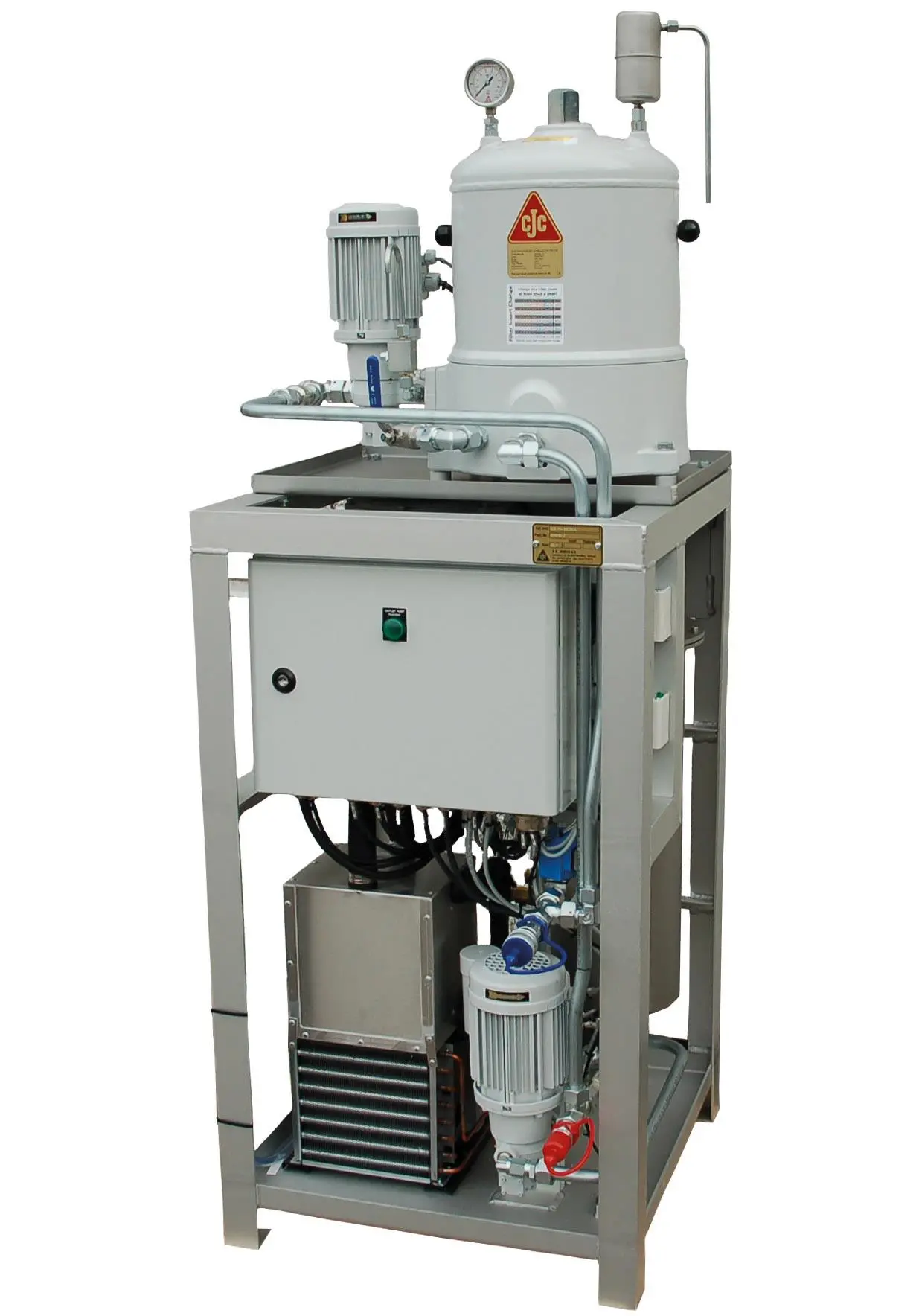
C.C. Jensen looked to its land-based experience, and decided to try installing a D10 Desorber unit onboard the ship. These Desorbers have been cleaning emulsified oil successfully from land based applications for more than a decade, and was found to work equally efficiently onboard the ship.
A further refinement was to fit a C.C. Jensen HDU Fine Filter unit, in order to provide additional filtration for particulate removal, and have a means of breaking a stable emulsion. Recognising that space for retrofitting additional equipment on most ships can be limited, the company tried to come up with a simple, compact and lightweight solution – by fitting the filter unit with one of C.C. Jensen’s compact desorbers, the desired result was achieved. Moreover, with just one inlet and one outlet, the unit is simple to install, on a ‘plug-and-play’ basis, which the company says means it can be ready to work in less than 30 minutes.
The unit is claimed to effectively remove any particles from either mineral or biodegradable oil, as well as remove water from an emulsified EAL, returning clean and functional lubricating oil to the system. The company says that the unit is the first of its kind on the market, and is based on proven, well-documented and patented techniques.
According to C.C. Jensen, the shipowner was satisfied with the improvement to the lubrication system after fitting the D10/HDU Combi solution, and placed an order for 78 units for other ships operating in US waters. C.C. Jensen feels that other regions, such as Europe and some Far East states, may not be far behind the US in insisting on EAL-type lubricants for some ship applications, so it foresees a high demand for its system in the near future.
Related Articles
 PROPULSION
 GENERAL NEWS
 GENERAL NEWS