



Rolls-Royce fast naval ship designs
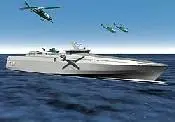
Rolls-Royce has unveiled designs for a family of fast naval ships at the Pacific 2004 exhibition in Sydney, Australia. All four naval ships are based on a fast monohull series it has already designed for the commercial shipping sector capitalising on more than 30 years of design experience.
The first ship, the 177 metre long Fast Naval Sea-Lift vessel (FNSL), is capable of carrying 2,500 tonnes of cargo over 3,000 nautical miles at 40 knots, almost twice as fast as conventional ships. The power plant would consist of three Rolls-Royce MT30 gas turbines driving three Rolls-Royce Kamewa 250 waterjets. Now Rolls-Royce has expanded that concept to include a smaller Intra-Theatre Logistics Vessel (ITLV), a Fast Surface Combatant (FSC), and a smaller Fast Attack Craft (FAC).
The ITLV, powered by a single MT30 and twin Rolls-Royce Crossley-Pielstick diesels, is 120m long and designed to transport troops as well as equipment within a war zone. The combined diesel and gas (CODAG) power arrangement allows the ship to achieve 40 knots but still have excellent loiter capability. The monohull design provides a high degree of damage tolerance to fire and hull damage, and a more benign ship motion compared with other fast hull types resulting in a reduction of en-route motion sickness amongst troops.
The ship can be constructed from steel thereby significantly increasing the number of shipyards capable of its construction while also reducing the ship’s initial cost and through life structural upkeep costs.
The 5,000-tonne FSC will also be based on the same fast hullform and will be capable of 40 to 60-knots. Power would come from a hybrid MT30 gas turbine and electric system linked to four Kamewa 160 waterjets providing the ability to operate efficiently throughout the speed range, essential for any fast combatant.
Finally, a FAC again provides high speeds of up to 60 knots, high agility, and a simple steel construction. Four Rolls-Royce MT5 gas turbines will drive twin Kamewa waterjets in a CODOG configuration. The propulsion system and internal general arrangement are configured to allow maximum availability of prime upper deck space for installation of a customer-defined combat system.
Dr. David Price, President, Rolls-Royce Naval Marine, said: “Naval operators are looking for ever-increasing speed, and our designs show we have the knowledge of how power-dense propulsion systems interact with hull forms. The project is an example of our ability to transfer technology across our commercial and naval businesses to provide practical solutions.”
All the warships are based on the P2500 Fast ro-pax designed by Rolls-Royce’s commercial marine operations which has received BV classification. A larger fast cargo version and small fast ro-pax were also designed.
Downloadable images of the Fast Naval Sea-Lift Vessel and Intra-Theatre Logistics Vessel are available on http://www.rolls-royce.com/latestnews/
Downloadable pictures of the MT30 are available on www.Rolls-Royce.com/media/gallery
Related Articles
 ALTERNATIVE FUELS & LUBRICANTS
 GENERAL NEWS
 GENERAL NEWS