



Rolls-Royce unveils integrated cruise concepts
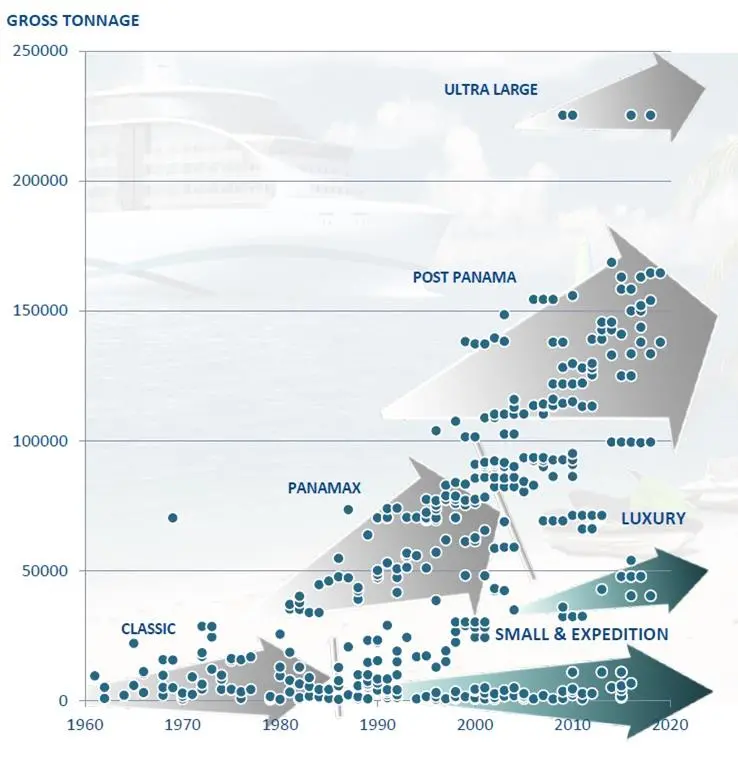
Conceived by Rolls-Royce’s Blue Ocean development team – which last year presented the LNG-powered large cruise ship concept Sapphire Blue – the latest cruise offerings focus on smaller luxury and expedition vessels. That niche matches both market demand and Rolls-Royce’s capabilities, notes Oskar Levander, vice president innovation engineering & technology.
“Designing systems that are matched to the vessel and its design intent is something we have been doing in the offshore sector for over 40 years,” says Levander. “As we have such a wide range of power and propulsion products, we can package them into systems that accommodate most customer preferences for vessels of this size.”
The scale of the vessels for which Rolls-Royce can provide complete solutions is limited only by the company’s engine portfolio. With no low-speed engines in its range, vessels of more than around 60,000gt would be too big for Rolls-Royce’s medium- and high-speed engines.
The systems are therefore designed to suit vessels from 5,000gt to 20,000gt, with between 200-300 passengers, so powers ranging from 4-11MW have been selected to cover propulsion and hotel loads. This provides service speeds of up to 21 knots and maximum endurance at 16 knots. In each case, power is provided by Bergen or MTU engines, or a mix of the medium-speed and high-speed engines driving Rolls-Royce thrusters or propellers.
Golden opportunity
The smaller cruise segment offers a golden opportunity. While mainstream cruise ships have grown ever larger over the past thirty years, the luxury and expedition niches have also increased in popularity. But with many of the major yards booked up with larger cruise ship orders, construction of smaller vessels often falls to smaller, less well-resourced shipyards. In that context, a partner that can provide a total system solution becomes invaluable, Levander argues.
“The cruise business has primarily been yard-dominated,” he explains. “The big yards have often bought the equipment and done the integration themselves. And of course we are very happy selling product to that industry, but we think that we can do something more if we provide a total integrated system.
“When it comes to smaller ships then you are talking different yards and a bigger need for a tailored, ready-made solution. These ships will most likely go to yards that are not so established in this market, as the big yards are full with post-Panamax ships. So having an experienced partner come in and take a big part of the project will reduce the risk for the ship owner.”
There is further value for ship owners. Selecting the right propulsion system for a cruise vessel means balancing performance, purchase price and lifecycle costs. The range of options developed by Rolls-Royce are designed to cater for four specific operating profiles, Operators simply pick the system package that best fits their needs, and can then concentrate on their ship design and passenger experience.
Levander notes the advantages of having one company provide the entire ship propulsion system. “It makes it easier and cheaper for the shipyard, and for the owner. And of course when one company designs the whole system it will be more efficient. It is designed with a holistic perspective, not only optimising parts here and there but providing a global solution.”
After completing ten system trade-off studies based on the requirements for known adventure cruise routes in both the northern and southern hemispheres, four systems capable of being efficiently integrated into any suitable cruise ship platform were selected.
The balanced system
This is reliable, efficient, conservative and offers relatively low initial capital expenditure. Main propulsion is provided by two 2,665kW Bergen C25:33 L8P engines each driving a CP Promas system through a reduction gear with hybrid shaft generator, so the main engines can be used to provide electrical power. Two 1,560kW MTU 12V4000 M33S generator sets supply the switchboard. This configuration allows the selection of mechanical, electric or hybrid modes for optimal performance in all operating conditions.
The compact system
The full electric propulsion system with twin Azipull thrusters is installation friendly with a small footprint and low weight. It also has the lowest capital cost of the four systems. Power is provided by four 2,080kW MTU 16V 4000 M33S gensets for a total installed power of 8.4MW.
As the generators are small and there are no long propeller shaftlines, there is significant flexibility in where they can be sited. This also frees up valuable space for other purposes, giving the designer more options. The 2,458kW Azipull units provide the necessary steering and manoeuvring control so no rudder is required.
The lifecycle system
Featuring a centre line propeller with wing thrusters, this package delivers the lowest ownership costs despite having the highest initial cost. A fully electric system, power is provided four 1,843kW Bergen C25:33 L6A diesel generators.
A single shaftline drives a large area CP propeller, which is flanked by two electrically driven Azipull 120 thrusters, which provide propulsion as well as manoeuvring, therefore there is no rudder. A central propeller is normally used to provide the necessary thrust for top speed.
The Azipull units can be used for lower speed cruising for improved economy and provide vectored thrust at the stern, and with a 1,000kW bow thruster give a high level of agility.
The LNG option
The lifecycle system is also available with Bergen LNG engines of the same size and power together with the complete gas system. Space for the LNG tanks is created by lengthening the vessel and inserting a new mid-ship section at the forward main fire bulkhead location. This section can house four vertical LNG tanks with sufficient capacity for three weeks’ cruising.
All machinery and propulsion packages can be complemented with additional Rolls-Royce products such as stabilisers, mooring winches and a Unified Bridge. They are integrated to perform efficiently together and are supplied with a range of Rolls-Royce automation and control equipment.
Rolls-Royce has also developed a case study of an individual expedition cruise ship, drawing up a detailed operational profile to show how the various elements of the concept can be deployed. The Royal Blue is a 132m loa and 11,500gt vessel (with slight modifications if LNG is chosen as a fuel over MGO). It is capable of carrying just over 200 passengers, with a service speed of 17 knots.
Based on the range of propulsion options within the four concepts – twin shaftline propellers, twin thrusters or a hybrid system with one shaftline and two thrusters – the company noted a fuel consumption saving of around 12% for the hybrid system, compared to the conventional twin shaftline setup. The type of machinery depends greatly on the operating profile. “At low loads, diesel electric is attractive,” says Levander. “But at service speed the mechanical or hybrid comes out better.
The final piece of the jigsaw is the speed of the engine, either medium-speed, high-speed or a hybrid system. The resulting matrix – encompassing propulsion, machinery and engine type – can then be analysed to find the perfect combination of initial investment, operating cost and total lifecycle cost to meet the owner’s needs.
Finding balance
Levander explains: “You can say at a basic level that the high-speed engine with mechanical drive and conventional shaftline propulsion is cheaper initially, while the medium-speed diesel-electric system using thrusters is more expensive. But for operating cost it is almost the opposite. So you need to find your balance.”
Deciding whether to fuel the ship using LNG raises familiar issues. On the one hand the initial investment is nearly twice that of the MGO versions – explained in part by the need for large vertical tanks to hold enough fuel for a three-week expedition. On the other hand, by the time lower fuel prices are takin into account, total lifecycle cost (measured over five years) is only slightly higher than for MGO options. And Levander notes that with another few years on the life of the vessel, the LNG setup would pay for itself.
“If you look at operating costs it is very cheap,” he says. “But that depends on which price you use, and one thing you can say about LNG is that the price varies a lot. Are you in the US or Japan, how long do you need to transport the LNG to your ship, what is the delivery cost? But in general operating costs for LNG come out very well – and on the overall cost it’s not bad either.”
More than just a design statement, the concepts represent a sales strategy targeting the small cruise ship market, with Rolls-Royce providing the entire package – from propulsion and engine to deck machinery, bridge systems and electronics. Levander concludes: “We want to provide the technical platform so that the owner can look at his business model and decide what he wants. Based on our offshore industry experience we can provide an integrated solution to the cruise sector, and we believe that we can represent true value for the ship yard and owner.”
Related Articles
 PROPULSION
 GENERAL NEWS
 GENERAL NEWS