



RS INTRODUCES NEW GUIDELINES ON FATIGUE ASSESSMENT
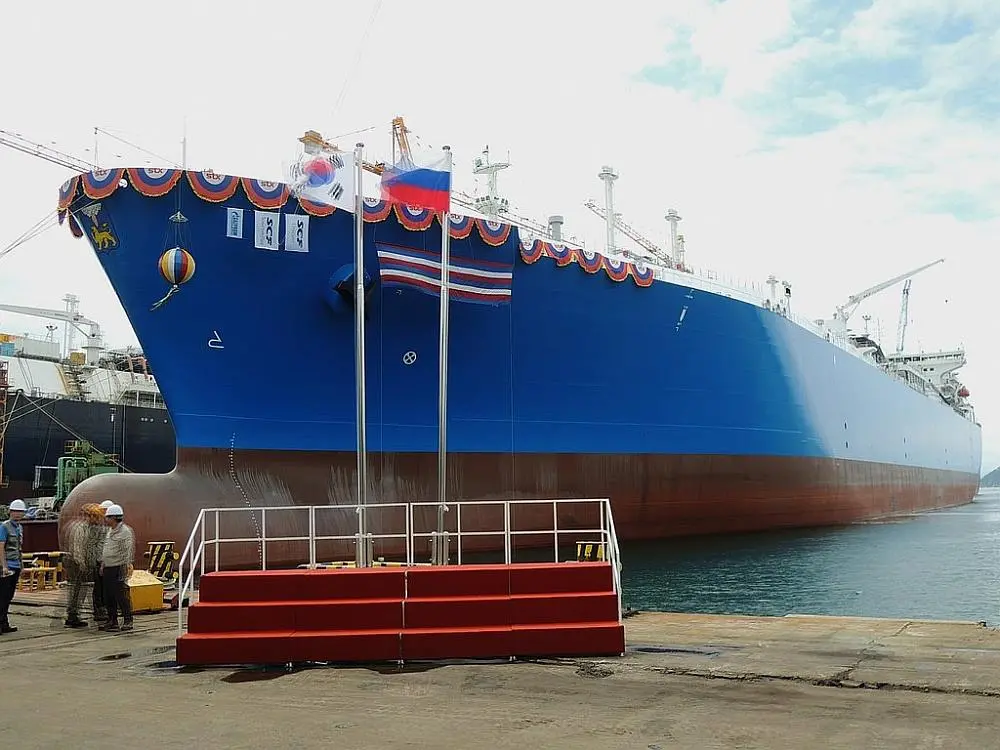
The Guidelines are applicable to welded steel ships with overall length 150≤𝐿≤350 at design stage. The aim is to ensure that hull structures meet design service life requirements through the prevention of failures related to fatigue cracks at weld joints, and the Guidelines were developed with close consideration for IACS Recommendation No. 56. RS says the notations are particularly suited to sophisticated assets such as state-of-the-art gas carriers where fatigue strength is especially important for hull and cargo tank arrangements.
The distinguishing mark FTL (years) may be granted to the character of classification if design remaining life of a ship (fatigue life) exceeds 25 years. The design remaining life of a ship within the range of 25 – 40 years (in five-year increments) is indicated in parentheses. The distinguishing mark FTL (years) Spectral North Atlantic is granted upon the verification of the fatigue life using spectral method calculations.
The requirements of RS Rules for the Classification and Construction of Sea-Going Ships already cover several aspects of fatigue strength (e.g. elimination of extra stress concentrations, introduction of an additional coefficient for still-water bending moment in order to consider the negative effect of low-cycle fatigue, etc.). However, scantlings according to the Rules mainly proceed from ultimate strength requirements.
The Guidelines include procedures for the calculation of fatigue life using S-N curves, a cumulative damage approach as well as a range of stress assessment methods (finite element method and simplified method). The choice of applicable method depends on the type of detail under consideration.
Still water sea and internal pressures are equally defined both in the Guidelines and in the Rules. The wave and internal inertial pressures provided in the Guidelines are derived depending on ship position against the wave contour and relative ship’s motion parameters. Meanwhile, the roll amplitude for inclined ship positions is determined according to the Rules. This approach is conservative for most ships, says RS.
According to the Guidelines, the vertical wave bending moment provided by the Rules is multiplied by 0.625. It allows for finding the relevant moment for fatigue assessment with acceptable calculation accuracy. The horizontal wave bending moment is calculated using the wave of service probability level for all ship types, whereas the Rules only designate this kind of calculation for ships with large deck openings.
For FTL (years) Spectral North Atlantic, the wave and internal pressures are defined as a result of a sea-keeping analysis in a regular sea state for a variety of wave frequencies and wave headings. Response in irregular sea states is calculated using the wave energy density spectrum for short-term statistics and the wave scatter diagram for long-term statistics.
Related Articles
 METHANOL
 MONITORING, CONTROL & DIGITALISATION
 MONITORING, CONTROL & DIGITALISATION