



Scandlines installs Norsepower Rotor Sail
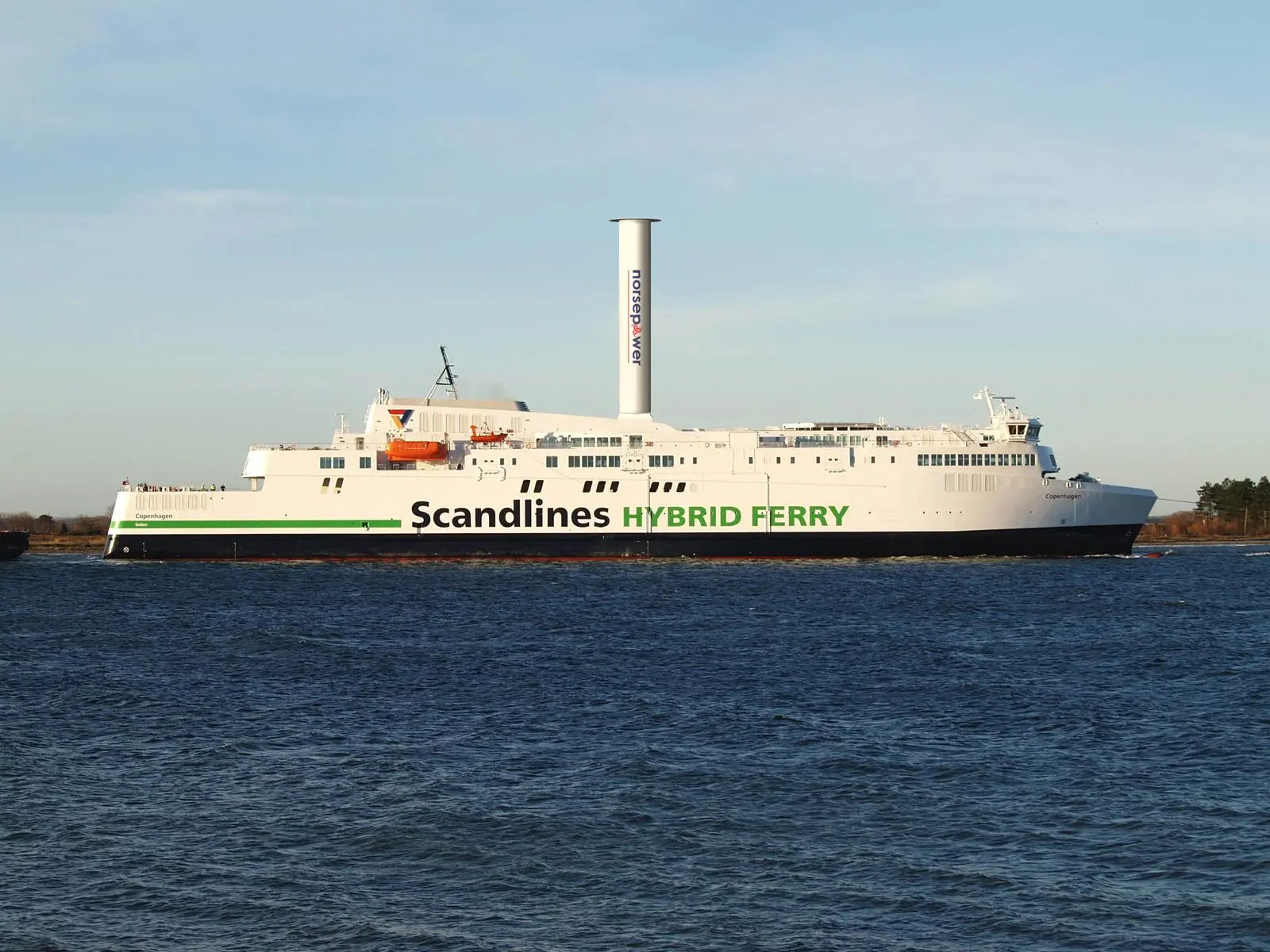
Operating between Rostock in Germany and Gedser in Denmark, the M/V Copenhagen belongs to the world’s largest fleet of hybrid ferries, combining diesel and battery power. Since 2013, Scandlines has invested more than €300m in building and retrofitting ferries from conventional diesel-driven to hybrid ferries.
“By installing a Rotor Sail, we can reduce CO2 emissions on the Rostock-Gedser route by four to five per cent,” said Scandlines chief executive, Søren Poulsgaard Jensen.
The route between Gedser to the north and Rostock to the south is almost perpendicular to the prevailing wind from west giving Scandlines favourable conditions for using Rotor Sails on the ferry crossing.
The solution is a modernised version of the Flettner rotor – a spinning cylinder that uses the Magnus effect to harness wind power to thrust a ship. When wind conditions are favourable, it enables the electric propulsion thrusters and centre propeller to be throttled back, reducing emissions whilst providing the power needed to maintain speed and voyage time.
Preparations for the retrofit will take place in November 2019 with the installation scheduled for Q2 2020. M/V Copenhagen is set to be retrofitted with one large-sized Norsepower Rotor Sail unit that is 30m in height and 5m in diameter.
Related Articles
 PROPULSION
 GENERAL NEWS
 GENERAL NEWS