



Schottel scores in Panama
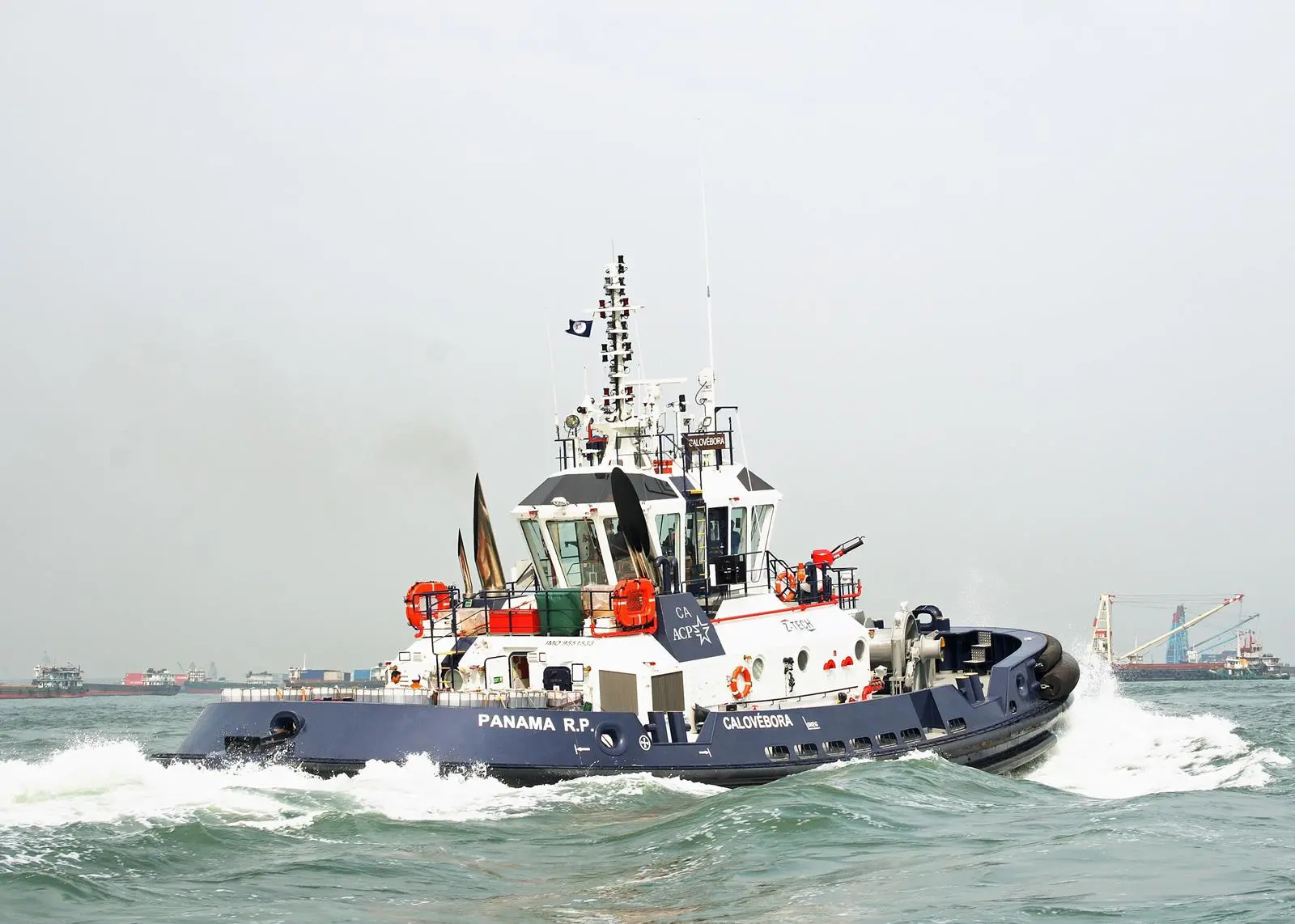
The company says that the Panama Canal Authority is investing in more powerful tugs able to handle the larger ships using the enlarged Panama Canal, with some 14 tractor tugs and 13 ASD tugs commissioned in the last four years, all with Schottel propulsion. The class of 14 tractor tugs built at the Astilleros Armon Shipyard in Spain has now been completed.
These tugs are of 28.9m length oa, width of 13,5m, and have bollard pull of 85 tonnes. Each are driven by two Schottel SRP 2020 rudderpropeller units, each rated for 2,330kW input power. All travelled from the yard in Spain to Panama under their own power, taking about a month for the voyage, and will take the place of locomotives handling ships in the new Atlantic locks. They are named after mountains in Panama.
They were preceded by 13 ASD tugs built in Hong Kong, at the Cheoy Lee shipyard. The ASD tugs are slightly smaller, at 27.4m long and 12.2m wide with bollard pull of about 65 tons. Built to the Robert Allan Z-Tech 6500 design, each relies on two Schottel SRP 1515 rudderpropellers, with input power of 2,180kW each. These were delivered at about six week intervals, beginning in 2010, and also undertook the delivery voyage under their own power, taking just over two months for the 9,700 miles, including a refuelling stop in Honolulu to refuel. They take their names from Panamania rivers.
Schottel says that the decision to use its propulsion units follows the success of four existing ASD tugs, in service since 2001, each with two Schottel SRP 1212 rudderpropellers. These are continuing in service, with the new deliveries replacing older models.
Not only tugs on the Panama Canal are Schottel-equipped; a double-ended ferry, the 5 de Noviembre, which is in service crossing the canal at the Gatun locks, is another relatively recent Cheoy Lee/Hin Lee shipyard delivery with a Schottel propulsion system. The 42m ferry, with capacity for 24 trucks and 20 passengers, operates a three-minute crossing of the canal, rather than the previous narrow bridge which could delay vehicles for up to 45 minutes. Two SRP 170 rudderpropellers enable a fully loaded cruising speed of 8 knots.
Related Articles
 PROPULSION
 GENERAL NEWS
 GENERAL NEWS