



SEMINAL OFFSHORE LOADER FOR NORTH SEA
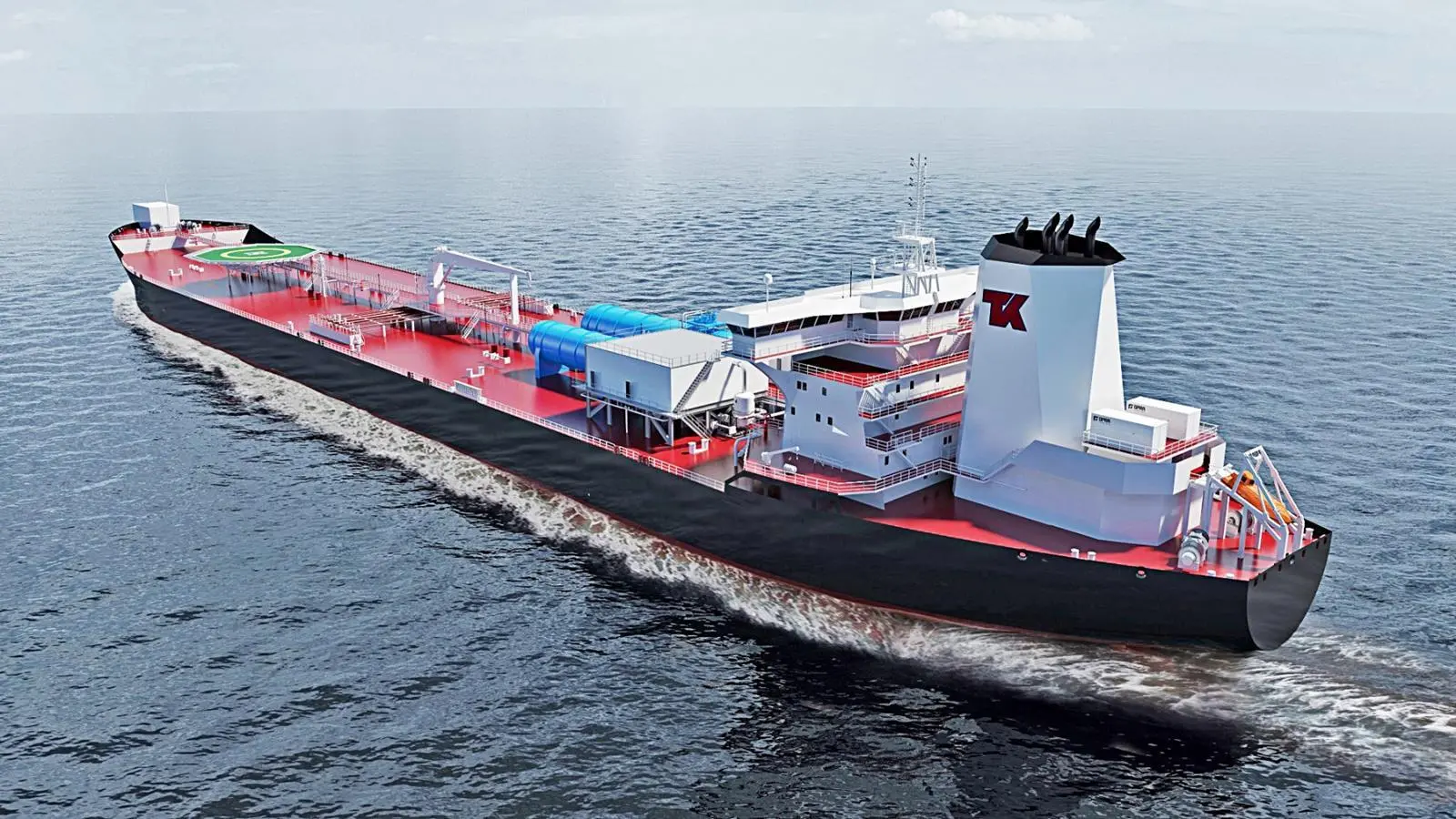
As the largest player in the shuttle tanker market, Teekay Offshore has commissioned the first of a new generation encapsulating an innovative blend of technologies and methodologies to significantly raise environmental and economic performance in the challenging business of loading and transporting oil from offshore installations.
Embodying the E-Shuttle Tanker concept, the 129,800dwt Aurora Spirit was handed over on 20 January this year at the Okpo complex of Samsung Heavy Industries. Four such DP2-class, Suezmax-size crude carriers incorporating dual-fuel electric power and propulsion were ordered from the Korean yard at a combined price of just over US$600m, and all are expected to enter North Sea service this year under the management of Teekay Shipping Norway.
The design breaks new ground on several fronts, not least in introducing recovered volatile organic compound (VOC) gas emissions into the fuel mix, and implementing battery hybrid technology, bringing energy storage into the large tanker domain for the first time. The raft of energy-saving, emissions-related initiatives are reckoned to have accounted for US$30m of the investment in each ship.
The E-Shuttle Tanker signifies a step-change rather than an evolution in the design of offshore loaders, and the company explained the rationale behind the project as follows: “When Teekay Offshore embarked on a fleet renewal programme back in 2016, we saw the importance of building vessels which will maintain their relevance throughout their 20-plus year lifespan. The technological advances seen today are progressing at a rate many times faster than what we have seen over the last 20 years. Therefore, to safeguard the substantial investments newbuild shuttle tankers represent, we decided to turn every stone in coming up with the most future-proof design available.”
Two of the four ships in the Suezmax series will operate under Teekay’s master agreement with Norwegian energy group Equinor covering direct shipments from North Sea fields, and two will be engaged serving the company’s North Sea contract of affreightment (COA) portfolio as a whole. State-owned Equinor has very high expectations of its contractors, and has recently underlined its strategic intent to cut greenhouse gas emissions from its fields and plants in Norway by 40% come 2030, 70% by 2040, and to near-zero by 2050.
Wartsila co-operated with Teekay in the development of the new breed of shuttle tanker, and the Finnish group’s technological influence is all-pervading in the power and propulsion elements, with the project team having set the bar high as regards ecological protection, economics and transportation service dependability.
Through the adoption of an engineering solution based on dual-fuel, medium-speed prime movers, LNG will be the ship’s primary energy source, complemented by an innovative set-up whereby the VOC can be recovered and mixed with LNG for burning in the engines as secondary fuel.
VOC is vaporised crude oil, formed and emitted during loading and transport, and has a deleterious effect on the environment due to the high methane content. On the Norwegian continental shelf, operators of offshore oil fields face stringent regulations relating to VOC. Oilfield licence holders are responsible for ensuring that shuttle tankers in their employ use appropriate VOC control equipment. The arrangements adopted in Aurora Spirit are therefore apposite to the ship’s intended role in the North Sea, and are the culmination of many years’ work by Teekay in exploring options addressing this particular sphere of atmospheric pollution.
Compared to existing shuttle tankers, the E-Shuttle is claimed to offer an annual emission reduction potential of 42%, and achieve fuel savings of up to 22%. Burning a mixture of LNG and recovered VOC is expected to reduce NOx by around 85%, cut particulates by some 95%, and virtually eliminate SOx.
The VOC recovery plant has been engineered to ensure compliance with the more stringent government requirements expected to be implemented in 2030. The system converts the heavier hydrocarbons into liquid VOC using several compression and cooling phases, and effects storage in a deck-mounted tank. The lighter hydrocarbons, referred to as surplus VOC, in which the main component is methane, are not liquefied or vented but burnt in a gas turbine to generate electricity for the shipboard grid during the cargo loading phase.
From a representative 850,000-barrel crude oil cargo taken aboard at a North Sea loading point, up to 100t of recovered VOC of the heavier hydrocarbons can be collected and used on a single voyage, equivalent to some 30-35% of the ship’s fuel requirement on that run.
The wherewithal fundamental to shuttle tankers includes state-of-the-art bow loading systems and DP2-class dynamic positioning, allowing safe transfers of crude in harsh weather and in close proximity to offshore installations.
A key driver in determining the final concept and technical specification of the newbuilds was the high electrical power demand when position-keeping and taking on cargo, and the need to ensure the flexibility as well as capacity and redundancy to efficiently and safely cope with an operating profile entailing regular and wide load changes. This involves regular periods in DP mode, short transits to shore terminals, and frequent loading and discharge. Companion aims related to the availability of condensed VOC, and the possibility to use VOC as fuel.
The power distribution arrangements are based on Wartsila’s proprietary Low Loss Hybrid (LLH) system, whereby the stored energy of batteries can be used to handle dynamic load variations, enabling the prime movers to be run at optimal efficiency and obviating the start-up of additional gensets to buffer changes in load. The hybrid solution simultaneously confers added overall system redundancy. Wartsila acted as the integrator for the battery installation, which is of the Corvus Orca Energy type, giving an aggregate storage capacity of 610kWh.
Adoption of electric propulsion and the LLH system has enabled total mechanical installed power to be reduced by 14% from the circa 26MW that would otherwise be sought in a more ‘standard’ vessel. As well as the adoption of batteries for peak load shaving and increased system redundancy, LLH is said to afford a superior capability to minimise the impact of a failure when in DP mode. This translates into heightened resilience in the event of unexpected incidents that might otherwise have severe consequences in the harsh environments in which the vessels operate.
While a more standard electric distribution system could lose more than 50% of installed power and several thrusters as a result of a failure, the hybrid system is designed to limit the loss to 25% of total power and a single thruster.
Dependent on their DP capabilities, shuttle tankers stand to benefit from a hybrid power system to a greater extent than most other cargo-carrying vessel types. While the DP system of a ‘conventional’ shuttle tanker typically consumes 60% of thruster power, this is expected to be brought down to only about 40% in the new ships, further improving fuel efficiency while ensuring exacting manoeuvring performance. In a review of the E-Shuttle project, DNV GL calculated that total annual energy consumption could decrease from 110GWh to 75GWh compared to ‘traditional’ shuttle tankers.
The four gensets are based on Wartsila medium-speed, dual-fuel engines of the 340mm-bore 34DF series, comprising two 12-cylinder vee-form models and two nine-cylinder, in-line units. Derived from the thoroughly-proven Wartsila 32 diesel engine platform, the 34DF was introduced in 2008 as the successor to Wartsila’s first dual-fuel engine, the 32DF. In its latest iteration, the 34DF produces a maximum 500kW per cylinder at 750rpm. Waste heat recovery (WHR) technology from Alfa Laval Aalborg contributes to overall system efficiency.
Operating in gas mode, the engines ensure IMO Tier III compliance without any secondary exhaust gas purification equipment, curb SOx, reduce CO2 and attain virtually smokeless operation. The Wartsila LNGPac outfit supplied to the new ship includes an IMO Type C tank of 2,000m3 capacity.
The two reduction gearboxes and pair of controllable pitch propellers are from the Brunvoll Volda range. To meet the exacting manoeuvring requirements of the ship’s operating profile and DP2 categorisation, a suite of powerful thrusters has been supplied by Brunvoll, comprising three model AR100 retractable azimuthing units and a single FU115 tunnel thruster.
The scope of Wartsila’s delivery has included an Eniram vessel performance management system, providing a data collection platform to assist in the optimisation of vessel operations, with automatic data analysis for decision-making support, reporting and real-time adjustments.
Aurora Spirit features a machinery seawater cooling system delivered by Hydroniq Coolers, the former Sperre Coolers. The Norwegian firm’s Rack cooling solution is integrated in the hull below the main engine room. As well as obviating use of invariably cramped machinery room space, the hull-integrated design means lower energy consumption by the seawater pumps. The system is intended to reduce overhaul time and facilitate maintenance by the crew. Hydroniq Rack cooling has also been nominated for two Aframax-size shuttle tankers on Samsung’s books for Teekay, besides all ships in the Aurora Spirit series.
The Aframax, DP2 newbuilds will be allocated to the North Sea fleet engaged in contract of affreightment work. The 103,500dwt offshore loaders have been specified with LNG dual-fuel electric propulsion and will apply key design tenets of the E-Shuttle programme.
Last year, Teekay awarded Samsung a contract for a further Suezmax shuttle tanker, costing US$130m. The vessel will deployed in Canadian waters, joining the three existing Heritage Class carriers bringing crude from fields off Newfoundland and Labrador.
PRINCIPAL PARTICULARS – Aurora Spirit
|
Length overall |
276.7m |
|
Length bp |
265.0m |
|
Breadth |
46.0m |
|
Depth |
23.4m |
|
Draught |
15.4m |
|
Gross tonnage |
85,329t |
|
Deadweight |
129,800t |
|
Cargo capacity |
c.870,000bbls/137,500m3 |
|
Ballast capacity |
62,144m3 |
|
Propulsion system |
Dual-fuel electric |
|
Main generators |
2 x Wartsila 12V34DF + 2 x 9L34DF |
|
Total mechanical power |
c.21,000kW |
|
Battery capacity |
610kWh |
|
Class |
DNV GL |
|
Class notations |
1A Tanker for oil, BIS, BMON, Bow loading, Battery(Safety), BWM(E |
|
Registry/flag |
Stavanger/Norway |
Teekay shuttle tanker newbuilds
|
Samsung Yard No. |
Name |
Deadweight |
Delivery |
|
2241 |
Aurora Spirit |
129,800 |
Jan 2020 |
|
2242 |
Rainbow Spirit |
129,800 |
2020 |
|
2256 |
Tide Spirit |
129,800 |
2020 |
|
2257 |
Current Spirit |
129,800 |
2020 |
|
2286 |
Wave Spirit |
103,500 |
End 2020 |
|
2287 |
Wind Spirit |
103,500 |
2021 |
|
2338 |
Suezmax n/b |
148,000 |
Mar 2022 |
Related Articles
 METHANOL
 GENERAL NEWS
 HYDROGEN