



Shipowners and industry establish private training centre
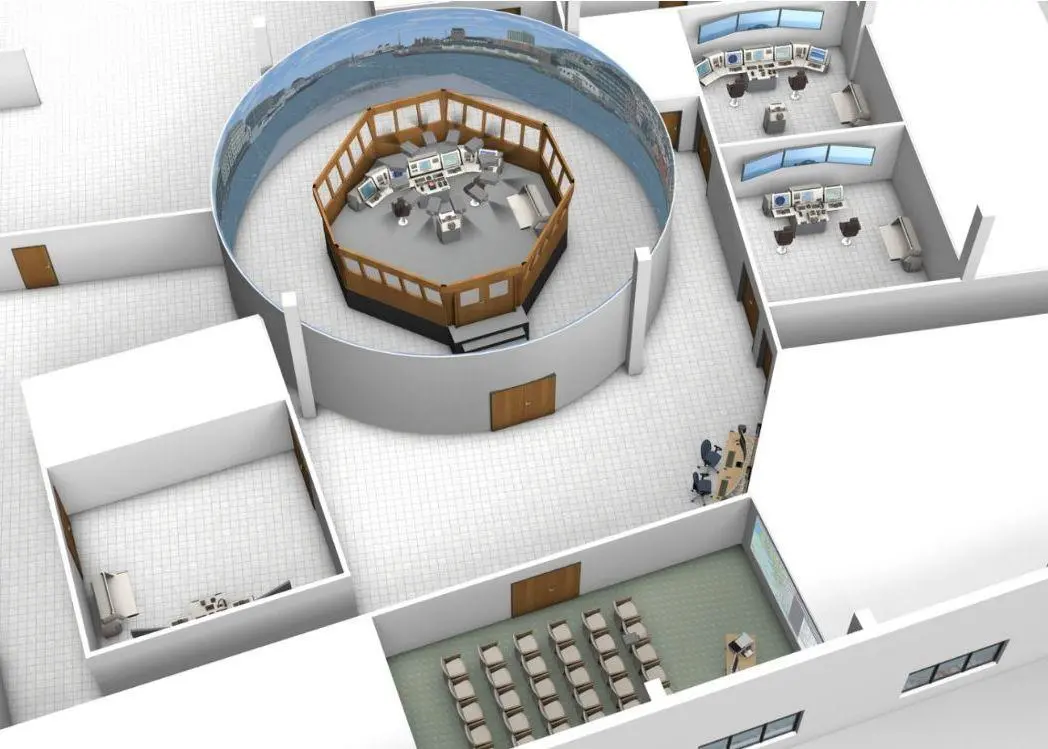
A group of private shipowners, companies and organisations in the Hamburg region – including Rickmers Reederei, MAN Diesel & Turbo, Marlow Navigation, Reederei Orion Bulkers, Germanischer Lloyd, LTF and Wussco – decided to set up their own training centre. Others involved in the project include three piloting organisations, representing around half of Germany’s 500 pilots, and Hamburg-based safety training company Maritimes Competenzcentrum (ma-co).
“Shipping companies were looking for an educational centre for their seafarers, and it was decided to set up a new private company for that purpose,” Mr Kuhlmann said. This took place at the end of year 2008.
MTC provides training for those who already have their certificates; it relies on other bodies for basic education. Most courses are completed in one week, or shorter time, other than some covering new regulations. MTC employs state-of-the-art simulators, for pilot training. “This is our main business at the moment,” says Mr Kuhlmann. This is due to IMO regulation A960 which was implemented some time ago, and which now requires all pilots to train on simulators every year.
MTC has invested around €6.5million in technical facilities, which include a shiphandling simulator, radar/ECDIS simulator (altogether six navigation bridges) an engine simulator with original ship‘s automation system, a simulator for electronically controlled main engines, which are becoming more common as both MAN and Wärtsilä have moved to electronic control to limit fuel consumption and emissions. Workshops are fitted out for two-stroke and four-stroke engines, and a dedicated workshop for electrical courses, including medium and high voltage. This is needed for the new STCW 2010, which requires training for all electricianc dealing with high-voltage plants on ships, mainly on container ships and cruise ships. There is also a GMDSS simulator and a liquid cargo simulator. “The latest simulator we have installed recently is a dynamic positioning simulator for the offshore industry,” Mr Kuhlmann added.
The shiphandling simulator, engine simulator and liquid cargo simulator and GMDSS simulator (including software) were supplied by Rheinmetall in Bremen; the DP simulator software by L3, and the electronic engine simulator software by MAN.
MTC provides a number of courses for navigation, ship‘s command, crisis management, pilot training (with a wide range of various courses and navigation tasks), engine operation, maintenance of engines, and cargo operations. More changes to the STCW convention are coming in as from January 2013, mainly regarding training for tanker crews. Specialised courses include GMDSS, various safety training courses in cooperation with ma-co, leadership courses (another new course resulting from STCW), the MAN ME engine, high voltage, and offshore DP training.
“With the shiphandling Simulator, consisting of in all three bridges, the students can run common exercises or separate exercises,” says Mr Kuhlmann. He added that the three simulators for ECDIS training are important as shipowners are now training their crews for paperless navigation. In recent months many shipping companies have started such training.
The engine simulator can operate with different models of two-stroke and four-stroke engines, including automation and engine remote control systems. It can be connected to the shiphandling simulator for crisis management training with engineers and navigators together.
“Tanker courses (liquid cargo simulations) can be done for all kinds of tankers, for crude oil tankers, product tankers, chemical tankers, LPG gas tankers, LNG gas tankers,” explains Mr Kuhlmann. MTC carries out the flag state compulsory tanker courses required to operate these vessels.
In addition to training, MTC provides ship visual and mathematical modelling and terrain modelling for their own and other companies’ simulators. Through this, crews can start training in navigation of a new ship before it is delivered. “For example in October 2012, the first 16,000TEU vessel (length 400m, breadth 56m) is coming to Hamburg. The Pilots have been training since December 2011 for the arrival of this ship,” says Mr Kuhlmann. Currently the biggest container vessels are around 13,100TEU, 367m long and 48.6m wide. The new vessels are expected to become the standard in the coming years.
MTC is able to provide training for pilots to operate azimuthing propulsion onboard cruise ships. According to Mr Kuhlmann: “Cruise ships business is expanding, particularily in Hamburg. We have more than 160 cruise ships calling in 2012.” MTC also assists with feasibility studies in new harbour construction, including related simulations. Recent simulations have proven that it is possible to leave the container port of Hamburg with a 360m container vessel at low tide, meaning that this operation is now approved.
The shiphandling simulator features a global selection of modeled operational areas, including Hamburg Harbour, River Elbe, German Bight, Kiel Canal, English Channel, Rotterdam, Los Angeles, Singapore, Shanghai, Yokohama, Tokyo and Helsinki.
Slower than expected development of offshore windfarm installation jack-up vessel projects has delayed the implementation of DP training; “Some of the projects are delayed,” Mr Kuhlmann says, “which is also delaying the education and the training.”
Annually, MTC provides some 10,000 training days for some 4,000 students, with 70% of trainess coming from outside Germany. For some courses MTC is working two shifts. “There are a lot of Eastern European engineers being trained,” Mr Kuhlmann says. This training takes typically between one and five days. Bridge simulation training in Germany seems to be flourishing, with five colleges and three private organisations operating bridge simulators.
Related Articles
 METHANOL
 MONITORING, CONTROL & DIGITALISATION
 MONITORING, CONTROL & DIGITALISATION