



Ships will become more intelligent, says Rolls-Royce
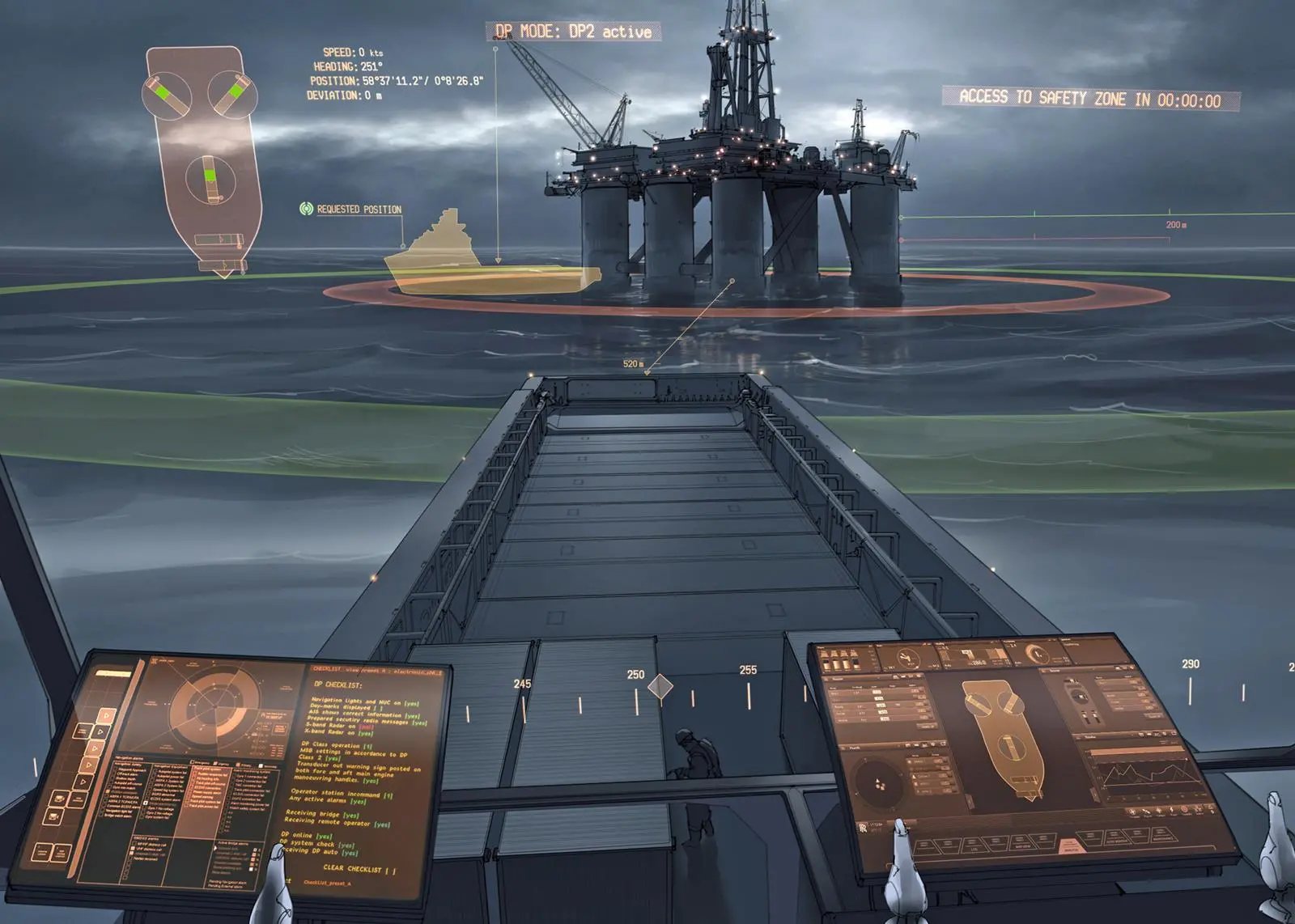
Faced with rising costs, demands for higher efficiency, and potential difficulties caused by more complex ships being operated by crew with lower levels of competence, the company sees the future in taking control off the ships themselves and moving it to control centres onshore. But as a first step, Rolls-Royce is making onboard operation simpler and more uniform, through its ‘oX bridge’.
Rolls-Royce predicts ships will require high levels of data analysis to operate on-board systems to manage propulsion, navigation and other systems. Together with VTT Technical Research Centre of Finland, the company has developed its futuristic ship’s bridge concept, which it believes could become reality by 2025.
Rolls-Royce, VTT researchers and Aalto University have combined their efforts on the new bridge, known as the Future Operator Experience Concept or ‘oX’. It offers the crew smart workstations, which automatically recognise individuals when they walk into the bridge, and adjust to their own preferences.
The windows of the bridge serve as augmented reality displays of the vessel’s surroundings, including visualisation of potential hazards that would otherwise be invisible to the human eye, in similar fashion to the ‘head up displays’ that have been standard in aerospace technology for many years. The system can, for example, pinpoint sea ice or tug boats and other craft that may not be visible to the crew, especially on large container ships.
Mikael Makinen, Rolls-Royce, president marine, said: “We are entering a truly exciting period in the history of shipping, where technology, and in particular the smart use of big data is going to drive the next generation of ships. Over the next ten to 20 years we believe ship intelligence is going to be the driving force that will determine the future of our industry, the type of ships at sea, and the competence levels required from tomorrow’s seafarers.
“The new oX bridge concept is one example of ship intelligence, and is a glimpse into the future where significant advances to navigation, efficiency of operations and safety at sea, can be achieved. “With the demands of environmental legislation and rising operating costs, ships are going to become more complex. Add to that the fact that skilled crews are already in short supply, then we see a distinct gap opening up between the complexity of ships and the competency of the people who will crew them. That will cause real problems for the industry, and we believe it is ship intelligence, that will fill that gap.”
The oX concept has resulted from studying user experience on ships today, and Rolls-Royce says it could transform the operating environment for crews on board, for example, large cargo ships and platform supply vessels. Using 3D animation, the new concept will utilise the latest digital techniques to create safer and more energy efficient ship operations.
Rolls-Royce says that it already has many of the technologies that will be part of the intelligent ships of the future.
The Unified Bridge system has recently entered service on the vessel Stril Luna, representing a new ergonomic approach to all the activity required on the bridge of a ship, coordinating the operation of on-board equipment ranging from engines to propulsion and cargo handling.
The remote monitoring of equipment on board ships is also advancing, and Rolls-Royce has control centres in Alesund, Norway, and Rauma, Finland, where many ships and thrusters are already monitored in real-time in operation around the world.
Oskar Levander, Rolls-Royce, vice president innovation, marine, speaking at a Ship Intelligence briefing in London, said: “Many of the technology building blocks that will control the ships of the future are already available today, but there is still work to be done to develop marine solutions from them. We are investing in ship intelligence, which will be a major driver of the next transition era of shipping. Much in the way that sail gave way to steam powered ships, and coal gave way to oil, we will see increasingly sophisticated ships, highly automated and perhaps even unmanned remote controlled, plying the seas within the next two decades.”
Indeed, Mr Levander says that unmanned ships will become reality in certain maritime sectors, and they can actually make a positive impact on safety at sea, even though there are many regulatory hurdles to be overcome and industry acceptance to be won.
Related Articles
 ALTERNATIVE FUELS & LUBRICANTS
 GENERAL NEWS
 GENERAL NEWS