



Short payback claimed for integrated propulsion solution
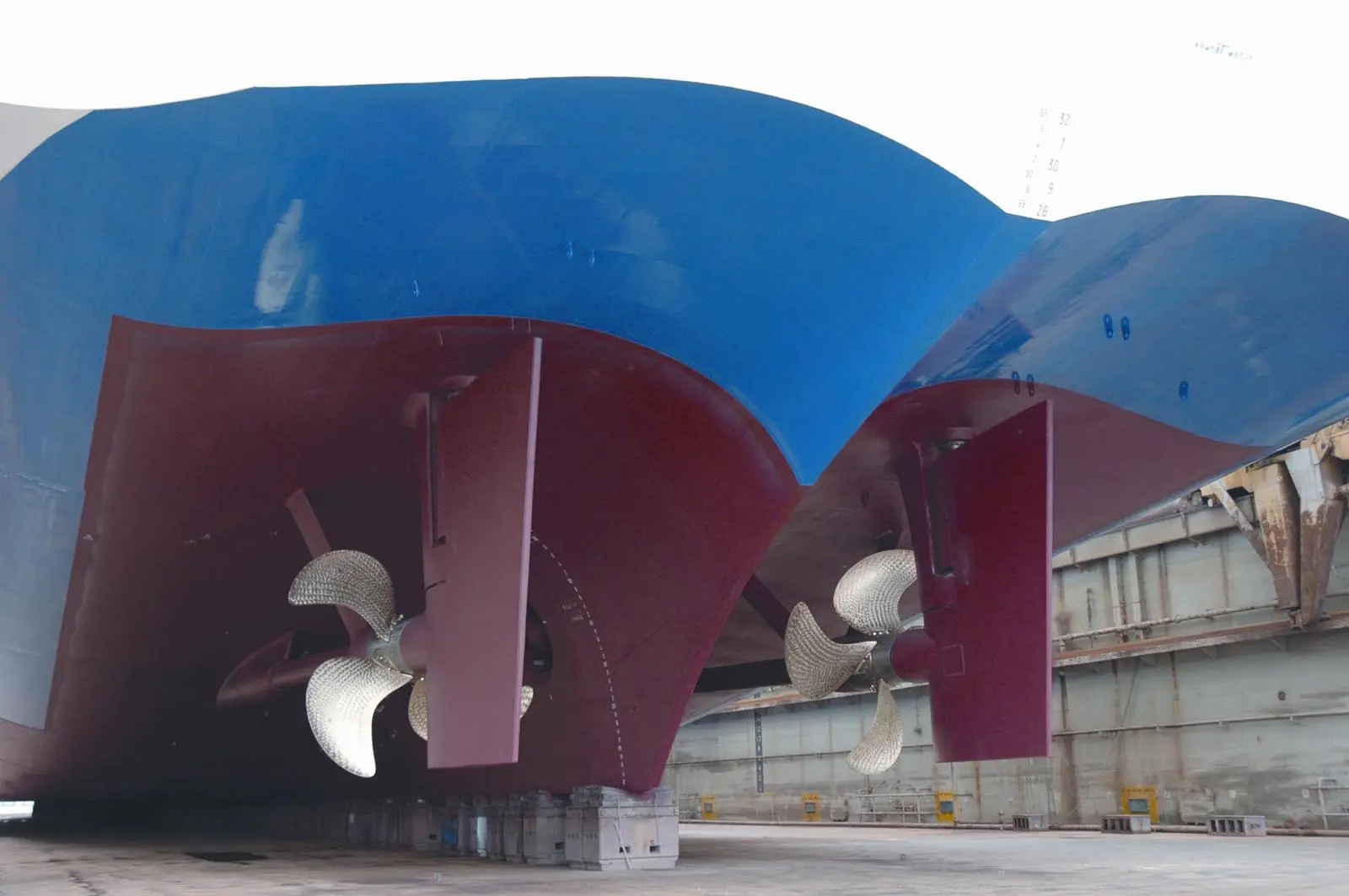
Rolls-Royce’s Promas system is described by the company as an integrated propeller rudder system that offers increased propulsive efficiency without any loss in manoeuvrability.
It forms a vital part of several of the company’s high-efficiency, low environmental impact, design projects including the Environship, in which it is integrated into the hull design which additionally features a wave-piercing bow, and is driven by a gas-fuelled engine with hybrid shaft generator. It is offered among the four propulsion solutions proposed for the R&D 8000 ‘merchant innovation project’ study, and a ‘Promas Lite’ version is available for retrofitting as part of conversion projects.
The propeller and the rudder are considered as a single, integral, propulsion unit and are designed together for optimum propulsive efficiency, the rudder design being adapted to the particular propeller chosen. The rudder is optimised to regain losses from the propeller slipstream, whilst the rudder bulb and hubcap help to recover losses from behind the propeller hub. A ‘twist’ is designed into the rudder; this reduces the local angle of attack at the rudder’s leading edge, thus enabling the rudder to operate efficiently in the rotation of the propeller’s slipstream. These features combine to increase the rudder efficiency, through lower drag and improved recovery of rotational energy from the propeller slipstream. Elimination of hub vortex losses further contributes to the efficiency gain, while lower noise and vibration results from the lower levels of pressure pulses.
Although the Promas components are carefully designed and manufactured, their basically conventional format is claimed to be simple and comparatively inexpensive to manufacture, and installation is likewise designed to be straightforward, in fact almost as easy as a normal propeller system. This means, according to Rolls-Royce, that payback time can be short.
The effect of including Promas as part of a new design means that propulsive efficiency can be increased by a typical 3% to 6%. Further claimed benefits include improved low speed manoeuvrability (15% increased maximum side force). Rolls-Royce says that the design of Promas is simple and robust, and offers improved possibilities for low pressure pulse and/or low noise propeller designs. In fact the system is particularly recommended for fishing vessels, where the reduced noise and pressure pulse can result in a better catch.
The company says that the best results are likely to be achieved on blunt single screw vessels with a block coefficient of 0.75-0.85 and a design speed in the 14 to 16-knot range. Here the efficiency gain can be as much as 6-9% compared with conventional solutions. For faster and slenderer single or twin screw vessels such as car carriers, efficiency improvements of 2-5% can be expected.
In a test comparison carried out on a medium size chemical tanker, comparing a conventionally designed propeller and rudder installation to the equivalent Promas system, a power reduction in the region of 4% to 5% was recorded, for a ship speed range of 14-16 knots.
Some other cargo-carrying vessels have been designed with Promas, but the greatest number of references comes from the passenger sector, with several ro-pax and cruise ships successfully sailing using Promas and Promas Lite propulsion
The Promas Lite, which is a simplified version of Promas is intended for vessel upgrading. The vessel’s existing rudder is retained, but is fitted with a prefabricated bulb, while the propeller – either CP or FP – is equipped with a special hubcap and new blades. The propeller is designed to make use of the existing bulb, and the new blades are closely matched to the current operational profile. If this profile has changed since the ship was built, which is not uncommon nowadays with slower steaming to reduce fuel consumption, this can be taken into account to provide even greater savings. Installation of a complete Promas Lite upgrade kit can normally be undertaken within a normal 7-10 day docking period.
Rolls-Royce says that recent Promas Lite installations on twin screw cruise vessels demonstrate efficiency improvements of between 5% to 15% are achievable, which translates to a payback period of well under two years. For these vessels the propeller designs were not only adapted to the Promas Lite system but also, in many cases, to a revised operational profile.
One particularly successful installation was an upgrade to the twin screw DRDS ro-pax ferry Pearl Seaway. Extensive modelling work was carried out at the Rolls-Royce Hydrodynamic Research Centre to refine the design and provide a tailored solution matched to the hull and operating profile. A twin 4.8m Promas Lite propulsion system was installed during the vessel’s regular dry-docking in early 2011. The existing CPP blades, originally designed for a higher operational speed were replaced by blades specifically designed to maximise the efficiency of the Promas Lite installation.
Prefabricated bulbs were welded to the existing rudders and stainless steel hubcaps fitted to the propeller hubs. Following a period of analysis, the DFDS technical team calculated the efficiency improvement to be up to 12.5%, representing a payback time of about 1.5 years.
Following the successful outcome of this installation, which resulted in fuel savings of around 13%, three more DFDS Seaways ferries, all sister ships, are being upgraded with Promas Lite systems for reduced fuel consumption and emissions.
The Dover Seaways, Dunkerque Seaways and Delft Seaways, which operate on the Dover- Dunkerque route across the English Channel, were originally designed for a speed of 26.5 knots, and the originally-fitted propellers were optimised for that speed. Current requirements on the route call for a lower service speed, of 18-19.5 knots, though the operator requires the availability of a few extra knots to recover delays, as well as good levels of manoeuvrability in port. Like the Pearl Seaway, these three ferries have a twin screw plant with two engines per shaft. Normal sailing on the current route can be maintained on one engine per shaft (1+1), with 1+2 and 2+2 available on the occasions when more power is needed.
According to Rolls-Royce, under these circumstances a substantial improvement in efficiency could be gained by fitting new blades, matched to the operating profile, to the propellers. By going one step further and adopting the Promas Lite solution, the additional efficiency improvement from hydrodynamic integration of the propellers and the existing rudders can be added to the advantages of new blades.
The conversion work for each vessel involves, for each shaftline, welding a bulb on to the existing rudder, bolting a stainless steel hubcap to the existing Kamewa CPP size 144 propeller hub, and fitting four blades of the new design to the hub. The settings of the existing control combinator are revised to ensure that optimal engine load and propeller pitch are combined so that the propulsion system functions with maximum efficiency.
The work on the three ferries is being carried out in France during the first quarter of 2012, as part of DFDS’s goal of reducing CO2 emissions by 10% over a five year period.
Related Articles
 PROPULSION
 GENERAL NEWS
 GENERAL NEWS