



SMM 2016: Top technology take-outs
1. Suppliers vote for digital revolution
On the opening day of SMM this reporter was twice told, by directly competing companies, that there is more computational power in today’s family cars than in the earliest space shuttles. Where today’s merchant vessels stand on that scale is anybody’s guess, although it would have been a much more useful comparison. But if the number of launches at SMM was any indicator, commercial vessels will soon be packed with efficiency-generating digital technologies, offering services from component monitoring through to fleet optimisation.
Accurate component monitoring is the basis on which all vessel control and optimisation will be built, and Wärtsilä revealed two innovations on this front. To support its Aquarius ballast water management system the company launched a real-time performance monitoring solution, which will be integrated into the Wärtsilä Genius digital offering, while the Seals & Bearings division presented the Sea-Master system, which incorporates several sensors for monitoring vessel shaft lines. Both systems have relevance not only in detecting failure and thus in optimising maintenance schedules, but also on a regulatory or classification level. Real-time monitoring of ballast water systems, to ensure they meet discharge standards, has already been debated as a future requirement under IMO’s Ballast Water Management Convention. And class societies are using tail shaft monitoring notations to enable customers to extend survey intervals, in particular for water-lubricated shaft lines.
Alfa Laval’s new FlowSync system for governing flow to fuel separators was a prime example of supplier’s efforts to harness digital technology to improve control of components. The system synchronises the flow of fuel to separators with engine speed, giving fuel more time in the separator bowls and therefore offering higher efficiency in removing cat fines. Governing flow to separators also prevents the energy loss associated with pumping excess fuel back to settling tanks, from where it would be passed through separators a second time. The system can also accommodate flow to multiple separators. With separators consuming around 1kWh for every cubic metre of fuel processed, such optimisation has clear benefits.
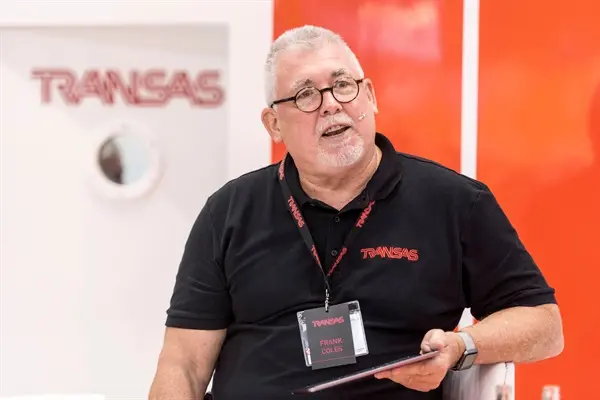
While digital monitoring and control of machinery offers clear benefits, integrating these systems into a holistic vessel-wide or fleet-wide optimisation programme is a daunting challenge for today’s ship owners – and a major opportunity for technology providers. No-one summed up that challenge better at SMM than Frank Coles (pictured above), CEO of Transas, launching the company’s own solution to the problem.
“Our industry today is awash with innovation, big data, unmanned ships, decision support tools, fuel saving applications, stress-reducing voyage planning and many other ‘save the day’ applications, noted Coles. “However, it is has manifested as a picture of uncoordinated fragmented promises that lacks a structure and platform. Shipping needs a solution not an application. Shipping operations is the complete picture not just the smart phone.”
Little wonder that big technology providers – be they propulsion manufacturers or electronic system suppliers – are climbing over themselves to offer such solutions to ship owners. Transas unveiled the latest such offering at SMM. Its THESIS (Transas Harmonised Eco System of Integrated Solutions) programme aims to integrate not just component monitoring and control, but also wider elements such as sea traffic control and fleet operations, into a holistic framework.
2. Propulsion remains core
Despite the proliferation of digital solutions, and the evolution of SMM into a much broader technology showcase, ship propulsion remains the most important element of the event. This was reflected by several launches to coincide with the fair.
MAN Diesel & Turbo officially announced the launch of its mass-optimised Mk 10 engine platform (see page 19). The company also took the opportunity to celebrate two important milestones. The G-type engine, the ultra-long stroke low-speed engine first launched in 2010 in response to slow steaming requirements and encroaching energy efficiency regulation, has now received 1,500 orders, making it the fastest-selling engine series in the company’s history. And the company reported a milestone in turbochargers too, selling its hundred thousandth unit just before the show.
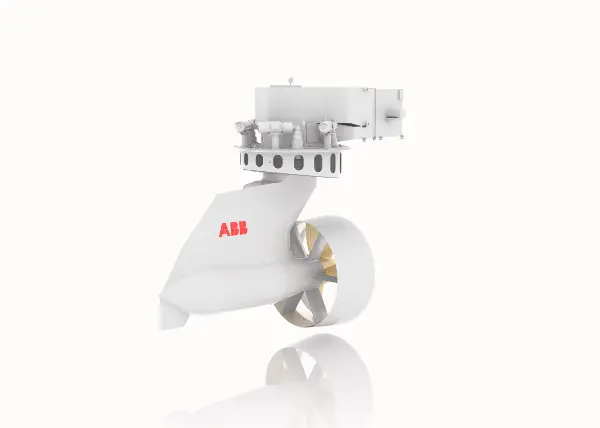
ABB used the event to launch the latest extension to its Azipod range, which this year celebrates 25 years since its launch. The Azipod XL (pictured below) incorporates a nozzle with stator plates to direct water from the propeller, with the resulting linear flow reducing turbulence and providing better thrust for the vessel. The result is that the new unit is claimed to be up to 10% more efficient than previous versions, with a higher bollard pull at lower speeds. It is being launched initially with a power output of up 17.5MW.
Rolls-Royce also presented a new thruster concept at SMM. After a year of sea trials onboard Norwegian research vessel Gunnerus the company is making its permanent magnet thrusters available commercially. The thruster has fewer moving parts than conventional thrusters. It combines a ring-type permanent magnet electric motor, propeller and nozzle in a tightly integrated propulsion unit. Simple bearings in the rotor hub carry all loads and only a small oil circulation pump is required. Over the course of the trial researchers found a high motor efficiency, 97% at nominal speed and high over the whole load range, an increase in bollard pull (+20%) and speed – approximately one knot over the range for the same input power – with airborne and structural noise readings lower or similar to previous performance. Hydro acoustic noise was also improved.
Although WinGD did not present any new concepts at the show, it was nevertheless an important event for the company, its first since it was fully acquired from Wärtsilä by China State Shipbuiliding Co in June. The company took the opportunity to explain to customers what the change of ownership means, but also to emphasise that it remains an agile and relatively small business whose development agenda is driven by close collaboration with all its customers. The Motorship will carry an important interview with Dominik Schneiter, vice president research and development, WinGD, in its November issue.
3. Green ship technology is hot
This year SMM introduced a new hall, A5, to accommodate specifically ‘green’ propulsion concepts. The new facility was certainly well insulated, perhaps more than was needed during the hottest September on record in Germany, but visitors braving the heat were treated to a feast of innovation in particular in the areas of electric, LNG and wind propulsion.
One of the biggest LNG related announcements of the week came from French gas provider Engie (a shareholder in containment specialist and Hall A5 exhibitor GTT), Mitsubishi Corp and NYK Line with the formation of their global LNG bunkering brand, Gas4Sea. The trio, which are already cooperating on ship-to-ship bunkering in Zeebrugge (due to begin operations imminently), aim to expand their offering globally, targeting Europe, North America and Asia as key markets. Interestingly all three partners are also part of the SEA\LNG consortium established recently to help ports, ship operators and regulators with the commercial considerations involved in establishing LNG operations. And while the bunkering brand is only at an embryonic stage – its only customer to date is NYK subsidiary United Europe Car Carriers at Zeebrugge – it is an important early move in the development of a viable, global LNG bunker market.
From Gas4Sea to e4ships, the German fuel cell development project, which used SMM to present a report on early progress – including demonstrators on a ferry and a multipurpose vessel. The project has been underway since 2009, and aims not just to develop technical solutions for implementing fuel cells in marine applications, but crucially to feed into the development of international regulations on fuel cells. Phase one of the project – including demonstrator projects coordinated by Meyer Werft and ThyssenKrupp Marine Systems, as well as input into the IMO’s IGF Code for low-flashpoint fuels – has been completed, and the next stages will involve further demonstrator vessels, the development of the ‘decentralised energy network’ concept (multiple fuel cells located across as vessel) and further regulatory input. The project partners, under the coordination of the German National Organization for Hydrogen and Fuel Cell Technology, aim to start work on bringing marine fuel cells to market from 2017.
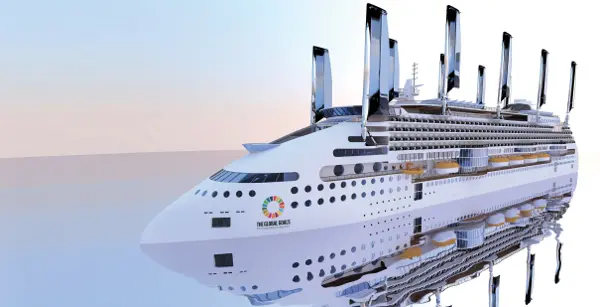
Also notable in the new Hall A5 were a collection of wind-propulsion exhibitors – many in the very early concept stages – coordinated by the International Windship Association (IWSA). Perhaps the biggest wind-related development of the week was the announcement pf a memorandum of understanding between Peace Boat, the Japan-based international non-profit NGO, and DNV GL to develop the Ecoship cruise ship (artist’s impression above). The Ecoship’s unique design is intended to improve efficiency, reduce waste and minimize environmental impacts. Notable features include 10 masts to harness wind energy for propulsion, solar panel-covered sails and a 6,000m2 top-deck solar farm, a closed-loop water system to reuse, purify and re-purpose water, waste heat recovery systems where it is hoped that 80% of the energy normally lost in the air and in the water can be reclaimed for use. The partners will work together on the design, construction and operation Ecoship, as well as promoting the concept as an environmental solution.
SMM also hosted the inaugural IWSA Wind Propulsion Innovation Awards. From around 40 nominations and through more than 1,500 votes, winners were selected in three categories: Innovation, Technology End User and Research. Wind power generation company Enercon’s Flettner rotor vessel E-Ship 1, with nearly five years of operational service, was highly recognised by industry voters, securing both the Innovation and Technology End-User awards, while the University of South Pacific’s Sustainable Sea Transport Research Programme took the Research prize. In a separate award open to IWSA members, a Lifetime Achievement award was presented to Wilhelm Proells and Bernd Wagner for their work over decades on Dynarig sail systems.
4. Tier III NOx strategies
The keel laying boom ahead of the introduction of Tier NOx emission limits, in place in the North American and Caribbean emission control areas since January, has meant that the marine industry has little practical experience to date of NOx abatement technologies, particularly for low-speed engines. That will change as building of vessels destined to serve US destinations picks up, and ship operators were justifiably keen to explore their options at SMM.
Of particular relevance was the CIMAC Circle event hosted by the internal combustion engine association CIMAC, themed ‘Environmental compliance strategies under the light of changes in the oil market’. Despite the title there was little focus on the price of fuel, or its impact on investment in environmental measures. Rather the focus was on available NOx abatement technologies.
Niklas Sievers, general manager medium speed products, ABB Turbo Systems, highlighted the challenges of maintaining performance and fuel efficiency for medium-speed dual-fuel engines, which are one potential solution to Tier III NOx limits. As gas fuel operation results in lower compression ratios, reduced scavenging, reduced power density and limited ability to vary engine speed (due to more restrictive control of exhaust waste gates and compressor bypass), dual-fuel engines face several challenges. In diesel mode, there is higher fuel consumption, higher thermal load and higher compressor pressure. In gas mode, the higher compressor pressure needed for diesel operation results in poor turbocharger exploitation.
Sievers investigated a suite of solutions comprising two-stage turbocharging, variable valve timing and variable frequency diesel-electric propulsion, showing how each can bring benefits in thermal efficiency. For a cruise ship operating over 5,000 hours a year at an average 75% load, with 70% of time in gas mode, fuel savings could reach 13% for gas and 10% in diesel. The end result could be a 7% reduction in operational expenditure, with a return on investment in around three years.
Kjeld Aabo, head of marine and offshore engine sales, MAN Diesel & Turbo, examined the challenges of NOx abatement from a two-stroke perspective. With after-treatments – either high- or low-pressure selective catalytic reduction (SCR) or exhaust gas recirculation (EGR) – the only available way for two-strokes to meet Tier III limits, the choice of technology will depend on several factors, Aabo noted. From the perspective of shipyards, capital expense, space requirements and installation capabilities will be deciding factors. For owners, operational cost and simplicity, reliability and the costs of maintenance and waste disposal are key.
Mikael Wideskog, director research & technology programs, Wärtsilä, looked at the NOx Tier
challenge from the perspective of fuel flexibility. Compliance can be achieved using any fuel in conjunction with after treatment, and Wartsilä’s study on a platform supply vessel identified the differences in cost: While EGR offered a -6% discount in capex compared to SCR, operation costs over a 10-year period where +3.5% higher. Ultimately, sulphur-free fuels are the most viable solution – among them LNG, LPG and methanol – and the future of engine design will need to accommodate this fuel flexibility.
5. The future of class
The classification market is more competitive than ever, with societies scrambling for new ways to lure ship owners as newbuilding stalls. Class societies were out in force at SMM, seeking to persuade owners that they were the ones to guide them through an increasingly complex future market.
Remi Eriksen, CEO of DNV GL, noted: “Shipping is going through some troubled waters, but it is important that do we not waste this crisis. It is a good time get rid of inefficiencies and take advantage of new solutions and new technologies.”
DNV GL is investing heavily in the modernisation of its core classification services. At SMM the company announced that it is investing 5% of revenues in research over the coming years, with half of that investment going into digital technologies. The company announced the launch of its recommended practices in cyber security, and highlighted its pioneering role in the use of aerial drones to conduct surveys. DNV GL also unveiled a host of new projects, including the second stage of its joint industry project exploring the potential for gas turbine-powered large containerships.
The American Bureau of Shipping took the opportunity of SMM to expand its CyberSafety series of guidance notes, arguably the most comprehensive class society guidance on the subject available so far. The company also announced the introduction of a cyber safety class notation, applying not just to ship based systems, but also – through the ‘+’ suffix – certifying security of shore-based ship operation centres as well. Further investment will see the creation of a ‘cyber lab’ where systems can be further tested and more detailed guidance developed, the company reported.
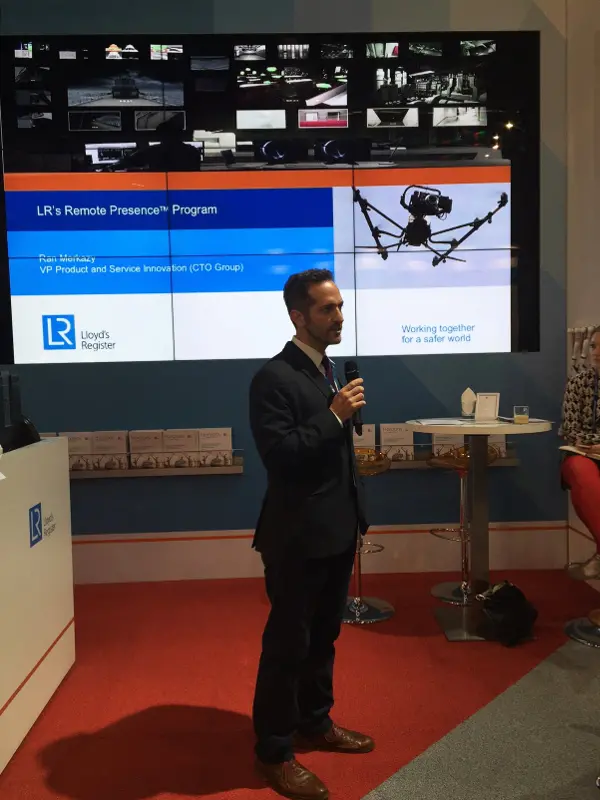
The future of shipping was a focus for Lloyd’s Register too. The company extended its Remote Presence programme with the signing of a memorandum of understanding with drone company Airobotics, under which pre-programmed inspection missions using drones will be developed. Another ‘cyber’ project is underway in partnership with UK technology company QinetiQ and ship operator GasLog, aiming to increase the level of security on cyber-enabled ships.
Related Articles
 ALTERNATIVE FUELS & LUBRICANTS
 GENERAL NEWS
 GENERAL NEWS