



Spray repair simplifies engine remanufacturing
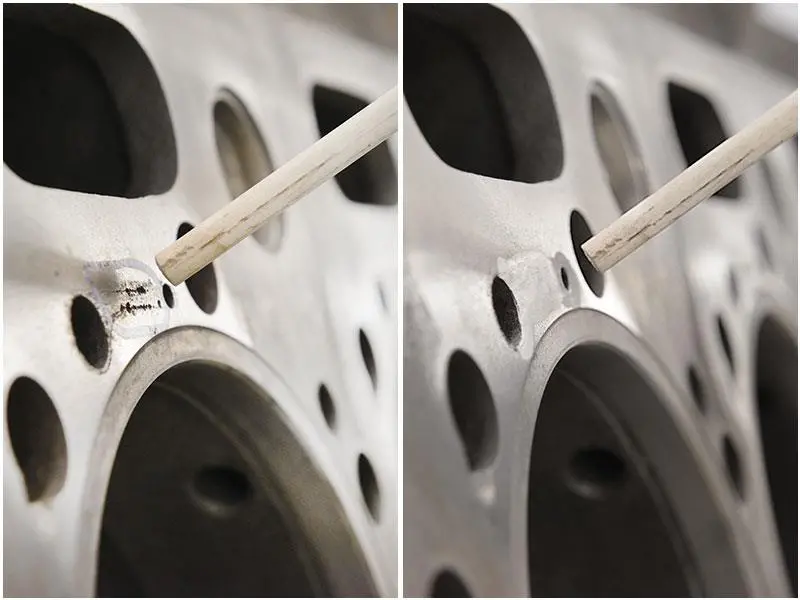
MTU has started using a new process known as low-pressure cold spraying in the remanufacturing of its engine components. Two powders, one spray gun, power and compressed air connections and an extraction system are all the equipment needed, the engine specialist reports, and damaged components are restored to their original condition within a matter of minutes.
If a used crankcase with surface damage was sent in for reconditioning by a client, for example, in the past it would have been repaired with epoxy resin adhesive and other agents. However, that tended to become detached again after a short time.
“The low-pressure cold spraying process has the potential to replace the bonding techniques used here,” explained Uwe Czerney, design engineer at MTU Reman Technologies in Magdeburg. “It can fill surface damage up to 10mm deep within a few minutes. And the best thing is, the crankcase itself is hardly heated at all, does not have to dry out and can be further processed immediately afterwards. As well as that, the repair lasts significantly longer.”
Quickly done
The damaged area is first cleaned and roughened using a fine-grain blasting abrasive. Then the selected powder, consisting of various ductile metals and an oxide ceramic, is sprayed into the surface damage.
“The slightly preheated powder impacts the surface at supersonic speed and is compressed into a solid layer by the impact energy,” added Czerney’s colleague Ralf Brandt. So that a flawless surface is obtained again after machining, a slight surplus of powder is sprayed on. Afterwards, the surface is machined again just in that area to restore the original shape.
“Especially with the reconditioning of used engines and components, our remanufacturing processes in other words, it means we can offer customers quick and high-quality reconditioning of parts,” relates Brandt.
“And since all the equipment fits inside a case, it is very portable. So we could carry out repairs on very large components without having to move them several times.”
In the last six months alone MTU reports that 34 crankcases have been repaired using the process in Magdeburg.
Tested under tough conditions
A field trials engine has been in use for more than 6,000 hours on high-speed trains running on the East Coast Main Line (ECML) in the UK. “We deliberately prepared the crankcase of this engine with surface damage repairs in order to test out the process,” Czerney explained. “To date, all of the repaired areas have lasted.” So with just a little powder, a substantial quality improvement compared with established repair methods has been achieved.
Another advantage is that the same area could be re-treated using the same method virtually any number of times. “That would only be possible to a limited degree with other reinstatement processes.” Apart from that, the speed with which the component is ready for use again is unbeatable. There is only one limitation, however – the low-pressure cold spray process can only be applied to very limited areas.
Related Articles
 EMISSIONS REDUCTION TECHNOLOGY
 ALTERNATIVE FUELS & LUBRICANTS
 ALTERNATIVE FUELS & LUBRICANTS