



Stagger sulphur restrictions, conference keynote urges
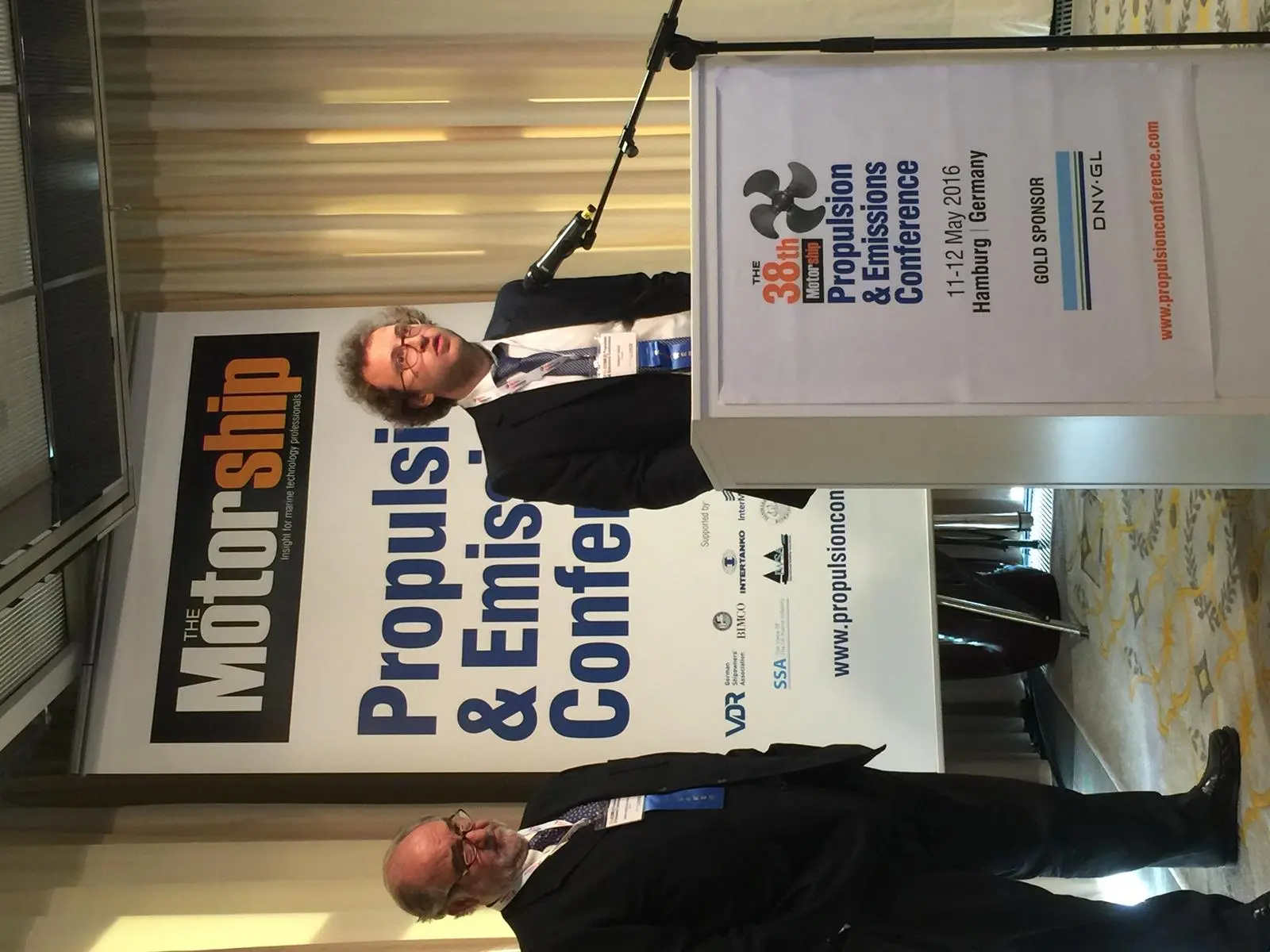
The IMO should consider phasing in the global 0.5% fuel sulphur cap set to be introduced in either 2020 or 2025, the consultant behind a major study – supplementary to the IMO’s own marine fuel availability study – has proposed. David St Amand of Navigistics Consulting revealed the recommendation – which the study’s sponsors will likely put to the IMO’s Marine Environment Protection Committee in October – as part of his keynote presentation. Using the IMO’s third Greenhouse Gasses (GHG) Study as a base, St Amand remodelled demand for compliant fuel based on the likelihood of slow steaming becoming less common, the potential uptake of scrubbers, alternative fuel uptake and changes to the design efficiency of vessels.
With no speeding up of vessels, the study predicted that added demand for 0.5% sulphur fuel in 2020 would be 3.6 million barrels per day, rising to 4.4 million barrels a day if scrubber uptake is lower than the IMO anticipates. Given that the International Energy Agency anticipates that a demand increase of 2 million barrels a day would put refiners under enormous pressure, St Amand proposed a staggered introduction for the global cap.
“The IMO should consider a phased approach by staggering the sulphur limit reduction, or by phasing in the new limit geographically or by ship type,” St Amand concluded.
Enforcement issues
The global sulphur cap, due to be introduced in either 2020 or 2025 under Marpol Annex VI, is currently the subject of another, official study being conducted by CE Delft for the IMO. It is due to be completed by MEPC 70 in October – after which a decision on the date of entry into force will be taken. Meanwhile the global cap was the subject of much discussion on the first day of the conference.
Enforcement of the cap was considered by several speakers. Captain Wolfram Guntermann, director environmental fleet management, Hapag-Lloyd, suggested that haphazard port state control enforcement of the 0.1% sulphur cap in ECAs (introduced on 1 January 2015) did not bode well for enforcement of a global rule.
Lars Robert Pedersen, deputy secretary general, BIMCO, also pointed out the challenges of enforcing the cap – particularly on the high seas. He suggested that Article 218 of the UN Convention on the Law of the Sea may provide a means for port state control to engage in this issue. The article enables port state control to launch an investigation if they suspect the contravention of an IMO instrument beyond territorial waters. But some national legislation may need to be updated – in the case of Denmark for example, such an investigation can only be launched if the actions are likely to damage the country’s interests.
The IMO’s Tier III NOx emission limit, introduced in the North American and Caribbean ECA on 1 January 2016, was also a key subject. Among several interesting discussions was a report from Tor Øyvind Ask, fleet director, Solvang, who described a project that combined a scrubber with exhaust gas recirculation in order to provide commercially viable NOx compliance while operating on heavy fuel oil. The system successfully trialled on ‘Clipper Harald’ was installed at just an additional 10% cost on top of the scrubber, and with the addition of a more powerful fan is expected to achieve Tier III this year.
MAN Diesel & Turbo’s Daniel Struckmeier highlighted the group’s advances in NOx abatement for four stroke engines, using selective catalytic reduction. Benefits of the integrated system include more accurate urea injection and temperature management – key factors towards effective NOx reduction and Tier III compliance.
A suite of support functions include a clean funnel configuration tool, and soon Ecomap 2.0, which will enable the engine and SCR to be optimised for urea cost and fuel consumption – saving up to 2.5% on fuel cost. “We see that the future lies in the optimisation of the whole system – optimising for fuel consumption means higher NOx emissions, but this you handle with your SCR or EGR,” said Struckmeier.
Efficiency improvements
Elsewhere, a more general examination of improving vessel efficiency was well received. Captain Stefan Bülow, managing partner of the Hamburg Bulk Carriers Group, revealed how the company had worked with ship designer Deltamarin on a new handymax bulk carrier design, the B.Delta 43, that has resulted in fuel (and CO2 emission) savings of 30% over comparable vessels, and a 28.6% reduction in its Energy Efficient Design Index rating. The company currently has five of the vessels, with a further five under construction, while Deltamarin will use the learnings to improve designs further in future series.
A fascinating session on the financing of energy efficiency and environmental technologies for shipowners. The case for investment in such technology, even in difficult times, was put elegantly by Jens Rohleder, Vice President, KfW IPEX-Bank GmbH, Maritime Industries: “When you have a state of the art vessel it is easier to employ worldwide, and you have better chartering potential. This might lead to better LTVs (loan-to-value ratios), hence better risk profile and higher repayment potential.”
KfW IPEX has developed tools to evaluate the efficiency of vessels against others in the same sector, and against compliance with current and future regulations. One retrofit evaluation tool for container vessels selects the best options based on the regulation requirements in the relevant trading areas, and shows the amortisation period for each option.
Regardless of the low oil price, investing in green shipping now makes sense, said Rohleder. “Start investing early because it takes time to test and become familiar with investments. After testing on a single ship it can take years before your full fleet is retrofitted.”
Despite that apparent encouragement from a major maritime bank, many individual retrofit projects fall well below the threshold value for traditional financing. James Mitchell, Operation Associate for Shipping Efficiency, Carbon War Room, presented a tour of some novel financing concepts. Retrofit ‘clubs’, witnessed in both Singapore and Hamburg, enable shipowners to band together to reach banks minimum loan values, while greater cooperation between ship owners and charterers – as in a recent case between Hammonia and charterer InterMarine – can provide the long-term guaranteed income that makes finance more attractive.
“Solutions are emerging, but they need to develop faster,” said Mitchell.
Among the highlights of the afternoon session, Martial Claudepierre, Business Development, Bureau Veritas Marine & Offshore and Hans Wevelbergh from Evergas jointly presented a case study on the first of a series of eight 27,500m3 multi-gas carriers ordered by Evergas and classed by Bureau Veritas. The ships can be powered by liquid ethane gas, LNG or diesel.
The first day of the conference was chaired skillfully by Dr Martin Kroeger, managing director of VDR (the German shipowners association). It concluded with a relaxed evening of fine dining and networking at the Schönes Leben restaurant in Hamburg’s Speicherstadt.
Build or retrofit?
Day two of conference began with a panel exploring vessel efficiency options for both newbuild ships and retrofits. Kjartan Ross, Business Development Manager, MAN Diesel & Turbo noted that, looking at the entire drive train holistically, it is possible to have a retrofitted vessel that can compete with new buildings for efficiency. He explained that before the fuel price crash last year it was only owner-operators who wanted optimisation. “Now we see a big interest from people who charter out ships too. I think the reason is that some charters are coming to an end and there is an interest in improving these vessels position in the market place,” said Ross.
Arthur Barret, Program Director, LNG Bunkering, GTT, provided a fascinating and in-depth report on a novel ship propulsion concept for container vessels – the PERFECt project for ‘piston-free’, or gas and steam turbine-powered propulsion. Ultra Large Container Vessels need to adapt rapidly to a constantly changing economic environment. Barrett offers a description of an innovative proposal for propulsion of ULCVs that could also be applicable to other type of ships and discusses a case study of a joint project with CMA-CGM.
Jonathan Brown, Chief Engineer, Large Engines, Pascal Revereault-Ricardo UK, presented the results of a study into improving reliability and performance of diesel-electric propulsion configurations/ And Juan Gonzalez-Adalid, General Manager, Sistemar and Thibaut Raes, Project Engineer, Evergas revealed how they had conducted optimisation – in particular propeller changes – on the second generation of Dragon multi-gas carriers.
In a session exploring fuel choices and technology, Dr Jerry Ng KL, Founder & CEO, Blue Ocean Solutions discussed the development of emulsion fuels, explaining that they represents a good way to improve combustion of fuel. Ng showed how Blue Ocean Solution has designed its own system to integrate emulsified fuel with electronical controlled engines.
Konrad Räss, General Manager Combustion System, R&D, Winterthur Gas & Diesel then took to the stage to discuss the impact of varying fuel types on two-stroke engine performance. The two-stroke engine is an omnivore – it can take just about any type of fuel you can feed it, said Rass. “But if you eat everything, sometimes you can have problems with digestion.”
A further session on new fuels cast a light on developments in fuel quality since the emergence of ‘hybrid fuels’ – designed to enable ECA sulphur compliance with the viscosity of residual, high-sulphur fuels. Michael Green, Global Technical Manager – Bunker Fuel Testing, Intertek Lintec, ShipCare Services, revealed how sample submissions suggested a wide and rapid uptake of such fuels.
“We braced for the worst, and the worst didn’t happen,” said Green of the lubricity and stability issues predicted for distillate fuels pre-ECA enforcement. Instead most issues have been related to paraffin formation, but are often easily manageable onboard.
Efficiency and safety
Apostolos Papanikolaou, Professor, National Technical University of Athens presented an important update on the SHOPERA (Energy Efficient Safe Ship Operation) project, which seeks to define technical criteria for minimum power requirements in adverse weather conditions – a crucial safety element that was initially overlooked when the IMO’s Energy Efficient Design Index was conceived.
Papanikolaou reported that a technically feasible solution to manoeuvring in adverse weather conditions has now been found that could possibly describe weather scenarios and define technical criteria for them. However the process remains challenging; with some ship types the maximum installed power demanded by the EEDI are so low that they are close to the minimum safe power needed for some conditions.
The final meeting for Project SHOPERA will take place in September, and a proposal will be put to IMO’s Marine Environment Protection Committee in 2017.
Other important sessions examined the impending European Monitoring, Reporting and Verification (MRV) regulation and its global equivalent under development at the IMO. Julien Dufour, CEO, Verifavia Shipping and Poul Woodall, Director, Environment & Sustainability, DFDS Seaways shared insights from the pre-MRV gap analysis conducted for DFDS Seaways; Jakob Buus Petersen, Director of Vessel Performance Solutions, discussed the role of data quality as explored in a new Danish project INNOplus; and Torsten Mundt, Principal Engineer of Environmental R&D, DNV GL – Maritime gave a stakeholder’s perspective of discussions to develop the MRV.
Finally, the increasing role of big data in improving vessel efficiency was explored in the last session of the day. Michael Haranen, Senior Data Scientist of NAPA, looked at the potential for automation of navigation and vessel operations, arguing that digital reporting and automated analytics should become the status quo, replacing traditional reports with continuous monitoring. Stefan M Nygård, General Manager of Asset Performance Optimisation Services, Wärtsilä Corp explained how cutting-edge data analysis are already being used to combine condition-based maintenance with operation optimisation, with a direct impact on fuel consumption and maintenance intervals. And Dr Barry Kidd, Section Manager of Hydrodynamics at AkzoNobel Marine Coatings, examined the science behind claims of fuel savings from hull coatings, which AkzoNobel has applied in its InterTrac Vision savings prediction tool.
The second and final day of the Propulsions & Emissions Conference was chaired by Lars Robert Pedersen, Deputy Secretary General, BIMCO.
Record readership for live conference reporting
The Motorship Live – minute-by-minute web coverage of this year’s Propulsion & Emissions Conference – welcomed a record readership in 2016 after being introduced at last year’s event. The service (which features sound bites, photos, video and social media reaction) attracted more than 1,400 page views over the two days, amplifying the conference’s audience and adding valuable exposure for speakers and sponsors.
Page views can be a deceptive figure in isolation, but an average time on page of around eight minutes – compared to under two minutes for most web news items – indicates that many readers used the service to tune for the presentations that interested them.
“We have already used The Motorship Live format for our two annual conferences – Propulsion & Emissions and Gas Fuelled Ships – and will soon be rolling it out to other industry-wide events,” said The Motorship editor (turned web blogger) Gavin Lipsith. “We’re delighted with the reception the service has received, and are particularly grateful to this year’s sponsor, DNV GL, for enabling this cutting-edge addition to our coverage.”
Related Articles
 ALTERNATIVE FUELS & LUBRICANTS
 GENERAL NEWS
 GENERAL NEWS