



Stena paints picture of future ‘fuel mosaic’
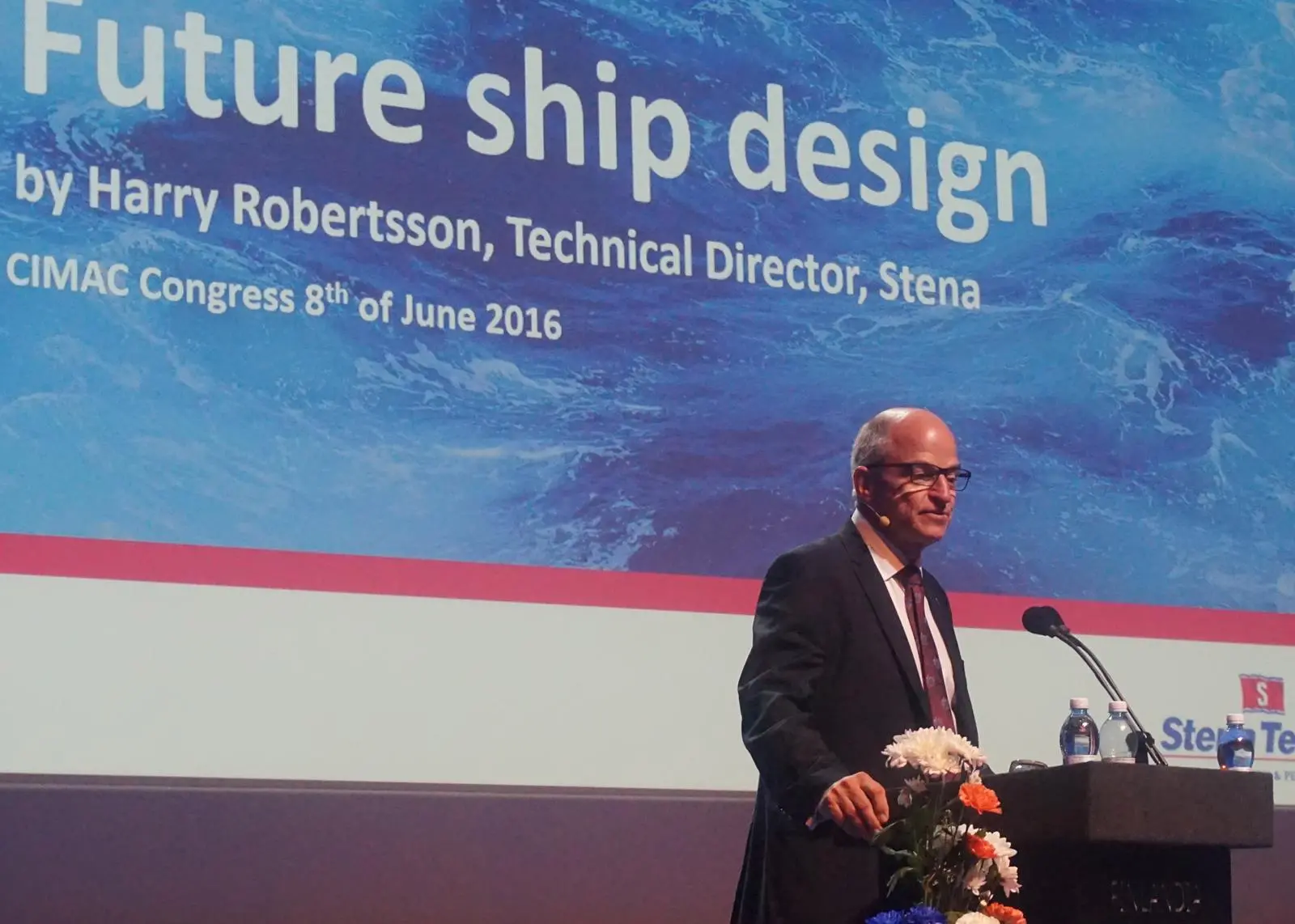
Speaking at CIMAC Congress in Helsinki this week, Harry Robertsson, technical director at Stena Teknik, suggested that using HFO with sulphur scrubbers could be the most cost-efficient fuel option – even if a carbon tax or fee is introduced on top of the fuel price.
At present the company has installed just four scrubbers, with a further three units planned. At a cost of US$5-10 million per installation, this is expensive and potentially complicated work. LNG retrofitting has also been discounted for the time being, except on the group’s LNG carriers, due to both the high cost of conversion (around US$30 million for a ro-pax vessel) and the loss of power – up to 20% of installed power in some cases studied by Stena Teknik, a deficit that would make it difficult for the ships to keep to schedule.
“Our approach to fuels is driven by the 0.1% sulphur limit in the North European ECA, as our activities for Stena Line and Stena RoRo are very much in this area,” said Robertsson. “I agree that we will have a fuel ‘mosaic’ in the future: different ships on different routes in different parts of the world will be running on different fuels.”
The fuel scenario looks very different in fifteen years’ time, according to in-depth research carried out by Stena Group. Then LNG could be an option for newbuild vessels, said Robertsson, in regions where the price is attractive and bunkering infrastructure is available.
Methanol is also firmly in the group’s sights as a result of the company’s conversion work on Stena Germanica – which is in the process of having the third of its four medium-speed Wärtsilä engines converted to methanol running. In Iceland methanol is already being produced in small quantities from CO2 and water (with thermal power to start the process), offering a tantalising prospect of shipping free from fossil fuels.
Exploring batteries
“What surprised us in this study was that batteries could be an attractive option for short sea shipping (under 100nm) fifteen years from now,” Robertsson noted. “And in the longer term biofuels and fuel cells will enter the market. But today marine batteries are three times as expensive as car batteries, and so far the capacity and lifespan of fuel cells are too small.”
Stena’s owners are keen to explore the potential of battery power, and the company is starting the process by looking at battery powered bow thrusters. This may eliminate the need to start an additional two generator sets when ships enter port – one to power the thrusters and one for redundancy.
The next step after bow thrusters would be to replace two of the four engines on Stena Line ferries with electrical motors, with shore-charged batteries enabling emission-free sailing in ports and the Stockholm archipelago. The group has also designed a concept vessel, the ro-pax Stena Elektra, which features methanol propulsion and energy storage, as well as a level of autonomous operation and modular design to allow for seasonal changes to operations. Robertsson suggested the vessel could be a reality by 2030.
In a wide ranging speech, Robertsson also discussed the company’s direction for future ship design. Highlights of the company’s envisioned approach in three core areas – safety, cost efficiency and environmental performance – are presented in the audio clips accompanying this article.
The Motorship is reporting live from CIMAC Congress this week, with the final day of technical presentations taking place on Thursday 9 June. Follow the action from our live blog page.
Related Articles
 ALTERNATIVE FUELS & LUBRICANTS
 GENERAL NEWS
 GENERAL NEWS