



Support offered for all engine types
800×600
The company cites, as a typical maintenance job, a task carried out in 2013 when the Rockwater 1, adynamically positioned dive support vessel, called-in at Barrow-in-Furness, UK, for 18 days of scheduled maintenance. The Rockwater 1 is powered by a diesel-electric propulsion system using five 1,700kW Brons-MAN ASL25/30 diesel engines, each of which drives a 2,125kVA NEBB WAB 630 generator. These produce power for two 1,800kW azimuth thrusters and three 790kW tunnel thrusters. The service order required the Royston engineers to completely dismantle three of the engines and overhaul their cylinder heads and liners, pistons and con rods, camshafts, bearings, vibration dampers and injectors and two turbochargers.
Royston says that its service engineers are used to working under pressure – which, adds the company, was just as well because a nine-man team worked day and night shifts aboard the ship while six engineers at the Royston workshop in Newcastle, UK, undertook the machining of components. This included servicing 27 cylinder heads and liners, fuel injectors and the complete overhaul of the two turbochargers.
The company says that maintenance and repair of turbochargers is another aspect in which it regards itself as having particular specialist professional expertise. After many years of working closely with various turbocharger manufacturers, Royston is now the UK service centre for Napier Turbochargers. This means that Napier customers using Royston to support their turbochargers can be guaranteed the same quality of parts and service as those provided by the Napier Turbochargers factory. This, claims Royston, has introduced a new level of convenience and flexibility to Napier customers while also reassuring them that only genuine Napier parts and engineering standards are being used in repairs and servicing.
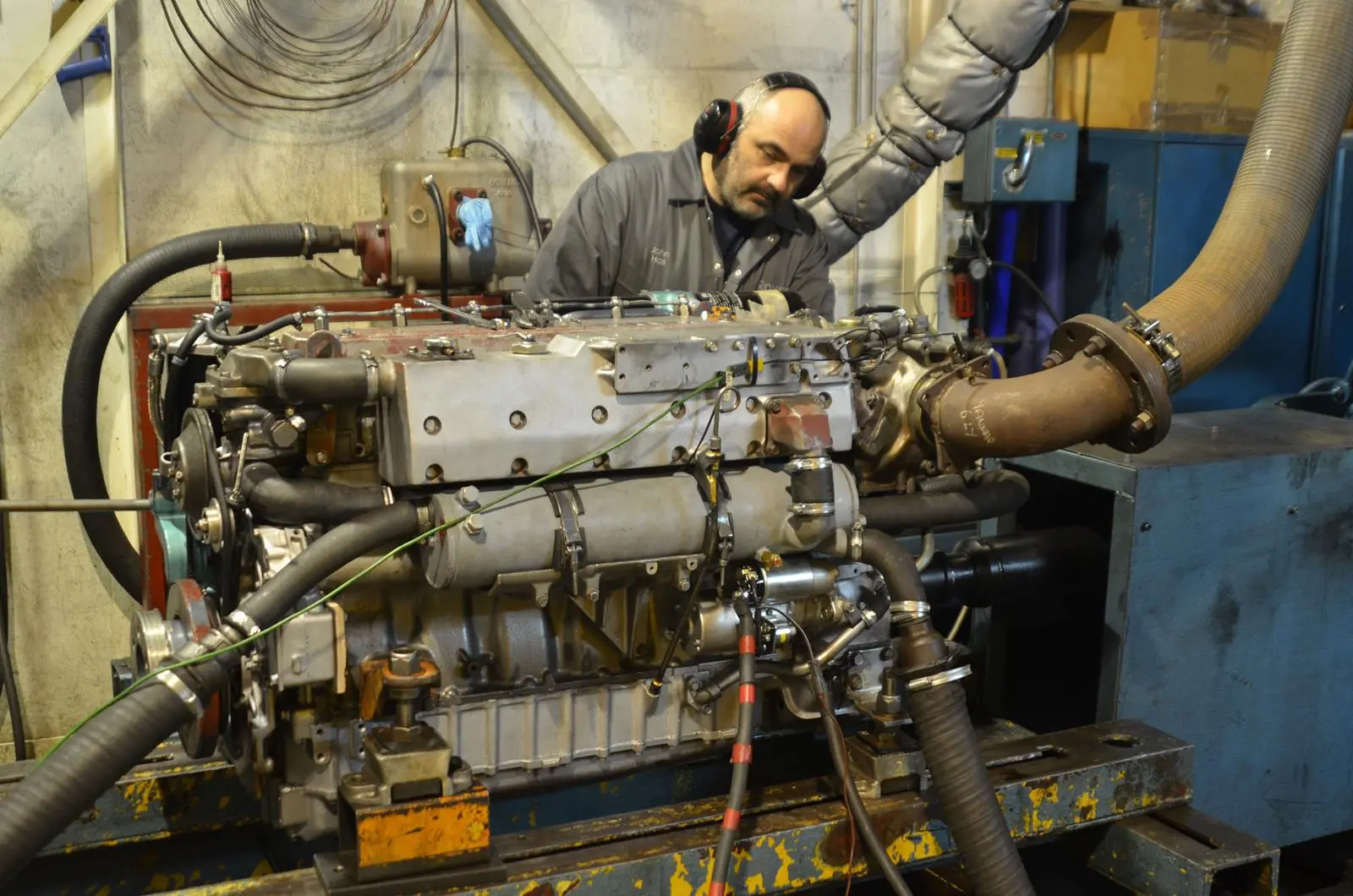
The equipment needed by Royston to maintain the high standards of workshop engineering at its premises is also enabling it to offer expertise and the use of a dynamometer to any organisation needing to test engines up to 2,000bhp. The company’s engineers regularly use this to measure the horsepower generated by engines that they have serviced or refurbished. Because such facilities are thought to be comparatively rare, possession of the dynamometer has consequently encouraged Royston to offer its engine testing facilities for use by a wider market and any organisation that needs to test an engine can have access to the dynamometer as necessary. This support, says the company, can extend to help with problem diagnosis and, if required, any subsequent servicing or repair work or the return of the engine for in-house repair.
Nowadays Royston services include the care of automation and control systems which enables the company’s service teams to support every aspect of its clients’ diesel engines. Royston markets and supports its own fuel monitoring system, known as ‘enginei’, which enables owners to remotely observe the fuel consumption of every vessel in the fleet and to ensure that they are being operated in a fuel-efficient and economical fashion.
With experience stretching back some 30 years, Royston believes that it has learned that success only comes by providing customers with what they want – and this, in its opinion, is the ability to assign the care of engines to a company regarded as being at the top of its game. Using one team to service both engines and generators are said to offer convenience and practicality, particularly when the service teams are said to know all there is to know about them, regardless of their make or age. Today ship operators are increasingly realising that the use of a service that is not confined to just one type of engine is more efficient and reliable, and is invariably the best financial option, says Royston.
The company regards itself as a leader in diesel engine technology offering a global reach in the provision of maintenance, repair and refurbishment services to clients in the marine and offshore industries. It believes its fleet maintenance capability enables it to offer an accomplished and practical service for all types of seagoing vessel as well as for diesel engines on offshore platforms or on land. The service engineers come from a variety of OEM backgrounds and work to ensure that their skills are kept at the highest levels, giving the breadth of expertise to ensure that even older or discontinued engines can remain fully operational and at peak performance. Royston has its headquarters and main workshops in Newcastle-upon-Tyne, UK and also has facilities in Perth, Australia
Related Articles
 PROPULSION
 GENERAL NEWS
 GENERAL NEWS