



Taking strides in shaftline monitoring
“For many years you would install the tailshaft, shut the bulkhead and not go back until something went wrong.” That’s how Martin Bignell, sales development manager for Wärtsilä Seals & Bearings, describes the shaftline monitoring regime for many ship operators in the past. Given the low component cost compared to the price of ship, that approach may have seemed reasonable. But the potential costs of a bearing or seal failure vastly outweigh the replacement cost – often a vessel will be put out of operation, and nine times out of ten such faults will incur a visit to the drydock, Bignell estimates.
It is no surprise then that as sensors and analytics evolve, the tailshaft is coming under greater scrutiny from efficiency seeking owners and operators. Recent class activity directed at extending overhaul times for water-lubricated shaftlines, dependent on condition monitoring, has only heightened the demand.
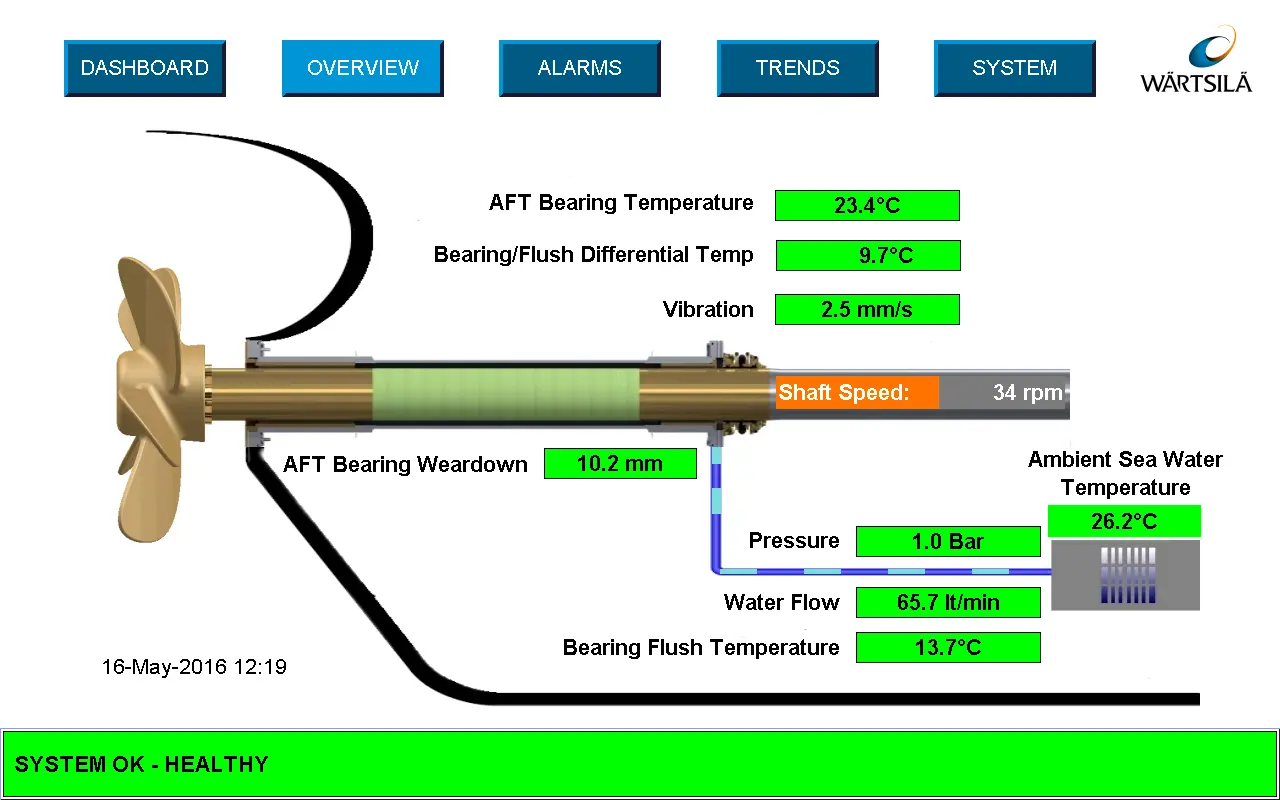
Wärtsilä was not the first to market with a shaftline monitoring solution but its Sea-Master system, launched at SMM last year, is the most comprehensive to date. The sensor suite includes a DNV GL type approved bearing wear gauge – a first in the industry – as well as other sensors measuring bearing temperature, lube (whether oil or seawater) temperature and pressure, shaft speed and vibration, system flush rates and (optionally) lubricant condition. Data is fed back to a display panel, also separately type approved, that offers clear, precise critical path information to crew.
“A lot of people offer condition monitoring with a focus on individual components,” says Bignell. “We are taking a holistic approach. Vibration is an indicator of underlying issues and the way the class requirements are structured for extended intervals, vibration and alignment are critical measures. But we look at system flush rates as well, for example, so we can understand what is happening both when the vessel is idle or loading, where there is a requirement to keep the system flushed and to rotate the propellers.”
The prime example of class notations aiming to extend intervals is DNV GL’s T-MON (tailshaft monitoring) notation, which can offer almost unlimited periods between inspections if all conditions are met. The notation relies on modern monitoring capabilities to enable operators to reduce lifecycle costs.
Bignell explains: “Cost of ownership is critical, and an area that will in the future need even more stringent control. There is typically a requirement to remove rudder, propeller, shaft for inspection every five years for water-lubricated shaftlines. Sea-Master helps to predict the condition of the tailshaft, so a vessel coming in for its five-year drydock potentially no longer needs to have a tailshaft inspection. That can save up to a week on the drydocking time.”
Greater insight into the condition of components also helps to prevent unplanned maintenance, and enables fleet owners to track how their assets are being used. For Wärtsilä, part of the appeal in providing a comprehensive solution was to be ready for evolving demands from owners and operators seeking more data to enable vessel optimisation, says Bignell.
“This moves us towards a future where we can get more from sensors, greater analytics and more useful data. As we move into this digital shipping age, this starts our journey.”
The journey developing Sea-Master began more than two years ago, and the system has since been tested on three vessels. In September 2016 a megayacht was fitted with Sea-Master, and more vessels will be announced early this year – including the first two in a series of commercial vessels featuring water-lubricated shafts.
While the system can be used to monitor both oil-lubricated and water-lubricated shaftlines, the growing trend towards water lubrication was a clear driving force behind the development. “We’ve operated water-lubricated shafts for 40 years – navy vessels have been using water for a long time – and we’re starting to see commercial vessels switch over,” says Bignell.
That trend is driven by environmental factors such as the US Environmental Protection Agency’s Vessel General Permit, which requires ships to use ‘environmentally acceptable’ lubricants to minimise pollution caused by leakages. But there are design advantages too, from eliminating the multiple reservoirs needed for oil-based systems. The extension of overhauls between inspections enabled by shaftline monitoring and new class notations now remove a significant barrier to choosing water lubrication.
Bignell notes that the system is compatible with other Wärtsilä systems – it can be integrated into navigation systems for example, allowing data to be viewed side-by-side – and complements a wide range of services offered by company. These range from all shaftline components through condition services – including shaft alignment – through to lifecycle support via Wärtsilä Genius service agreements.
“Our goal is to help our customers optimise their operations by providing safe, reliable and environmentally sound solutions that ensure the health of their equipment,” Bignell concludes. “This goal steers our product development and digital initiatives. Sea-Master is a good example of the advances offered by digitalisation to the maintenance of propulsion technology.”
Related Articles
 PROPULSION
 GENERAL NEWS
 GENERAL NEWS