



The best of both worlds
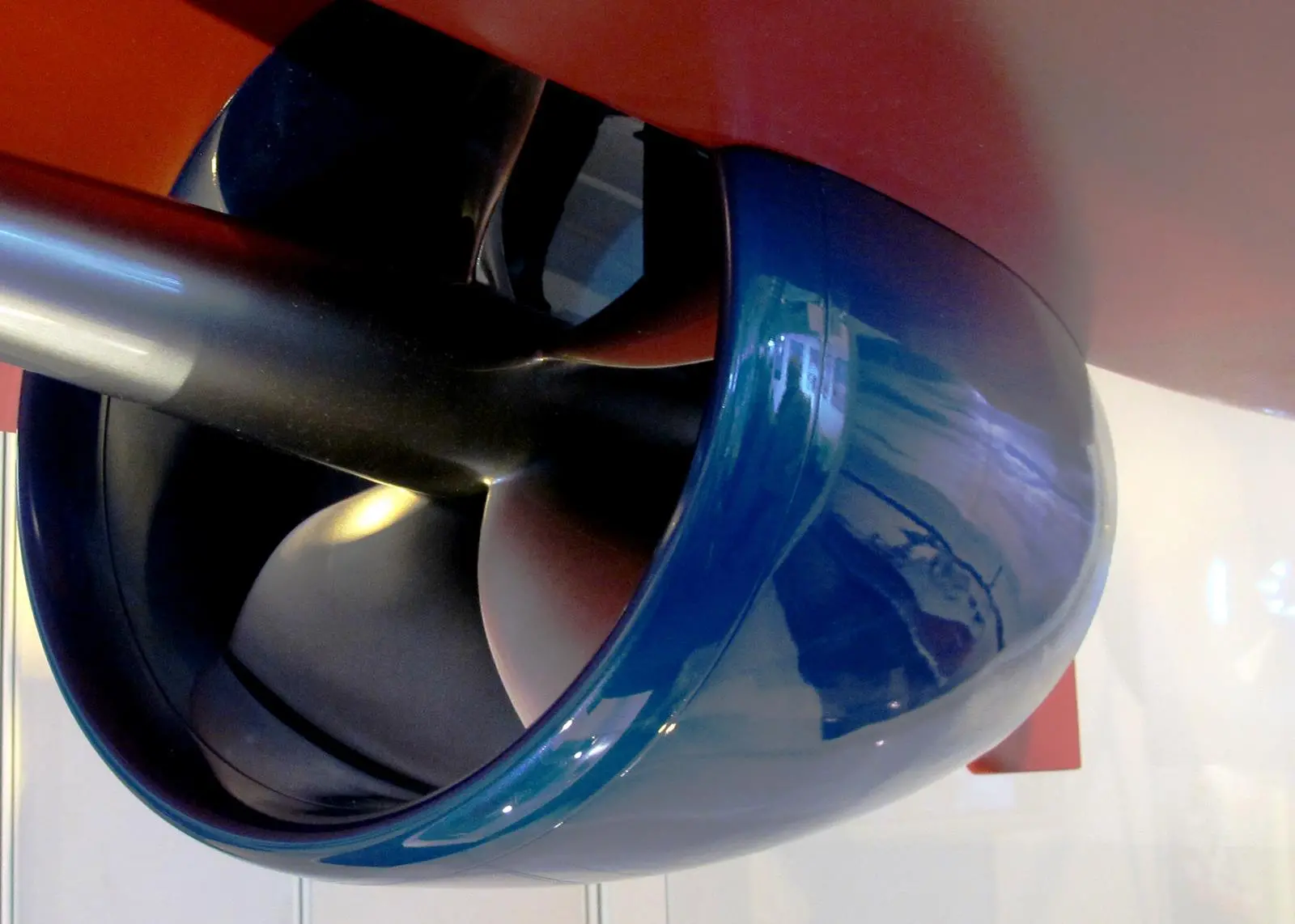
Following sea trials with the system fitted to a wind farm support vessel, Voith Turbo’s marine manager, Mark Harvey, says: “We believe the Voith Linear Jet is a significant breakthrough in world marine propulsion systems that takes the best elements of two existing technologies: the conventional screw propeller and water jets.”
In developing the Linear Jet the company looked at the problems associated with the two systems – the heavy weight and complexity of water jets and the relatively low efficiency of screw propellers. “We were looking at finding a middle ground where we could harness the best parts of these two propulsion systems and try to develop a more efficient system”, comments Harvey. “The Linear Jet has the propeller and shaft of conventional propulsion systems and this operates in a tunnel in much the same way as a water jet, but there the similarity ends.”
The Linear Jet features a rotor that is similar to that used in a water jet, which operates inside a tapered nozzle that is fitted with a stator to recover the swirl energy associated with propellers. In this respect the Linear Jet can benefit from the increased thrust energy that is a feature of water jets, without the complex control systems of the water jet required to achieve steering and reverse. By operating the propeller in the controlled environment within the nozzle there have been significant efficiency gains over a conventional propeller.
One of the main development challenges was the design of the nozzle. This nozzle creates increased friction from the water flow and much of the development was aimed at reducing this resistance as much as possible whilst at the same time compensating with increased propeller thrust. The final concept has the tapering nozzle located in a semi-tunnel that is shaped into the hull. These semi-tunnels are similar to those found on many propeller-driven vessels in order to get a more efficient horizontal propeller shaft and to reduce the draft. With the Linear Jet, the semi-tunnel feeds the water flow into the nozzle where it is accelerated by the propeller. A conventional rudder located behind the nozzle provides steering and the propeller in the nozzle can operate effectively in reverse.
Maintaining hull draft
The nozzle can be fully integrated into the hull semi-tunnel so that it is only slightly lower that the hull draft. Where draft is critical the nozzle can be made virtually flush to the hull, affording good protection for the propeller. The nozzle can be constructed from material that is compatible with the hull with composites, aluminium or steel all suitable materials. The propeller in the Linear Jet has larger clearances than those used on water jets, which will help to reduce any erosion problems.
The design of the stator located aft of the propeller has been carefully shaped to produce a parallel water flow as it emerges from the aft end, maximising thrust. The stator also provides a support bearing for the aft end of the propeller shaft, so no additional shaft brackets are required. As this is a water lubricated bearing, maintenance requirements are low. Marine growth is reduced and would be easily accessible for diver clearance, as opposed to the problems that such growth can cause for water jets.
The Linear Jet is claimed to make significant reductions in both noise and vibration, give a good increase in the available bollard pull and produce higher top speeds with the same engines and hull design. Turbine Transfers fitted the Linear Jet to its latest wind farm vessel. Alistair Knowles, marine superintendent notes that measured noise levels were down to about 62 decibels “and we could chat comfortably without raising our voices even at high speeds”.
“The Linear Jet is phenomenal,” Knowles adds. “It is extremely fuel efficient for a vessel of its size, so it is able to run at 25 knots under reduced power and with a fuel consumption that is comparable to smaller and less capable boats.”
Voith plans to offer the Linear Jet in versions that can absorb power outputs from 500kW up to 25,000kW, which should make it an effective propulsion system for a wide variety of vessels ranging from smaller workboats up to large fast ferries. It is claimed to retain its efficiency up to speeds of 40 knots which covers most applications in the commercial and military sectors as well as performance yachts.
Related Articles
 PROPULSION
 GENERAL NEWS
 GENERAL NEWS