



The new Klondike
The extraction of minerals from the seabed is gaining increased attention globally, most recently with the announcement in June that the Norwegian government plans to allow the mining of its continental shelf for “crucial metals for the global energy transition”. But regulation, rules, and standards are needed before prospectors start rushing to this new “Klondike”.
While mining the ocean floor at water depths of = between 1000m and 6000m will undoubtedly benefit from offshore oil and gas industry experience, the recent tragedy surrounding the Titan submersible serves only to remind us of the dangers involved in navigating the deep. And although subsea mining vessels will be unmanned, there is still a risk of equipment loss, pollution, and accidents aboard the surface vessel. From a technical perspective, seabed mining is in uncharted territory.
Jonathan Struwe, Inspection Engineer and Surveyor, Underwater Technology, at Norway-headquartered classification society DNV, which is assisting the International Seabed Authority in the development of guidelines, said the technology required for subsea mining at these depths needs to be certified for safety and environmental reasons.
He said that while it is unlikely these unmanned subsea mining machines will need to carry out complicated tasks, they will be high voltage, requiring a huge amount of power and a lot of interaction with the human interface. “In theory, this means there are requirements for certification but there is currently no international regulation in place.”
According to DNV’s Chief Specialist, Environment, Jens Laugesen, one of the main technical challenges is getting the mined minerals and metals from the seabed to the surface. “I think one of the most difficult tasks will be pumping it up through a riser up to 6km from the seabed to the surface. The development of mining equipment is relatively possible, it will need to withstand higher pressures; but the riser and getting it up is a tricky part,” he said, adding that a pilot test last year saw 3000 tonnes of nodules brought up through a 4300m riser to a surface vessel.
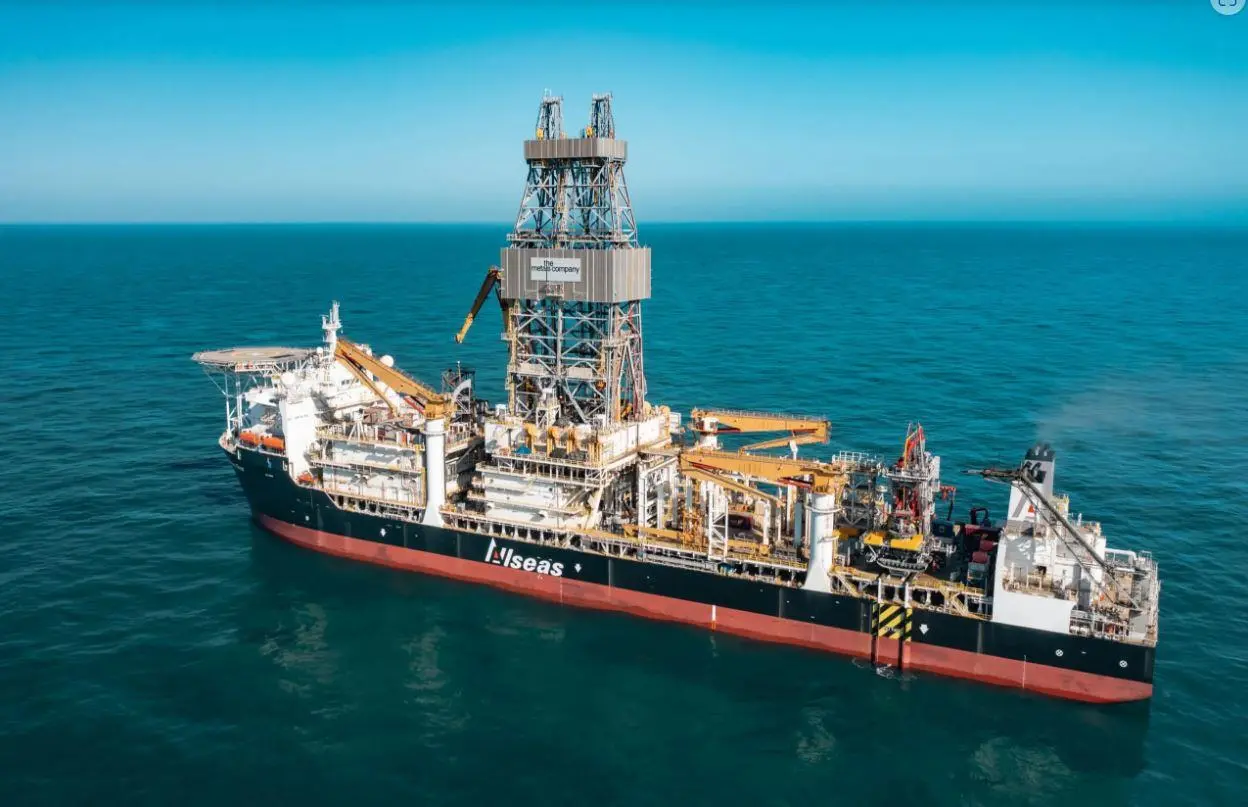
That surface vessel was Hidden Gem, a 228m long ultra-deepwater drill ship previously called Vitoria 10000, which Allseas converted to a polymetallic nodule collection vessel in 2021. In November that year, The Metals Company and Allseas successfully trialled their jointly developed deep-sea mineral collection system to responsibly recover polymetallic nodules from the ocean floor and transfer them to a surface vessel for transportation to shore.
The Metals Company is currently undertaking the world’s largest integrated ocean surface-to-seabed research programme to fully understand the impact of collecting nodules from the ocean floor.
Nevertheless, despite this success, Laugesen believes that the first mining expeditions will see all finds and surplus materials being taken up from the seabed and shipped to shore since there is no vessel currently capable of de-watering the surfaced material and residual waste in such volumes.
“The processing of the mineral material that is taken up would need a whole processing plant on board the ship to separate out the metals. That is not feasible at the moment, and some say it will never happen. They say it we will always have to transport the material to land. That is feasible and I think what every vessel will do is to de-water the material at sea,” he said,
While seabed mining holds promise for resource extraction, containing valuable metals such as silver, gold, copper, manganese, cobalt, zinc and other important elements, the primary concern is the potential disruption of fragile ecosystems and biodiversity.
The deep sea is home to unique and potentially undiscovered species that may be adversely affected by mining operations. The plumes created during the extraction process could also have a long-term impact on the environment and human impact, releasing toxic substances and heavy metals into the water column. Additionally, noise pollution generated by mining equipment could disrupt marine mammals’ communication and migratory patterns.
Indeed, when DNVs research department in 2014 started looking at the impacts of deep-sea mining in 2014 they quickly identified the environment as the most important consideration, subsequently publishing a recommended practice but “there is still a lack of information about life on the seabed, and what will happen down there if you start a [mining] operation,” said Laugesen.
For its part, the Norwegian government has stressed that extraction permits for national waters on the Norwegian continental shelf will only be given once environmental sustainability has been demonstrated.
In a statement published in June, Norwegian Minister of Petroleum and Energy, Terje Aasland, stated: “Norway has significant anticipated mineral resources on the seabed. If proven to be profitable and extraction can be done sustainably, seabed mineral activities can contribute to value creation and employment in Norway while ensuring the supply of crucial metals for the global energy transition. Extraction of minerals could become a new and important industry for Norway.”
Not everyone agrees. Some member states of the International Seabed Authority, namely Canada, France and Germany, want to slow development down due to the lack of hard environmental knowledge. And during its 27th session, ISA decided among others to progress the development of environmental threshold values as binding standards as part of the ongoing development of standards and guidelines that support the development of the draft regulations on the exploitation of mineral resources in international waters (defined as the Area).
Nevertheless, if seabed mining does increase – and there are currently about 30 subsea mining projects that have been granted exploration licences in international waters by ISA – there will be a need for constant and extensive monitoring of the seabed to ensure the environment is not adversely affected. (To date, no licences have granted for exploitation.)
In 2021 ISA published Technical Study No. 29 concerning how remote monitoring technologies in addition to physical inspections can be used in the inspection regime for monitoring of all mining activities. The study, carried out by DNV, has been used by ISA in the ongoing work with the inspection regime that will be a part of the regulations for exploitation of seabed minerals.
The ISA council, which met in Kingston, Jamaica, in July had hoped to complete the adoption of the relevant rules and regulation within two years of a request for exploitation. The Metals Company submitted a request in June 2021, which has now expired.
Related Articles
 METHANOL
 MONITORING, CONTROL & DIGITALISATION
 MONITORING, CONTROL & DIGITALISATION