



The return of coal-fired steam ship propulsion
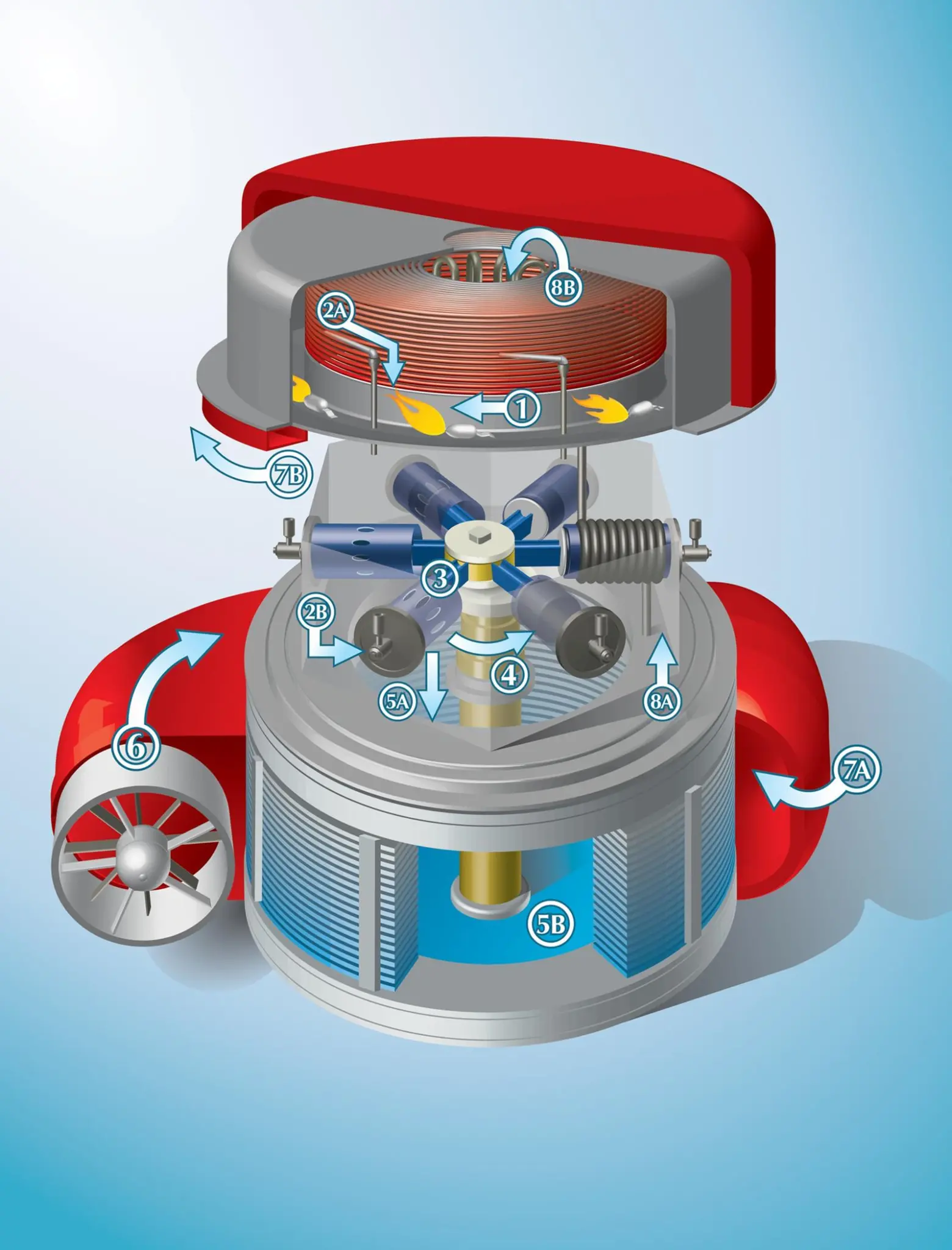
The design – known as the Cyclone Power Mark V engine – has been developed to operate on any type of fuel, including powdered coal. At present Cyclone has a 100hp test unit up and running in a boat and a 350hp unit is under development. Not only is this new development exciting because of the flexibility of steam power but this new concept of steam engine offers good ‘green’ credentials.
The new engine concept has been developed by Cyclone Power based in Florida. They have developed the engine around a radial format, with six cylinders, to give a very compact arrangement. The pistons drive an eccentric spider wheel which in turn links to the crankshaft, and because the engine does not require a cooling system, this part of the unit is more compact than that of an internal combustion engine of equivalent power rating.
The whole engine unit comprises three layers. At the top is the steam generator and below this is the actual radial engine unit. At the bottom are the condenser and the blowers that first of all send air through the plate condenser, and then upwards to provide the air for combustion in the steam generator.
For generating steam, the team has done away with the conventional boiler that was used on steam ships. Instead the steam is generated in a series of coiled stainless steel narrow diameter tubes. On the 100hp unit these tubes are around 4mm in diameter so they are able to withstand much higher pressures than would be possible in a conventional boiler. Should the pressure build up through an unforeseen problem then, as one team member said, “The tube would just go pop rather than explode as might be the case with a conventional boiler”. Another advantage of this steam generator is that it can be at working pressure within 10s of activation, so starting is virtually instantaneous.
The steam generator has the steam coils located at its centre with the combustion taking place in the circular chamber around the coils. The combustion air is fed in at an angle so that it sets up a circular flow in the chamber and fuel is then injected in with combustion started with igniters around the circumference. One advantage claimed for this circular flow is that any soot particles are thrown against the combustion chamber walls by centrifugal force where they are eventually burnt off, thus making the exhaust virtually particle free.
The steam, at pressures of over 2,000lb/in2 (130bar), is fed from the generator to the cylinders via a spider network of piping. Valves in the cylinder heads control the inlet of steam to each cylinder. After the power stroke the steam exits through an exposed port in the cylinder wall where it then goes to the condenser and the sequence starts again. In total the 100hp engine holds about 2.5 US gallons (10 litres) of water in the closed circuit system.
A unique feature of this engine is that it requires no lubricating oil. Harry Schoell, the leader of the development team, has experimented with water lubrication for the past 10 years and felt it could now be applied to this steam engine. “With the advent of new ceramic bearing materials I felt that the time was ripe to use water lubrication in this steam engine and so far we have been very pleased with the results”. The use of water lubrication not only reduces costs but improves the ‘green’ credentials of the engine.
The torque of a steam engine is very high, so that the engine develops a very high thrust at low speeds, and because it is also reversible no transmission is required. Further weight and cost savings are achieved by not requiring a starter motor, silencer and cooling system apart from the condenser. The designers claim that this engine will be able to operate on virtually any fuel such as gas and bio-fuels – which will cut exhaust emissions – as well as conventional diesel and powdered coal. Frankie Fruge, CEO of Cyclone Power, is excited by the possibilities of using powdered coal. “We have run the engine on this fuel for short periods and we know it works but there could be problems with abrasion in the injectors over a longer period and we need to spend more time studying this aspect. It could have a huge impact on the future of transport if coal could be used as a fuel, the world has huge stocks of coal that at present is considered to be a dirty fuel.”
The Cyclone engine is claimed to have an efficiency of around 30% at this stage of development, and is larger than a comparable diesel engine, but is still able to fit into a boat. The team is confident that the design can be scaled up in size and the 350hp unit is the next stage of development. At present the marine application is likely to be as a prime mover for generators although there are plans to put two of the 350hp units into a 50ft motor boat as the main engines. The quiet running of the engine could be a bonus for the generator application.
To prove the potential of this new steam engine, Cyclone Power has installed one of the first units into a 7m boat, which the company plans to use to break the world speed record for steam power on the water. This currently stands at 45 mile/h and was set way back in the early 1900s. A speed of around 60mile/h is expected.
The unit has attracted interest from the automotive industry, as well as from Raytheon, to power submarines. A 5hp Cyclone engine has been developed to harness power from solar heat and there is a 12 cylinder version of the engine in the factory. Record attempts, on land and sea, this year will help to establish the credentials of this new type of steam engine, which the designers are calling an external combustion engine.
Related Articles
 PROPULSION
 GENERAL NEWS
 GENERAL NEWS