Thrusters and DP critical to WTIV operation
The first-ever Jones Act compliant offshore wind turbine installation vessel (WTIV), the Charybdis, is nearing completion at Seatrium AmFELS in Brownsville, Texas. Upon delivery, it will be owned and operated by Blue Ocean Energy Marine, a subsidiary of Dominion Energy, and will start operation on the Coastal Virginia Offshore Wind project, the largest offshore wind project in the United States.
The self-propelled, self-elevating GUSTO NG-16000XL design vessel is 144 x 56 metres and has a draught of 11.5 metres. It is equipped with a crane capable of lifting up to 2,200 tonnes and has an accommodation capacity of up to 119 people.
WTIVs have distinct operating modes (loading, sailing, DP, jacking and installation). They need to lift the complete weight of the vessel during installation operations, so power systems need to support this as well as ensuring DP, sailing and manoeuvring capabilities are maintained to the highest standard.
Kongsberg Maritime has supplied an extensive and fully integrated equipment package to Charybdis including engines, thrusters, deck machinery, electrical systems, DP, marine automation, safety, navigation, and telecommunication systems. “The integration of these systems ensures seamless operation and enhanced reliability, leveraging proven technology specifically designed for this type of vessel,” said Tommy Andree Hove, sales director – advanced offshore units, at Kongsberg Maritime.
The propulsion system features six Bergen Engines (B33:45L8A) and a combination of Kongsberg Maritime Z-drive and combi thrusters, providing robust and efficient manoeuvrability. The thruster models are 4 x US 305 FP Z-drive / 3,200kW / 3.2m propeller, 2 x ULE 355 FP Combi / 3,700kW / 3.5m propeller and 1 x UL 355 FP / 3,700kW / 3.5m propeller.
The electrical system includes generators, medium and low voltage switchboards, propulsion drives, transformers, shore connection, and UPS, all designed to ensure a stable and reliable power supply.
“The dynamic positioning (DP2) and thruster control systems, along with marine automation and safety systems, offer precise control and enhanced safety. Additionally, the navigation and K-Bridge systems, along with a comprehensive telecommunication suite, ensure effective communication and operational efficiency. This integrated approach highlights Kongsberg Maritime’s commitment to delivering advanced and reliable solutions for the offshore wind industry.”
The project was enrolled into the U.S. Coast Guard’s NVIC 10-82 and 10-92 programs which delegated the majority of statutory inspections and plan approval to ABS. Rob Langford, ABS Vice President, Global Offshore Renewables, said the DP system is built to ABS DP2 classification requirements and is a highly redundant system that can maintain the vessel’s position even if faced with a single component failure. “With our extensive knowledge of U.S. regulations and with our longstanding offshore industry leadership, ABS is the ideal partner for the Charybdis.”
As the first Jones Act WTIV, Charybdis would be available for projects in U.S. waters, eliminating the need for foreign-flagged WTIVs to have local vessels deliver turbines to them to meet Jones Act requirements.
The global WTIV fleet continues to grow in size and number as offshore wind projects get underway further from shore.
In August last year, Kongsberg Maritime secured a contract from COSCO Shipping Heavy Industry to supply a package of mission-critical technology for the latest WTIV which is currently under construction for Cadeler. This is the fifth Cadeler WTIV to be built at COSCO’s Qidong yard, all equipped with Kongsberg Maritime systems.
The new GUSTO NG-20000X design vessel will have a complete electrical, automation and propulsion system from Kongsberg Maritime which features nine thrusters, all with fixed-pitch propellers. The package comprises four UUC355FP main propulsion thrusters, two ULE355FP retractable azimuth thrusters, and two TT3300DPNFP tunnel thrusters to provide additional lateral manoeuvrability.
Kongsberg Maritime introduced the UUC355FP, a new member of its underwater mountable azimuth thruster range in July 2024. The thruster has a 3.7-metre propeller and 4.2MW power output. It features an integrated permanent magnet motor that delivers 81 tonnes of bollard pull while requiring less space in machine rooms than comparable systems. Other features of the new thruster included low noise operation, less lubricating oil volume, and no oil-to-sea interfaces.
The retractable thrusters provide the full manoeuvring and positioning capability of an azimuth thruster, without affecting the draft or running resistance of the vessel, when the propulsive power is not needed. They also provide redundancy and “take me home” capability to the vessel.
The electrical system includes generators, medium and low voltage switchboards, DC switchboards, energy storage system, and propulsion drives in addition to an integrated control system, including a DP system. Tailored energy control functions also optimise the vessel’s energy efficiency, and the battery-hybrid electrical system can reduce the number of engines required for crane operations and manoeuvring.
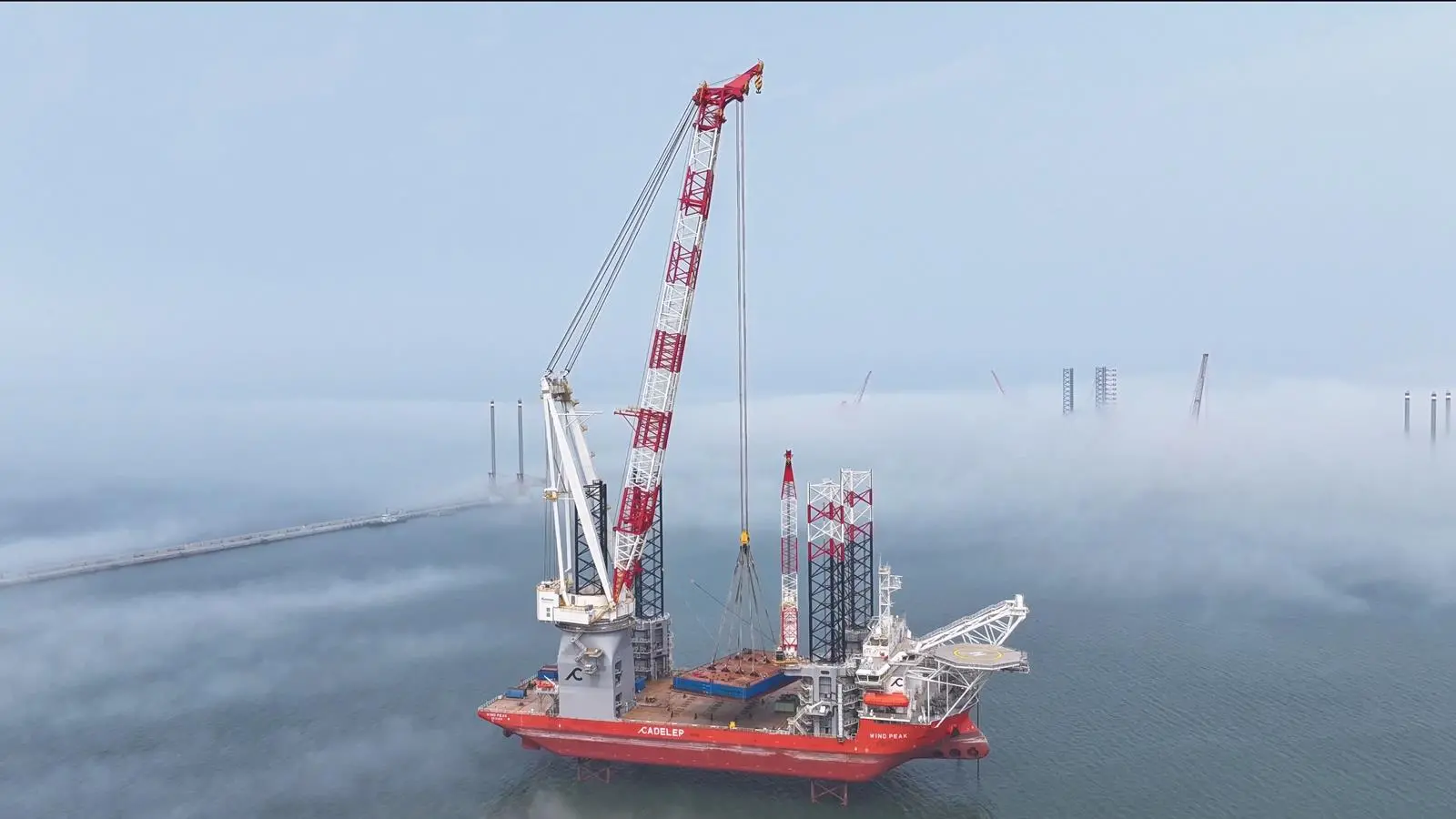
Cadeler latest deliveries include the P-class Wind Peak and sister vessel Wind Pace which also feature Kongsberg Maritime technology, as do the A-class Wind Ally, Wind Ace, and Wind Apex currently under construction.
Wind Peak and Wind Pace can transport and install seven complete 15MW turbines or five sets of 20MW+ turbines. They are the largest vessels in the Cadeler fleet, and are 162 x 60 metres, have draught of 9.7 metres, a total deck space of 5,600 square metres, a payload capacity of over 17,600 tonnes, and a Huisman main crane capable of lifting more than 2,500 tonnes at 53 metres
Kongsberg Maritime is supplying the hybrid electric power and energy management systems. The vessels also feature four Kongsberg Maritime azimuth thrusters, two retractable thrusters and three tunnel thrusters. Kongsberg Maritime’s DP system cooperates with the integrated propulsion system, energy control system and sensors, to ensure accurate operation with heavy loads.
The company says its WTIV solution substantially reduces the costs associated with wind farm installation projects. Shipyards will save engineering hours and cabling and installation work, while owners and operators will see lower operating expenses. Tailored energy control functions optimise the vessels’ energy efficiency, and the battery-hybrid electrical system includes advanced ThrustAllocator™ and PowerBoost™ functionalities that can reduce the number of engines online and the amount of fuel required for crane operations and DP manoeuvring.
Kongsberg Maritime is now expanding into floating offshore wind construction technology with two new floating wind installation vessel designs (WTIVs): an anchor handler designed to handle large dragging anchors and a large subsea construction vessel with mooring system installation capabilities. The high-thrust propulsion for the large anchor handler is provided by a triple azimuth thruster configuration at the stern, which offers enhanced station keeping, high bollard pull of around 300 tonnes and DP redundancy.
The company has also developed Tow Assist which enables unpowered floating turbine structures to become DP-enabled during towing and positioning operations.
Martinus Løken, Kongsberg Maritime’s aftermarket sales manager, says towing completed floating turbines to location is a key challenge for operators. With Tow Assist, temporary positioning equipment is installed onboard the turbine and linked wirelessly to the connected towing vessels, which are equipped with DP systems.
Real-time data on position and heading, along with thruster and winch status, is transferred wirelessly to the Tow Assist master computer, located on the lead vessel. Then the connected vessels, ideally three of them, act as thrusters for the floating structure.
“We’re essentially providing a decentralised DP operation to a floating object. We can measure the position of the floater and the position of the connected vessels, and then we can establish a model for the precise positioning of the unit, either for station keeping or moving along a trajectory in a controlled manner.
“This approach is particularly useful when getting the floating structure into the exact position for attaching anchors, or hook-up. However, we believe it should be used for the entire journey from shore to field, as it offers optimal performance of the vessels. We’re going to see more and more of these structures being transported in different parts of the world, where there will be different levels of seaborne traffic and other obstacles to navigate, so all parts of the towing journey can be enhanced.”
The key benefits of the Tow Assist System are optimised vessel usage, optimised operational efficiency, increased hook-up weather window, improved situational awareness, reduced fuel consumption and improved safety. In summer 2024, Kongsberg Maritime demonstrated the Tow Assist System’s capabilities during a successful trial at the Hywind Scotland offshore wind farm off the coast of Aberdeen, and the system is now set to be commercially available this year.