



Thun Puts Down Another Building Block
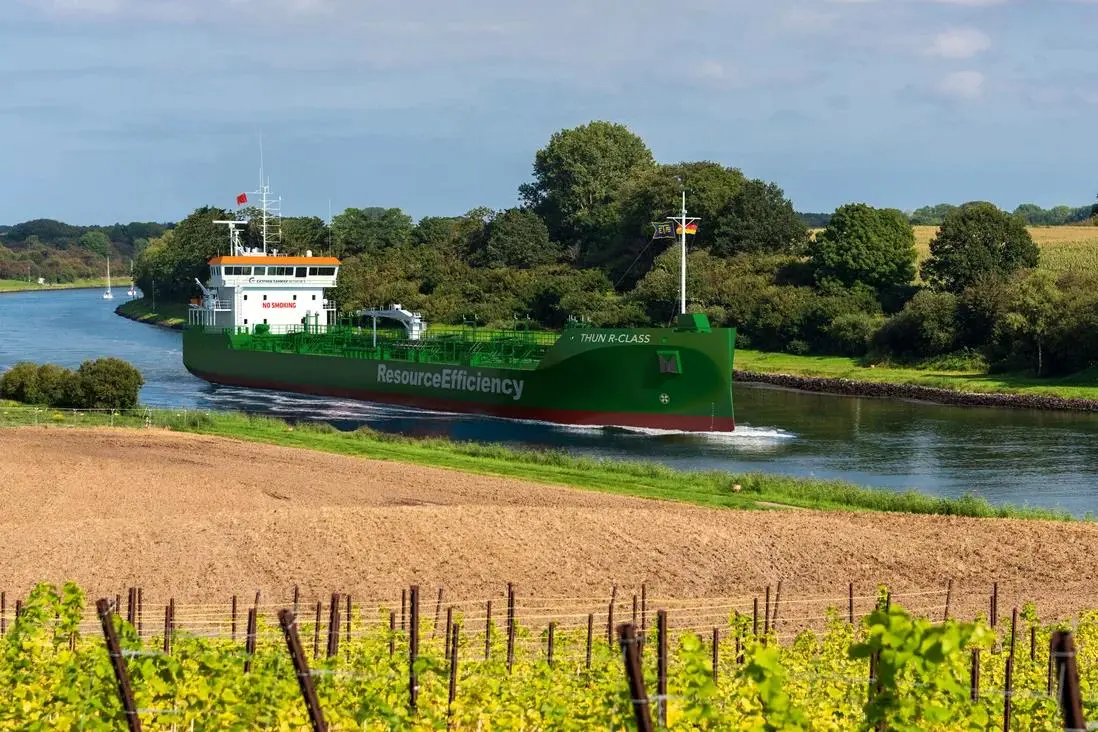
Hard on the heels of the realisation of the company’s E-class newbuild programme, two vessels of the derivative R-class type have been booked from Dutch contractor Ferus Smit.
With the R designation denoting “resource efficiency, environmental responsibility, and logistical reliability”, the latest product carrier concept is embodied in a 7,999dwt class offering a cargo capacity of around 9,600m3. The vessels are due to be delivered within the first half of 2024 from the Westerbroek yard on the Winschoterdiep waterway in the north Netherlands.
While the new 115m pair will have main dimensions identical to those of the E-class coastal tankers, a higher level of compartmentalisation will be incorporated, entailing 13 cargo tanks rather than the nine in the forerunner vessels. Moreover, the LNG dual-fuel primary power adopted for the Thun Eos quartet will not be perpetuated in the R-type, for which a battery/diesel hybrid arrangement has been specified.
The adaptive propulsion system will minimise energy usage, through recourse to a UPS (uninterruptible power supply) battery pack. The shipbuilder states that the main engine in each of the new tankers will be of 1,950kW. By comparison, the Wartsila 6L34DF installation in the E-class is rated at 2,999kW. The vessels’ electrical outfit will also be prepared for connection to the landside grid when alongside in port.
“The scope for the R-class series has been to build the most resource efficient vessels available for the trade, with minimal environmental impact,” said Thun Tankers’ chief commercial officer (CCO) Joakim Lund. “Thun’s long experience of building high performing, quality vessels has been used in the design process. We have been combining this with a number of new features to further improve performance while reducing our climate footprint,” he added.
As with the E-class, the next generation has been developed to better ensure long-term viability in the intensive and highly competitive north European traffic, working from refineries to depots, storage terminals and industrial users, and on inter-refinery movements. Reinforced and fitted to Ice Class 1A criteria, the trading capability extends to unfettered, year-round Baltic navigation.
The cargo spaces will be treated with Jotun Tankguard coatings to give the requisite resistance and facilitate the short cleaning and turnaround times demanded in the coastal/shortsea business.
The latest order has strengthened a longstanding business relationship, whereby Thun Tankers’ parent Swedish shipowing group, Erik Thun, has had some 40 dry cargo vessels and tankers from the Dutch shipbuilder over the years. The tally includes 16 tankers, the most recent deliveries being two 4,250dwt NaabsaMAX coastal traders from Ferus Smit’s German subsidiary in Leer, following the Thun Eos quartet from Westerbroek between 2018 and 2021.
Thun Tankers’ registered office is in the coastal community of Farmsum, in Groningen province, with commercial operations centred in Gothenburg. Technical management and manning of the R-class will be entrusted to the MF Shipping Group of Farmsum. On delivery, the vessels will be entered into the Gothia Tanker Alliance, the Gothenburg-headquartered cooperative venture which holds shipment contracts with oil majors and traders, primarily across northwest Europe.
Related Articles
 METHANOL
 GENERAL NEWS
 HYDROGEN