



Twists and turns to an LNG story
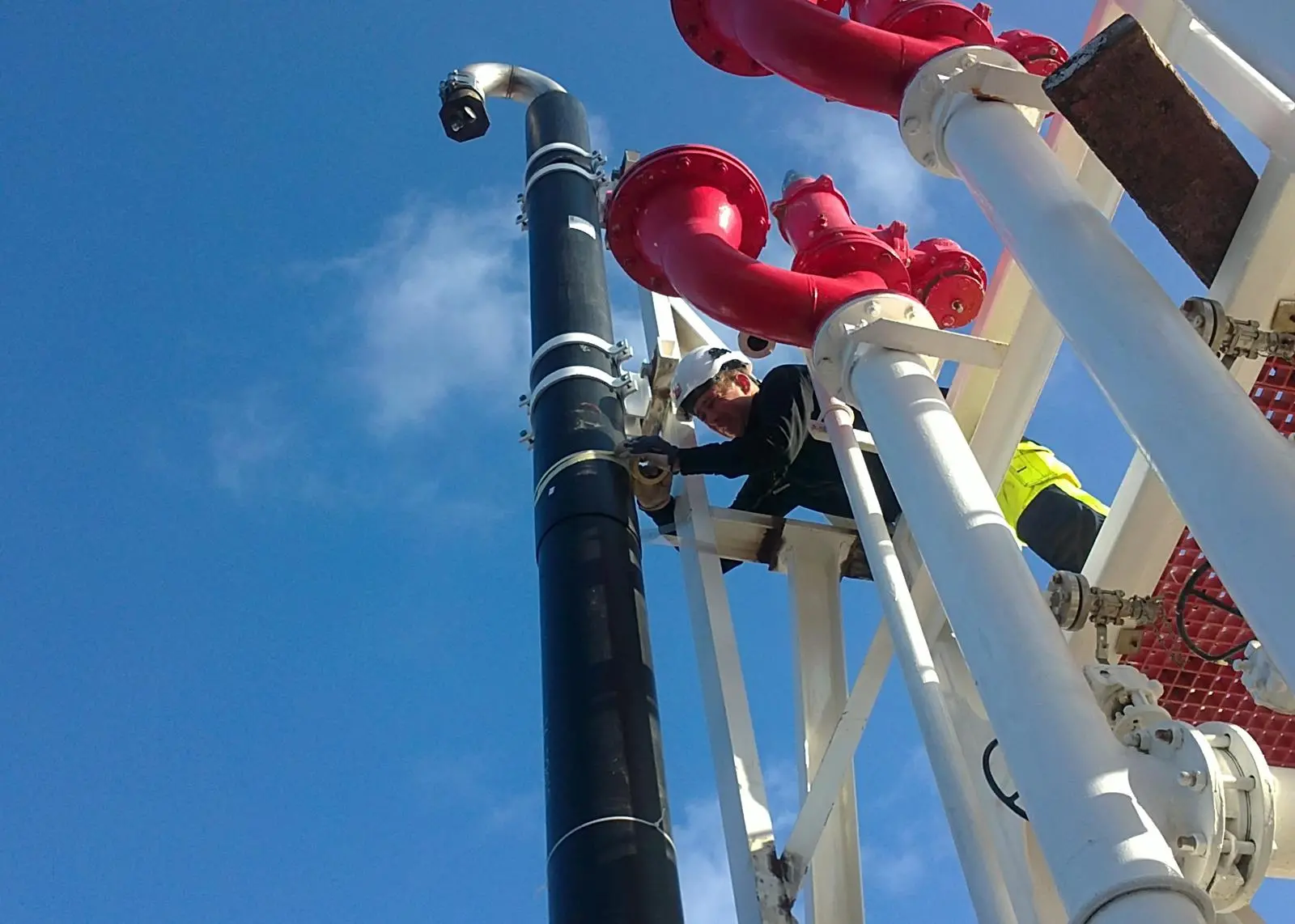
These long term partners supplied tanks, piping and welding for the 25,000 dwt product tanker: unlike normal pipes which have to be insulated on site, these have a stainless steel inner carrier pipe in the centre, covered by high-density polyurethane (PE-HD) insulation, which in turn is protected by a slightly elastic outer high-density polyethylene cover, itself extremely tough.
David Appelblad of Mittel explains the pipes have evolved through a number of applications, from land-side domestic systems to industrial hydro projects where temperatures can plummet to extreme lows – a point that needs considering. Mr Appelblad adds: “The temperature of the LNG pipework is shifting all the time with the engine draw, so it can vary by an enormous amount, with a range of around 180 degrees Celcius as it tips between the LNG temperature of minus 160 degrees and close to the ambient air temperature.” This obviously puts enormous strain on the pipe work and means that it needs the extra ability to expand, contract and flex.
One of the most relevant properties of the piping is the very effective polyurethane insulation. “It is both really dense and compact – it only adds between 5cm and 8.5cm thickness – and its properties are not just a blessing when you are dealing with liquids that run at such extremely cold temperatures, but also when you are working with extremely tight void spaces,” says Mr Appelblad.
In fact, the insulation layers are graded, with the slightly thicker layers in the bunkering section being between 82mm and 75 mm. Fulfilling a slightly different task, the pipes used to feed the engines have a 50mm layer but also have a heat cable inside; the purpose of this is to gradually increase the temperature of the gas before it reaches the engines. These pipes are designed with a ‘box’ section to allow for significant longitudinal expansion.
And of course, no part must be exposed. So, the welds needed to be sealed hermetically tight to withstand temperatures down to -160 degrees Celsius (-260 Fahrenheit). The absolute necessity for perfectly sealed joints rests on avoiding the creation of any kind of thermal bridge: as either positive or negative heat energy flows through the path with the least resistance, it “short circuits” via any element with a higher conductivity than surrounding material, resulting in condensation and ice – and consequently damage.
The extra problem here of course is the fitting of the pipes around the ship’s existing installation. “It actually results in an incredible amount of angles and elbows,” points out Mr Appelblad. In fact, 600 metres of piping was delivered by KWH in 153 sections with a plan that involved just under 200 joints. “There was nothing straightforward on the whole installation,” he comments.
Normally, the joints are the weakest links in any energy system, but here there was no room for lowering the overall integrity of the piping. So, Mittel’s TSC (two-step casing) weld method was used: this means bringing the inner stainless cores together with a metal bridge that pins the two in place. Outside this a polyethylene cuff links the two insulation layers and insulant is pumped into the void. Pressure and electricity – introduced through the metal bridge – are used to bond the whole together.
To be sure of the long term viability of the LNG joints onboard the Bit Viking, every single one was tested by X-ray.
The schedule also threw up a challenge, and Mr Appelblad points out that, of course, “everything had to run like clockwork, with a very intensive planning process”. However, he adds “The TSC joints turned out to be of particular value during the last, time-constrained stages of the project, because it allowed the team to compensate for on-site adjustments made during the installation.”
However, the project did have the advantage of continuity: the ship was originally designed by Wärtsilä and the new installation was carried out using the Wärtsilä LNGPac system for both the LNG propulsion and the tanks onboard.
Related Articles
 EMISSIONS REDUCTION TECHNOLOGY
 ALTERNATIVE FUELS & LUBRICANTS
 ALTERNATIVE FUELS & LUBRICANTS