



Two-stroke breakthrough for hydrogen shipping
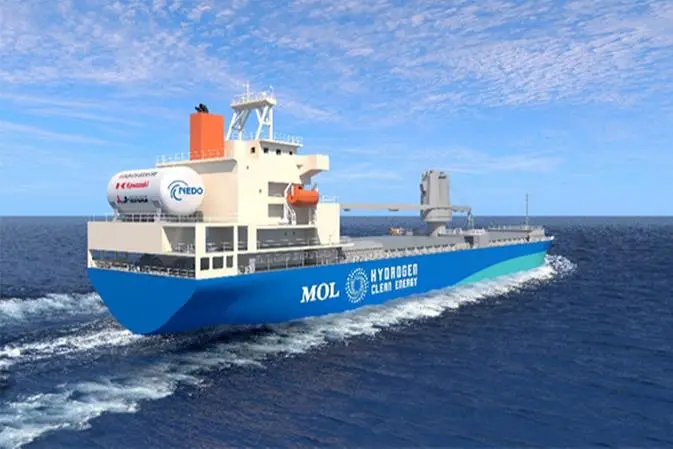
At the centre of the programme is the 6UEC35LSGH, the world’s first full-scale, large low-speed two-stroke engine designed for installation on a commercial vessel, which has successfully begun hydrogen co‑firing operation in all cylinders.
“To date, the engine has achieved a hydrogen co-firing ratio of over 95% at 100% load, confirming both GHG reduction effects and stable operation,” the partners stated.
A scaleable alternative
The project, in collaboration with Mitsui O.S.K. Lines, MOL Drybulk, Onomichi Dockyard and ClassNK, targets scalable alternative fuels for deep-sea shipping through a domestically developed, low-speed two-stroke engine.
While most hydrogen vessel projects to date have focused on short-range, low-output applications, this development integrates a high-efficiency two-stroke engine with a liquefied hydrogen fuel system, enabling long-distance, high-output operations.
The approach marks a significant step toward practical hydrogen propulsion for large merchant vessels.
J-ENG’s work builds on extensive research into hydrogen materials, combustion and fuel injection durability.
Following ongoing verification testing, the engine is scheduled for shipment in January 2027 and will be installed on a 17,500-DWT multipurpose vessel constructed by Onomichi Dockyard.
Kawasaki is developing the vessel’s hydrogen fuel system, with ClassNK overseeing safety evaluations.
The vessel will undergo a three-year demonstration from 2028 under MOL and MOL Drybulk, supporting the wider adoption of alternative fuels in commercial shipping.
Related Articles
 2-STROKE & 4-STROKE
 2-STROKE & 4-STROKE
 2-STROKE & 4-STROKE