



Vales ambitions to decarbonise the front haul route
Motorship: Before we look at Vale’s plans to lower environmental emissions from its marine supply chain, would it be possible to assess Vale’s own environmental emissions targets. You announced ambitious targets to reduce GHG emissions from your overall operations by 33% by 2030.
Rodrigo Bermelho: Vale aims to lead the transition to low-carbon mining. For that, we have Paris Agreement-aligned emission reduction targets for scopes 1 and 2, which include a net-zero goal by 2050. In the mid-term, we will reduce our scopes 1 and 2 emissions in 33% by 2030. We aim to deliver this goal mainly through increased energy efficiency, 100% renewable energy, bioenergy and electrification. To achieve these targets, we will invest at least US$2 billion by 2030.
We can only be leaders in the low carbon agenda if we induce our value chain in the same direction.
MS: As a company, you have been an early adopter of low-emissions technology in your operations, with a wide range of initiatives ranging from electric vehicle mining vehicles to increasing zero-emission energy generation.
RB: Just to look at initiatives in the 12 months, we approved the installation of overhead electricity lines for mining trucks at our Carajás mine, which will allow trucks to cut consumption running uphill. The project will lower CO2 emission reduction for the fleet between 2023 and 2031 by 20% at the largest iron ore mine in the world. It is also a key enabler in the adoption of future battery-powered mining trucks.
We have also been testing a new 100% electric battery powered switchyard locomotive on Estrada de Ferro Vitória à Minas at Tubarão Yard Complex in Brazil since the turn of the year. Railways represent approximately 10% (or 1.2 million tons of CO2 equivalent) of Vale’s annual scope 1 GHG emission (2020 data) and electrification is a potential technology to compose the solution to reduce those emissions.
We are also investing to meet our goal to consume 100% renewable electric energy in our Brazilian operations by 2025 and, globally, by 2030. We have invested US$500 million in a 766MW capacity solar plan, Sol do Cerrado in Jaíba (Minas Gerais state), that will meet 13% of Vale’s electricity demand in 2025. We have a long term power purchase agreement for a wind farm in Bahia state, and we are installing one of the largest lithium-ion energy storage systems in Brazil to meet electricity demand at the Ilha Guaíba Port Terminal (in Mangaratiba, Rio de Janeiro state).
In addition to strengthening energy supply management and reducing costs, this initiative is part of our strategy to replace fossil fuels.
MS: Your mining products will also play an important role in supporting the decarbonisation of other sectors for customers globally.
We are also holding discussions with our partners at Kobe Steel and Mitsui about the terms and conditions to establish a New Venture with the objective of delivering low CO2 metallics to the global market, providing new technological solutions to our clients.
These solutions are based on technologies for production of biomass-based pig iron (Tecnored) and HBI (using natural gas). Vale is committed to helping its steelmaking clients with the challenge of reducing their carbon footprint.
MS: Turning to your maritime plans, you mentioned in your Carbon Neutral strategy that you planned to reduce your Scope 3 emissions by 15% by 2035 [compared with 2018]. Could you provide any more detail about your objectives for maritime transportation?
At Vale, we recognise that to lead the mining industry’s transition to net zero, we need to act along the supply chain. We have announced a target to reduce net scope 3 emissions from our client and supply chain by 15% by 2035. The target will be reviewed in 2025 and every five years thereafter, given the uncertainties regarding low carbon technologies and climate policies.
Currently, Scope 3 emissions account for 98% of Vale’s annual GHG emissions, but they are not under the company’s direct control and management. While Vale emits approximately 12 million tons of GHG in Scope 1 and 2, Scope 3 emissions account for approximately 563 million tons of CO2e per year (2019 data). Of the Scope 3 emissions, almost 16.9 million tonnes of CO2e came from shipping, while the remainder came from the steel making process.
Aiming at consistency and alignment with the ambitions of the Paris Agreement, Vale will reduce absolute net Scope 3 emissions by 15% by 2035, through the development of new products, nature-based solutions, partnerships and engagement with customers and suppliers.
MS: Would it be possible for you to give some examples about the efficiency savings you have achieved with own digitalisation solutions?
Vale has created in 2017 the Integrated Operations Center (COI, in Portuguese), which is responsible for scheduling and controlling the production and logistics of iron ore, in the short and medium term, from mines to the clients.
At COI there is a multidisciplinary team and process with an integrated, real-time view of the production and value chain, ensuring greater flexibility in decision making. One of the process running is the fleet allocation of the more than 300 vessels that transport our iron ore, matching products, ports, and clients.
MS: As a beneficial cargo owner, would it be possible to discuss the challenges of encouraging vessel owners to modernise equipment or to employ modern route optimisation software?
In the long-term contracts, upgrades are funded by the shipowners who will also collect the benefits of the fuel consumption reduction.
Although shipping is known traditionally as a conservative industry, we also recognize that there has been a lot of improvements over the past decade when ships from same class have evolved to become almost 15% more efficient.
To accelerate these improvements, we believe that we must foster a collaborative environment including a more open approach to data sharing.
MS: Your very large ore carriers and ValeMax vessels are among the most efficient vessels every built in terms of tonne mile CO2 emissions.
Since 2018, the company has been operating with second generation Valemaxes (VLOCs) and since 2019 with the Guaibamaxes (VLOCs) with a capacity of 400,000dwt and 325,000dwt, respectively. Both carriers produce up to 41% less CO2 equivalent emissions than a 180,000dwt Capesize ship (built in 2011) and are among the most efficient vessels in the world.
The second generation Valemaxes and Guaibamaxes were also designed for future use of liquefied natural gas (LNG), which may further reduce emissions by 23% per vessel after the system is installed.
The efficiency of these vessels has already greatly contributed to reduce the emissions compared to the 2008 IMO baseline.
MS: What is your perspective on the upcoming introduction of EEXI and CII regulations on your fleet?
Vale is committed to supporting the shipping industry in fulfilling the ambitions of the International Maritime Organization (IMO). The recent adoption of the efficiency regulations known as EEXI and CII represent an important step to reduce emissions.
Although we transport iron ore in the most efficient vessels in the world, according to the EEDI database, we believe there are still further energy efficient gains to be captured to reduce fuel demand. that will allow a transition to alternative fuels.
MS: Do you have a specific programme to reduce emissions with these vessels further?
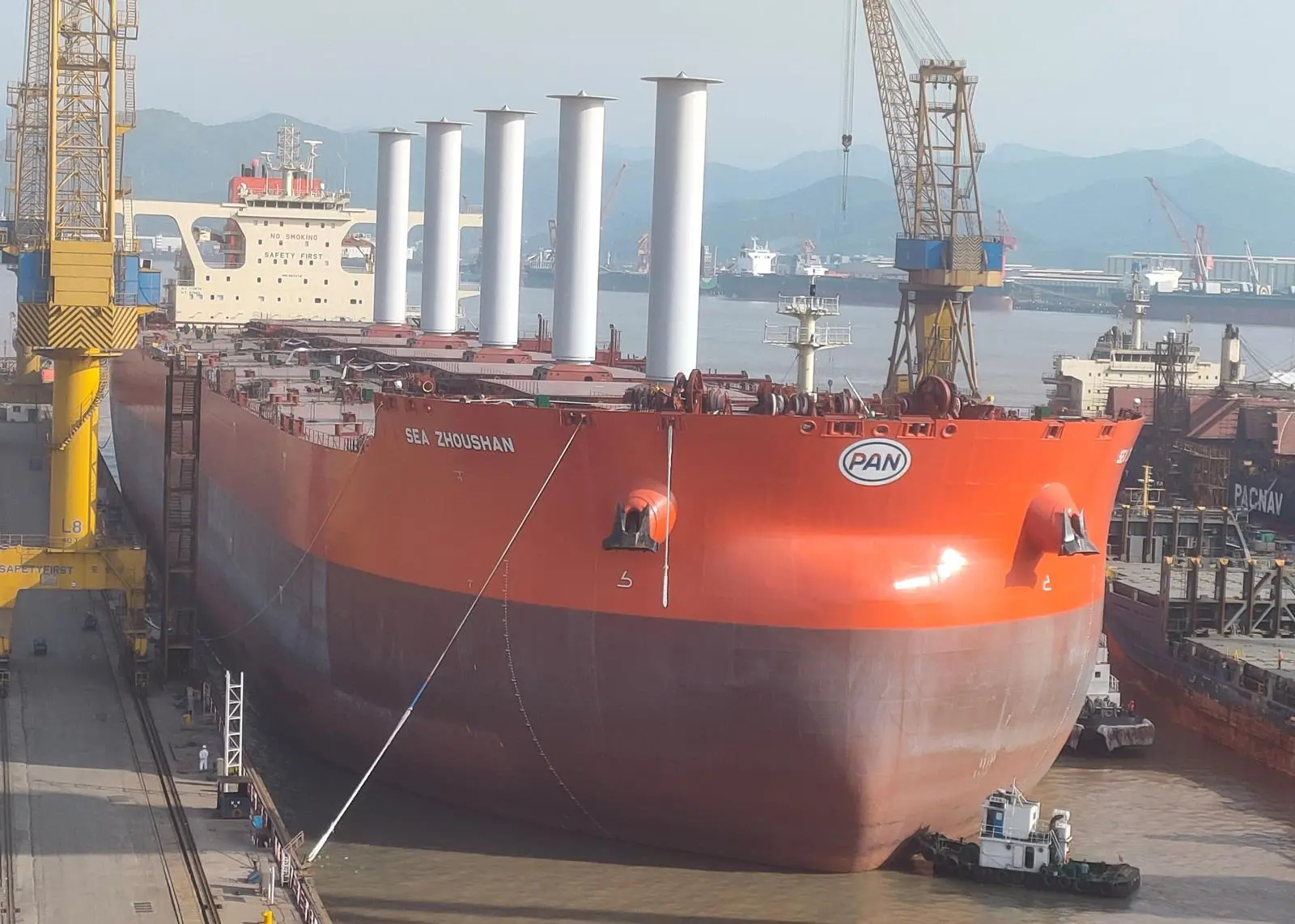
The first Rotor Sails technology ship, expected to be delivered this month, has begun tests in China. The technology uses wind to propel the ship and consequently consumes less fuel and thus, lower GHG emissions. There are five rotors installed on a Guaibamax ship (325,000dwt). The ship will sail to Brazil this month. With additional 5-8% efficiency, there will be a reduction of 3,400 tons of CO2 per ship per year.
Next week, the first Guaibamax ship (325,000 dwt) with the Air Lubrication system will also be ready in China. The technology creates a carpet of air bubbles under the ship reducing water friction against the hull. Conservative expectations of fuel savings are around 4 to 8% with a potential to reduce 4.4% of Vale’s scope 3 emissions by 2030.
One of the principles to develop pilots within our Ecoshipping program is the scalability aspect and we believe that the Very Large Ore carriers are a great platform for that. Taking for example the case for the Rotor Sails, the project we have developed could be replicated to all 47 vessels of this series plus another 67 Valemax in operation.
However, at this stage our focus is to collect and analyse data about the pilot to learn how we can improve the performance of each equipment for future projects. The sails, for example, could be more in number and larger in size, but to reach that we must first learn from this experience.
MS: Within your Technical Institute, you have been evaluating a number of different technologies. Would it be possible for you to provide insight into the range of different technologies that you are assessing?
In addition to rotors sails and air lubrication, we have been studying a variety of technologies such as hydrodynamic devices, waste heat recovery , carbon capture, shore connection for our ports, fuel cells, multifuel tanks for different types of fuels such as ammonia, methanol and others.
And besides that, to accelerate innovation and reach the widest range of solutions, we have created a Shipping Innovation Hub that is connecting with various technology ecosystems around the world. For example, we have been with Rainmaking in two cycles of the decarbonization challenge that have scouted more than 2000 start-ups, and we have engaged in further detailed study with some of them.
MS: Could you provide any details about other renewable energy solutions under consideration – what is your perspective on PV energy generation, for example?
Renewable energy will play an important role on the development of zero emissions fuels and we have been researching on the various technology pathways to produce clean fuels.
Recently Vale has signed a MOU with ITOCHU and another 21 companies from different industries to develop a project Study to the use of ammonia as a maritime fuel.
With regards to shipboard renewable energy solution, unfortunately at this stage the possibilities are limited. The current capability of PV energy generation, even in very large ships like the Valemax are simply insufficient compared to the energy needed.
MS: What is Vale’s perspective on the alternative fuel debate within the shipping community? Some other multinational mining companies have recently signed long-term charter agreements for LNG-fuelled vessels. Is Vale evaluating LNG as a potential solution?
Vale has been preparing for the adoption of alternative fuels for many years. Dozens of second-generation VLOCs already in operation since 2018 have LNG-Ready class notation and have been designed for future liquefied natural gas (LNG) system installation, including an under-deck compartment to receive a tank with capacity for the entire voyage.
Since then we have been constantly evaluating LNG as a fuel. We note that there are two main challenges to it: the development of the bunkering infrastructure and the price mechanism in relation to current fuels that will allow the appropriate business case to be developed to recover in the midterm the high investment needed for the vessel retrofit.
However, even more important than the LNG retrofit business case, we are focused on expanding the optionality of our fleet not only to LNG but also to other alternative fuels that have greater potential to reduce emissions.
The ambition to achieve low carbon shipping means LNG can only be a transition fuel. In our opinion, the 23% reduction in CO2 emissions (on a tank to propeller basis) that it can provide is simply not enough to meet the future emission reductions required.
MS: Would you be able to provide any detail on your view about other potential fuels, including methanol, ammonia or LBG or synthetic LNG?
We think that there is still uncertainty about which fuel or mix of fuels will be selected by the maritime industry to achieve its ambitions and therefore we are developing a multifuel strategy.
In 2019, Vale started a multifuel tank conceptual design to expand the optionality of Valemax and Guaibamax vessels that were built as LNG-Ready, by studying the characteristics of a type-B tank able to store and handle not only LNG but also methanol and ammonia as fuel. A preliminary study suggests that the emission reduction could range between 40% to 80% on those vessels with methanol/ammonia.
By standardizing the tank, we remove the cost risk for the most expensive part of the system and will be able to test different solutions to be able to move to the selected one. The tank could be used for 77 Valemax and Guaibamax vessels that were built as LNG-Ready with endurance for round voyage at low speed and partial voyage complemented by fuel oil on higher speeds.
Related Articles
 ALTERNATIVE FUELS & LUBRICANTS
 GENERAL NEWS
 GENERAL NEWS