



Varied work keeps German yards busy
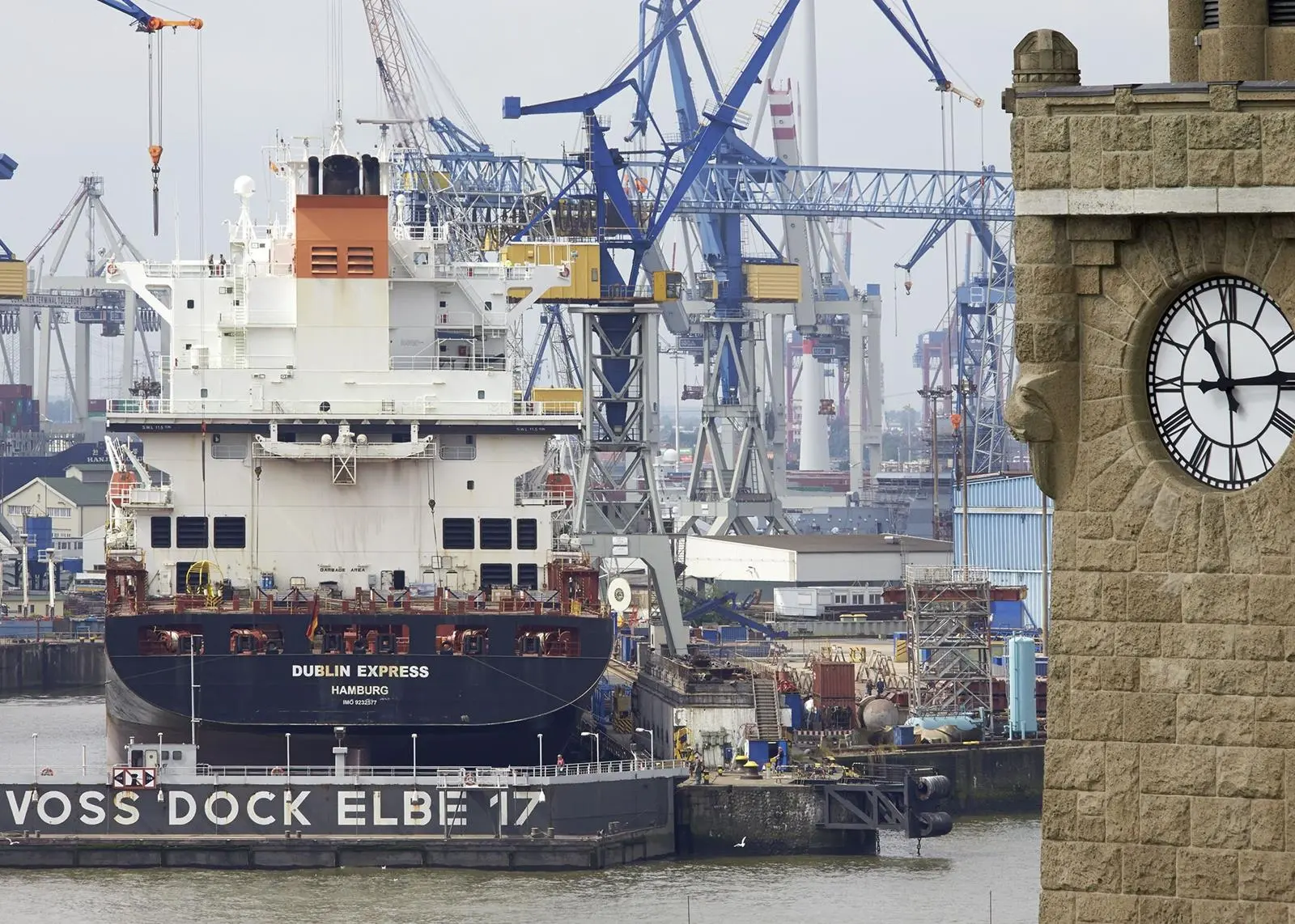
Blohm + Voss docks have stayed full after a spate of four cruise ship jobs in rapid succession in April. Big merchantmen have made up a fair share of the repair business since then. One of the biggest was the 81,283dwt bulker Panther Max for rudder repairs.
Three 46,000dwt 13 year old Hapag Lloyd container ship sisters called for routine work. Glasgow Express came for hold cleaning and coating, container cell guides renewal and insulation renewal, while Liverpool Express docked for cell guide work. They were followed by Dublin Express for hold cleaning, coating and other unspecified work. The 52,726gt Vargas Trader docked earlier for class work and hull cleaning and conservation and a fifth container ship, the 50,963gt MSC Cordoba also called.
The 47,232gt vehicle carrier Hoegh Beijing called for rudder and rudder steering gear work, painting and the overhaul of ramps, bow thrusters and electric motors. Propellers were swapped and the bow thruster was drawn on the 24,613gt RoRo ship Britannia Seaways while the 12,907gt passenger ship Ocean Endeavour docked for hull painting, propeller shaft, stabiliser, valve and tank work, B+V said.
One unusual recent visitor was the 12,890gt RoRo Flettner rotor-driven E-Ship 1 for coating, propeller overhaul and bow thruster maintenance. Another out-of-the-ordinary job for the ever-versatile B+V has been work on the 1,400 ton Number 6 gate from the Brunsbüttel lock complex on the Kiel Canal. The 46.8m x 9.36m gate, built in 1914, came for damage repair as well as corrosion protection and the overhaul of pumps, pipes, sealing and guide bars.
It was announced meanwhile that Queen Mary 2 will call at B+V next year for what was described as extensive and major refurbishment. The Cunard flagship will arrive May 27 and stay until June 21 for dry-docking and work which the yard said would include classification renewal and a range of unspecified “shipbuilding activities”. That’s apart from the installation of 50 new cabins.
Drydocking bids
Blohm + Voss is likely to have been among German yards which, as The Motorship went to press, were bidding to bag drydocking and routine maintenance work on another cruise ship – Deilmann’s former 22,400gt classic cruise liner Deutschland. The ship was being remodelled and renamed World Odyssey for the US Semester at Sea study programme after being bought by a US company.
German reports said yards in Hamburg, Bremerhaven and Rendsburg were among the bidders. In Hamburg only B+V appeared likely while the only candidate in Rendsburg was Nobiskrug. In Bremerhaven, Lloyd Werft (LWB) told The Motorship it “hoped” to carry out the overhaul.
LWB could have the edge. It tackled class and repair work on the previous 24,318gt Semester at Sea ship Explorer in May last year. World Odyssey will be the fifth to serve with the floating university programme. Built by the former HDW in 1998 it is for service from September.
LWB has concentrated on repair and conversion for more than ten years with only the occasional side-step into newbuilding. However as this report was written, it was waiting for conversion of a letter of intent for five cruise ships for Crystal Cruises and also hoping for a successful outcome to talks with Crystal parent Genting on a shareholding in the German yard. If those developments have been confirmed in the meantime then LWB may want to gear up its facilities for newbuilding production rather than repair and conversion.
As of late July LWB said it was also still waiting for confirmation of another contract to carry out retrofit work on the 31,240gt newbuilding Ceona Amazon, which it completed late last year. The ship returned in May after its owners added the design and construction of an on-board 80m long pipe welding facility – a so-called firing line – to the work list. LWB told The Motorship it was hoping to begin work in August for completion at the end of October.
Amazon enhancements
The new facility is a core component and the yard reported that the work involves welding, ultrasound inspection of seams, sand blasting and weld seam preservation. For installation were six modules along with lighting, gas supply and fire-fighting equipment and pipe racks in the loading bay and on deck.
In another unusual demonstration of its engineering capabilities, LWB this summer equipped and prepared one of the world’s biggest offshore installation ships, Pacific Osprey, for its latest project. The 160.9m, 8,400dwt ship is just two years old. Project Manager Stephan Bieber told The Motorship LWB installed owner-supplied grillages on the deck over a period of less than three weeks.
Another summer caller has been the 15,067gt cruise ship Hamburg, which arrived in early June for what reports said was a “mechanical repair” and was still at the yard in early August.
The ship grounded off Scotland’s Isle of Mull in May reportedly sustaining hull and propeller damage. Her owners brought in Deutschland to replace the ship during what they said would be “a yard stay lasting some time”.
LWB could not provide any details of damage repairs, but was able to say that class-related docking and repair work had been carried out. Project Manager Sven May told The Motorship the class work included seacock overhaul, underwater conservation and pipe work renewal, lifeboat davit and crane overhaul, renewal of diverse electric motors and overhaul of the ship’s diesel engines.
Rockpiper returns
Neighbouring Petram Group associate German Drydocks (GDD) reported the return in June of the 30,600gt fall pipe and rock dumping ship Rockpiper for installation and testing of a special offshore loading system. The ship was at GDD in January for initial foundation work and on her return was handled in Dock 111 at Lloyd Werft.
Other ships tackled by GDD – either in its own docks or those of LWB – included the 4,805dwt general cargo ship Unimar, the 43,067dwt fruit juice carrier Carlos Fischer and the 68,131dwt container ship Montevideo Express. There were no details of work.
Among those handled in GDD’s 147m long floating Dock 1V was Germany’s emergency stand-by tug Baltic. The 63.4 m twin-screw tug called for her first five-year classification visit. No further work was reportedly needed. Another tug, Taurus, was renamed ALP Ippon during a stay at GDD.
It remains to be seen whether GDD will benefit in any way from the potential upcoming changes at LWB. A GDD spokeswoman told the Motorship the yard would not comment on the latest developments there.
Nordic Yards tackled a trio of unusual repair jobs – only one of them involving a ship. That’s par for the course at a yard which has established itself as a frontrunner in the offshore transformer, windfarm and platform engineering sector.
Volkswerft variety
The ship was the 82m long German sail training ship Gorch Fock. The three-master was dry-docked for the first time in seven years to establish sea-worthiness and was also de-rusted and repainted. That work was carried out by Volkswerft in Stralsund, acquired by Nordic last year.
A Nordic Yards spokesperson said only about two square metres of outer hull needed replacing on the now more than 80 year old sailing ship while a few welds were renewed. The ten day job cost more than €100,000, reports said.
Nordic Wismar, one of the other two yards in the group, meanwhile completed the four-month conversion of a 550 ton ferry and RoRo landing pontoon for the Port of Rostock. The job, which cost €1 million, involved widening by 4m to 28m to handle ever wider RoRo ships with bigger ramps.
The third Nordic repair job this summer, also in Wismar, involved the repair, overhaul and upgrade of a 140m long floating dock belonging to Lürssen Group yard Kröger Werft. The 30m high covered dock was partially dismantled and towed from Rendsburg on the Kiel Canal to Wismar on the Baltic. At Nordic the 30 year old dock’s lift capacity was increased by 600 to 4,600 tons by means of buoyancy tanks.
Elsewhere in the Lürssen Group, the Norderwerft repair yard in Hamburg docked the 97.5m German government-owned research ship Meteor for a longer than usual five-week stay.
Meteor makeover
Former Meteor Captain Niels Jakobi at the Control Centre for German Research Vessels at the University of Hamburg told The Motorship the 30 year old veteran underwent routine class renewal which cost about €2 million and included deck and tank steel work, genset maintenance and hull and superstructure conservation.
However Captain Jakobi also reported additional jobs this time. He said stern crane frame capacity had been upped from 20 to 30 t SWL to cope with the increased weight of scientific probe equipment and provide more reserves during ship movements. Research winch control had also been modernised, he said.
Lürssen spokesman Oliver Grün told The Motorship the class and maintenance work on Meteor had been “extensive” . He reported the same work on recent callers including the 15,100gt container feeder Barmbeck, the 8,388gt heavy cargo ship Annemieke and the 6,264gt cargo ship Berta as well as on a number of tugs and pontoons.
Grün also reported season-linked and extensive maintenance work on smaller ships at another Lürssen Group repair yard – Neue Jadewerft. Among callers there were the passenger ship Harle Kurier, the ferries Harlingerland and Wangerooge, the tourist ship Lady von Büsum and tugs and fish cutters. Bigger ships like the German Bundesmarine frigates Lübeck and Mecklenburg-Vorpommern had undergone “comprehensive overhaul” he said also reporting maintenance work on the frigate Brandenburg and the Navy tender Tegernsee.
Nobiskrug Werft in Rendsburg completed a much longer than expected 15 months of repair and renovation on the 131.7m, 8,800gt government-operated hopper dredger Nordsee. The original order was for class renewal, hold and forward water ballast tank steelwork and suction pipe renewal, but that was substantially extended after the ship arrived at Nobiskrug early last year to include renewal of grey and black water pipes as well as of large sections of the heating system. The ship’s 22m oil pollution sweeping arms, dredging gear including cranes, ratchets and suction head trays, large areas of the hold and both forward ballast water tanks were all overhauled. The deckhouse was gutted and completely rebuilt with new windows and energy-efficient insulation.
Commercial Project Manager Simona Heins said it was “a unique project, the scope and complexity of which presented us with multi-facetted and interesting tasks. We were pleased we could complete them all so satisfactorily.”
Lock damage repair
Like Blohm + Voss in Hamburg, Nobiskrug, along with sister German Naval Yards Kiel, is one of several facilities on and near the Kiel Canal which have of late been involved in lock damage repair and restoration work.
That work has risen dramatically and looks like continuing to be a good little earner for a while. Lock breakdowns have increased as the waterway’s century-old locks show their age and the need for restoration or replacement becomes acute. Another reason for the increase in repairs is the growing number of ship accidents as canal traffic rises and vessels grow in size.
Elsewhere, the now 94m long car/ferry Ostfriesland has entered service for AG Ems as Europe’s first operational passenger ferry with DF/LNG drive. Cost of the lengthening and conversion of the 30 year old ship at the Brenn und Verformungstechnik (BVT) Shipyard in Bremen was €13 million.
By using LNG fuel from Bomin Linde AG Ems say they are saving more than a million litres of diesel a year with the ship which now boasts two Wärtsilä W20DF engines.
And at Schiffswerft Diedrich, the repair and overhaul of workboats and commercial vessels has been more evident of late after the seasonal spate of winter work on small local ferries.
Among the latest ship in for machinery and equipment overhaul as well as hull conservation maintenance were mussel cutters among them the 36m Ursula and Anna and the 46m Charlotte. Other ships include the 25m island transport ship Harle Riff, the 52m hopper dredger Seekrabbe and the 44.6m island waste transport vessel Störtebeker.
Related Articles
 EMISSIONS REDUCTION TECHNOLOGY
 ALTERNATIVE FUELS & LUBRICANTS
 ALTERNATIVE FUELS & LUBRICANTS