



Veteran Polarstern docks again – but not for the last time
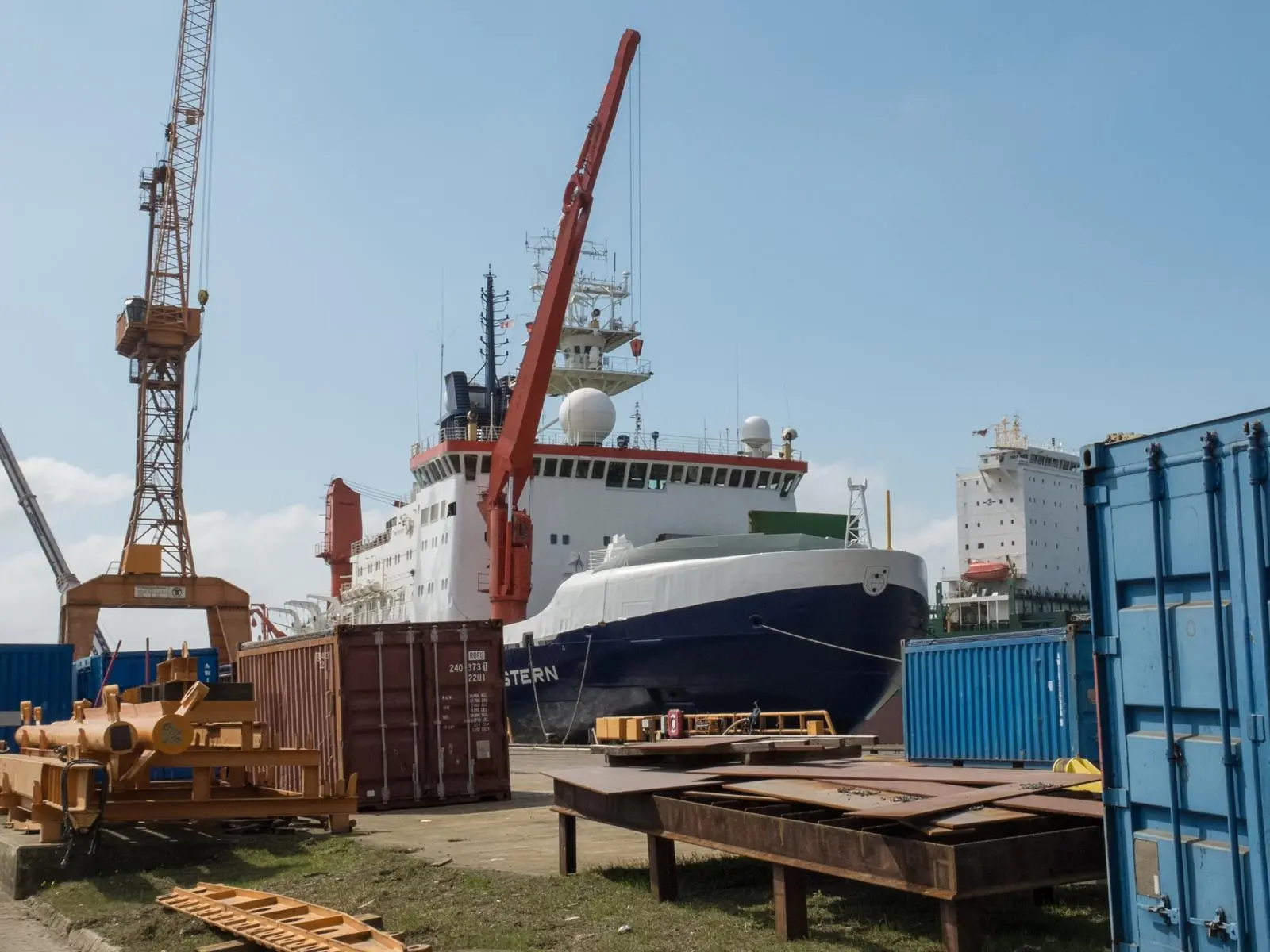
A decision on who will win the Polarstern II contract is expected this year but Lloyd Werft Bremerhaven MD Rüdiger Pallentin told this correspondent the old ship would return to his yard.
“This year’s visit is certainly not its last”, he said revealing that routine docking of Polarstern had already been booked for next year. “The new Polarstern cannot be built inside a year, so the current Polarstern will continue to serve for some years to come”.
The comment raised the interesting possibility that Lloyd Werft, which is among yards hoping to win the contract to build Polarstern II, could see both ships in its docks at the same time in future.
The veteran 118 x 25m Polarstern, drawing11.5m, is operated by the Alfred Wegener Institute, Helmholtz Centre for Polar and Marine Research (AWI). It is at Lloyd Werft until August 10th and in the big Kaiserdock II graving dock for most of that time, the yard said. The dock is one of only a few in Germany capable of handling the ship’s deep draught .
Work on Polarstern includes dismantling and overhaul of fin stabilisers, propeller, rudder, stern tube sealings and bow thrusters and superstructure coating. Steel works are planned tweendecks near the ship’s funnel as is work on the bow crane. A new tank heating system and a new spare parts storage platform in the helicopter hangar are being installed.
Protective work is also being undertaken to prepare the ship and its machinery for the upcoming MOSAiC Project – one of the most ambitious international expeditions to the Arctic – and for over-wintering in the Arctic pack ice.
Polarstern is one of the most capable Polar research ships in the world, able to cut through ice up to1.5m thick with its double steel hull and four KHD main engines with a combined 14,120 kW.
Regular maintenance work on Polarstern was “absolutely imperative” because of its Polar work which “takes its toll on the ship’s hull”, Lloyd Werft declared. The yard noted strain on propellers and rudders through ice contact and added that below freezing surface temperatures also affect winch and cranes behaviour.
Related Articles
 EMISSIONS REDUCTION TECHNOLOGY
 ALTERNATIVE FUELS & LUBRICANTS
 ALTERNATIVE FUELS & LUBRICANTS