



Which path to decarbonisation?
Shipping’s emissions were high on the agenda at the IMO’s MEPC meeting in London last month and, of course, the decision to adopt a 0.5% global cap on the sulphur content of marine fuel in 2020, rather than 2025, dominated headlines. But following last December’s so-called Paris Agreement in which ways to tackle climate change were addressed head-on, carbon emission and greenhouse gas (GHG) reductions were also high on the MEPC 70 agenda.
A ‘roadmap’ for developing a “Comprehensive IMO strategy on reduction of GHG emissions from ships” was approved by the MEPC covering the period until 2023, with an initial strategy to be adopted in 2018. New mandatory requirements were set out for ships of 5,000 gt and above to collect consumption data on each fuel used as well as data on actual transport work carried out. These ships account for the lion’s share of shipping’s GHG emissions – about 85% – and the purpose of the data is to provide a sound basis on which IMO can introduce GHG-reducing measures in the future.
In the week before MEPC 70, Lloyd’s Register launched a report examining possible future strategies for the reduction of GHG emissions from shipping. Called ‘Low carbon pathways 2050’, the study was undertaken jointly by the class society, the Low Carbon Shipping project and Shipping in Changing Climates, a $4m multi-university and cross-industry research project funded by the Engineering and Physical Sciences Research Council.
The report examines the technological and operational specifications of the global fleet and how these may change in relation to a given rate of decarbonisation, a process to which shipping is now committed under the Paris Agreement. LR’s Katharine Palmer, Environment and Sustainability Manager, and Carlo Raucci of Shipping in Changing Climates both stressed the need for speed.
“The later we leave it [adopting a decarbonisation process], the more disruptive it could potentially be for shipping,” commented Palmer who stressed that improving ships’ energy efficiency alone would not be sufficient because transport demand itself, which will increase steadily over the coming decades, has a major impact on carbon emissions. In fact, design and operation initiatives are already projected to raise shipping’s efficiency by 30% between 2014 and 2025 but other decarbonisation measures will also be necessary.
FUTURE FUEL SCENARIOS
At the study launch, Palmer predicted that an intersessional working group would be set up at MEPC 70. This was confirmed at the IMO’s meeting and the working group is likely to meet at MEPC 71 in mid-2017. Central to the working group’s focus will be effective data on the work that ships perform and the fuel that they burn in doing so, hence the new mandatory requirement for data collection.
“The data collection system will equip IMO with concrete data to help it make the right decision,” IMO’s Secretary-General Kitack Lim told delegates in London, “as well as enhancing its credentials as the best placed and competent forum for regulating international shipping,” he said.
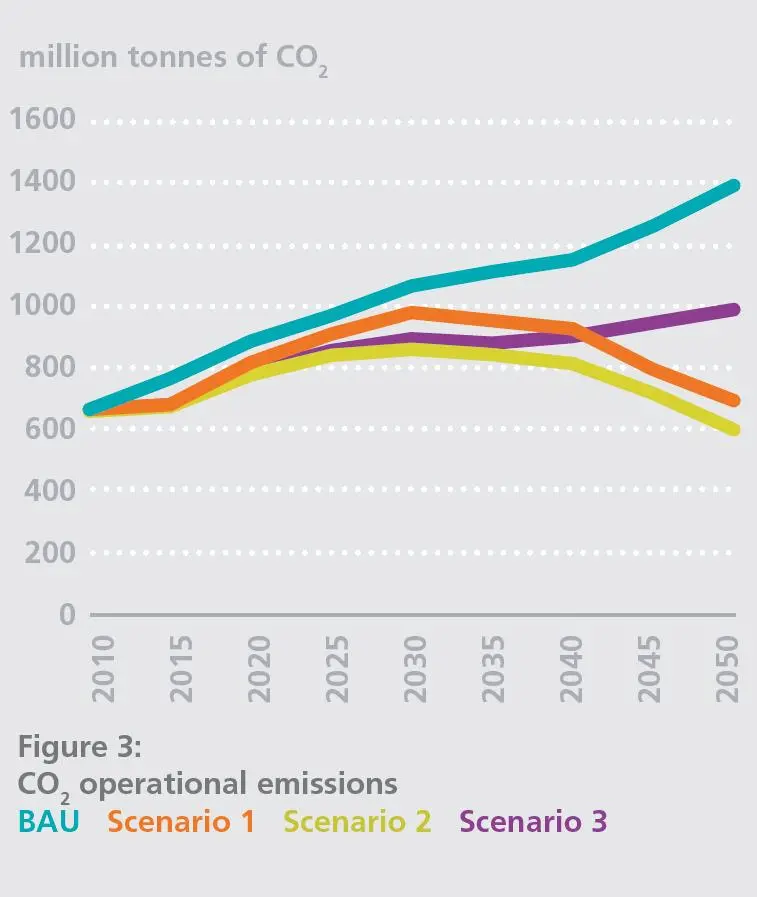
The study chose three future scenarios for the period 2015 to 2050. All three assume that all fuel options are available, but in the first one, there was assumed to be a high availability of hydrogen, used in fuel cell technology. This would demonstrate what could be achieved through technology and innovation, the report’s authors explained.
The second scenario assumes ‘a mid-range market penetration of biofuels’ in which shipping is assumed to adopt biofuels in a similar way to road transport through blending targets and mandates for fossil fuels. In the third scenario, a ‘market-based measure’ was assumed to be set up from 2025 by which carbon dioxide offsets would be bought equivalent to half of the revenue generated from carbon pricing.
The three scenarios were then compared with a ‘business as usual’ base case assuming existing regulations including the energy efficiency design index (EEDI), SOx and NOx regulations, but no additional GHG-reducing measures. Each scenario was then considered for individual ship types and sizes (tankers, bulk carriers and container ships) and the results aggregated for presentation. In the ‘business as usual’ case, shipping’s carbon dioxide emissions are projected to more-than-double from about 650m tonnes in 2010 to 1.4bn tonnes in 2050.
In scenarios one and two – high hydrogen and high biofuels – shipping’s net emissions peak around 2030 and then fall at an increasing rate as more decarbonisation takes place. By 2050, net emissions are both down to about 50% of the 1.4bn business-as-usual case. In the third scenario, operational issues continue to increase but the carbon budget, as it is termed, is achieved by using offsets.
All three scenarios see a continuing role for heavy and low-sulphur fuel oils in combination with appropriate emissions abatement technologies. This, the study explains, is because the cost of these fuels remains attractive as compared with other options, even considering the capital costs associated with various abatement technologies including scrubbers, exhaust gas recirculation and selective catalytic reduction.
Related Articles
 ALTERNATIVE FUELS & LUBRICANTS
 GENERAL NEWS
 GENERAL NEWS