



Which way repair after German yard changes?
Genting’s majority take-over of Lloyd Werft Bremerhaven (LWB) last autumn along with a clutch of orders for newbuildings – eleven at last count – appeared to put LWB on a purely newbuilding production course with repair and conversion out of the equation. However Genting’s purchase in January of the remaining Lloyd Werft shares and its acquisition in March of Nordic Yards within a newly formed Lloyd Werft Group have created the space for newbuilding outside of Bremerhaven and put a different slant on potential development.
Following on from that, LWB has now said it intends to remain active in repair and conversion as well as newbuilding. It announced it will lengthen the 32,289gt Ro-Ro ferry Primula Seaways for DFDS in July and has secured options for two more. Still unclear, however, as this report went to press was how that might affect its partnership and docking alliance with neighbouring German Dry Docks (GDD).
The 199.8m Primula Seaways will arrive at LWB on July 1st and stay 31 days during which time it will be lengthened by 30m to 229.8m. An official statement did not say where the work would be carried out but Board Member Dirk Petersjohann told The Motorship’s correspondent it will be in LWB’s 281m x 38m Floating Dock 111, which can cope with up to 90,000 tons.
LWB said: “The lengthening is of special importance for Lloyd Werft, particularly because options have also been secured to lengthen two further ferries for DFDS and (also) because further projects for European ship owners are in hand …”
Petersjohann said the orders were a sign that the yard “does not regard itself purely as Genting’s own house-yard but should and will continue to acquire orders independently on the international shipbuilding market. We will not withdraw from competition but will, on the contrary, utilise our new possibilities internationally to acquire more work”, he declared.
LWB said that as well as lengthening the Primula Seaway, it would also repair substantial collision damage and carry out routine maintenance. Tanks are being adapted to new MARPOL regulations and DFDS said the ramp from the main deck to the lower hold was being widened to improve loading. After conversion the ship will have 4,650 lane m for 307 trailers and ship 20% more cargo using the same amount of fuel, said DFDS.
Lending credence to LWB’s intent to continue with repair and conversion is the fact that it has not ceased to be busy in the sector throughout the latest developments. Unfortunatelt it has not given much information about recent projects, however others have – in the case of at least one rare job.
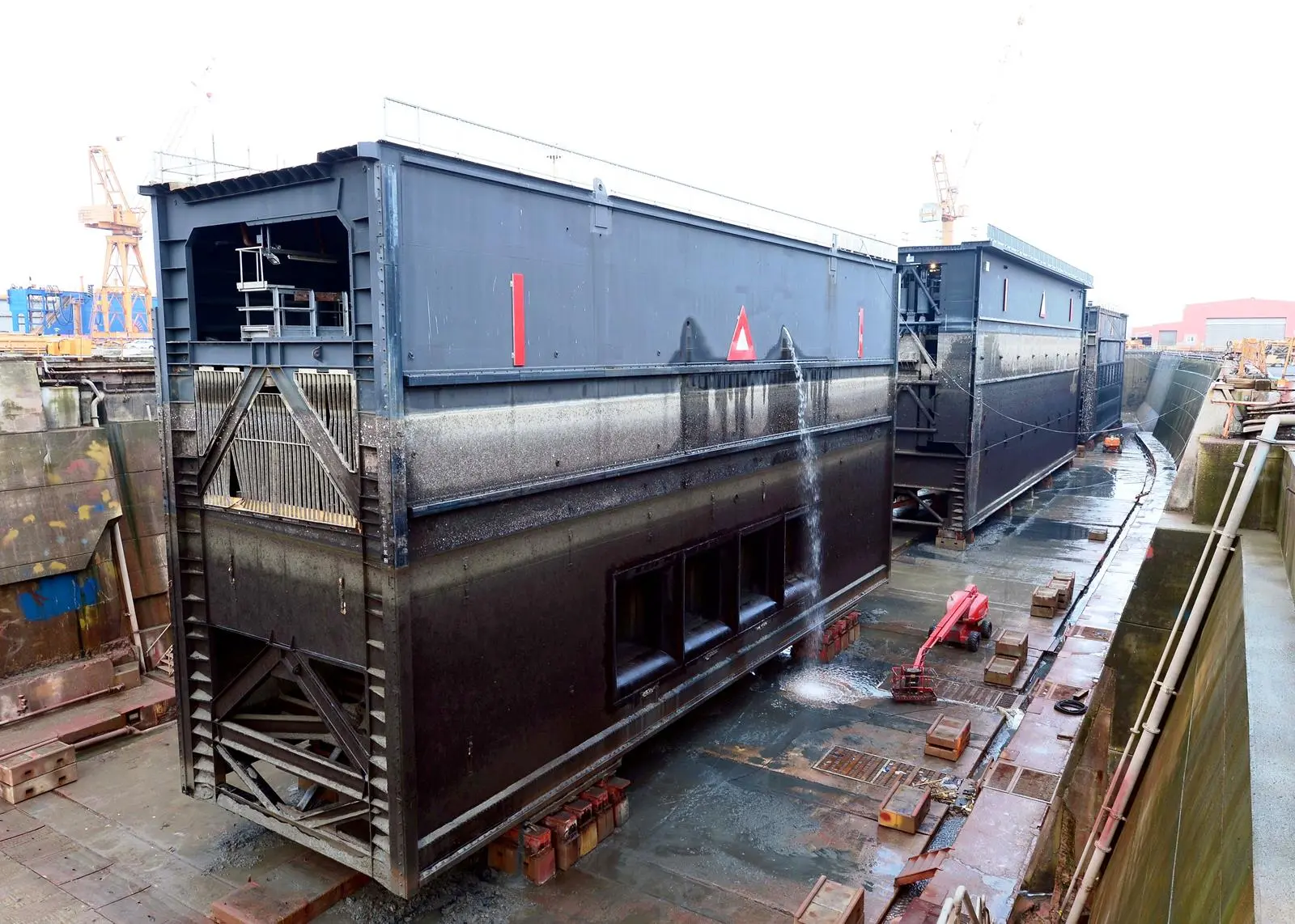
Bremerhaven port operator bremenports detailed the repair and overhaul by LWB of the giant gates from the port’s three most important sea locks. The work demonstrated not just yard expertise but also local dependence on the facility’s big docks. The gates, together weighing more than 4,300 tons, were floated into the Kaiserdock 11 – LWB’s biggest drydock, 335m long with a 35m clear width. The dock has in the past been used for some of the yard’s most impressive conversions.
Bremenports told The Motorship the lock gates were repaired, overhauled and newly conserved where required. Worn gate parts and sealings were also renewed, they said.
Among other yard repair visitors to LWB facilities of late, either for LWB account or the account of neighbouring associate GDD, have been the11,730gt offshore supply ship MPI Enterprise and the 15,328gt offshore construction jack-up Bold Tern. The 17,349dwt general cargo ship BBC Ems also called.
The pipelay and construction vessel Ceona Amazon, which completed complex work at LWB last year, remained berthed at neighbouring former Rickmers yard (now GDD) as this report went to press. A buyer is reportedly still being sought for the ship, completed at LWB in 2014, after its owners went into administration in 2015.
Further east on the Baltic, the future of repair at Lloyd Werft’s new partner Nordic Yards was also unclear as this report went to press. A Nordic spokeswoman told The Motorship that the Genting take-over of Nordic’s facilities in Wismar, Stralsund and Warnemünde was not yet complete as of late March.
She said contract signing had already taken place but that the sale would not be completed until the deal had been formally closed. No closing date was revealed but she said that until then there would be no comment – on job developments, newbuilding orders or repair work.
Jobs have been a contentious issue at the troubled, currently Russian-owned yard group since last autumn when redundancies were proposed by management but never announced. Nordic Yards has also suffered recently from offshore order decline and the political situation.
The Genting deal looks like a Godsend – for both jobs and orders. Nordic could get the bulk – if not all – of the newbuilding hull work on Genting’s planned cruise ship and if that happens it will be hiring not laying off.
But repair might be headed for decline if that happens – particularly at Nordic in Stralsund which has been occupied with some small, but interesting specialist ship repair of late.
LWB neighbour GDD appeared to be taking stock at a busy time following the announcement that LWB will continue to handle repair and conversion and seek new work.
GDD continues to utilise LWB docks as well as its own and after the Genting acquisition of LWB last year, MD Guido Försterling said GDD strategy would be to continue the six-dock shared facility arrangement enjoyed by GDD and LWB as part of the Petram Group shipyard alliance.
However Försterling also spoke of expanding GDD’s docking of offshore ships, retrofit and repair facilities, engineering and engine competence. The aim was to “grow as a yard to support customers on a global basis” Försterling told The Motorship at that time.
That expansion is still apparently on the cards. Commenting just this year on GDD’s take-over last autumn of Rotterdam Ship Repair to create a Dutch and German coast operation, Försterling said “we want and must expand and we are in the process of building up an international network for ship and engine port and voyage repairs”.
As of late March, GDD did not want to comment on the latest developments at LWB. A spokeswoman speaking to The Motorship at that time said it was, “for now, repair business as usual” and added, without elaboration, that she would have a lot more to report in June.
Meanwhile the yard has completed some impressive work. It carried out class and maintenance work on the floating offshore hotel ships the 8,893gt former ferry Wind Solution (of 8893gt) and the13,336gt ex ferry Wind Ambition. They were in Docks 5 and 6. Converted earlier in Denmark the ships are now much more than just hotels and offer storage and workshops plus transfer for offshore wind farm workers. GDD quoted officials as praising the work on Wind Solution for being on schedule and in budget. Other ships at GDD of late have included Montevideo Express which came for an unspecified “very challenging repair”, Isarstern and Rio de Janeiro.
Also completed on schedule was the extensive €1 million class renewal and overhaul of the very special 9,998gt veteran cargo ship Cap San Diego.
Now a floating museum, it docked for nearly a month for work which GDD said included the replacement of a 70 m2 area of tweendeck. Tanks and bilges were cleaned, repaired and conserved, loading equipment, lifeboat davits and gangways were overhauled and anchors and anchor chains drawn and inspected. So was the propeller and shaft. The hull underwent safety thickness tests, bridge position lights were renewed and derricks and cranes overhauled.
Cap San Diego, built in 1961/62, is unique. The last of six fast breakbulk sisters, it is 159.4m long and has a two-stroke 9-cylinder MAN K9Z 78/140 D diesel which drives a single propeller providing 19 knots. The ship also has four auxiliary KHD-engines (500 hp) with generators.
Cap San Diego has been berthed in Hamburg since 1988 as a maritime monument and much-loved museum ship. It also serves as a floating hotel but because of regular maintenance work it remains operational carrying up to 500 passengers on frequent trips to other German seaports as well as across the German Bight to Heligoland. Built for a crew of 50 it now sails under 40 retired seafarer volunteers.
GDD has meanwhile also completed the installation of Alfa Laval PureSOx hybrid scrubbers of a new design into the two1025TEU container feeders Condor and Corsar. Both left the yard with new charters as SCA Tunadal and SCA Munksund. Their scrubber systems have multiple inlets connecting the main engine and two auxiliary engines to one U-design scrubber. In contrast to earlier multiple inlet systems, the inlets now lead into a single scrubber jet section. Alfa Laval said the change was “an advance in construction that will make the scrubber more compact”.
GDD has now retro-fitted five ConRo ships and two container feeders with the latest generation of scrubbers and is clearly hoping for more work like it.
Blohm + Voss Repair in Hamburg was expecting the 148,528gt Cunard flagship QM2 in late May for refurbishment booked last year. Cunard said the ship would “undergo an extensive 25-day dry-dock” between 27 May and 21 June 2016. Some 50 new cabins will be installed and B+V said, without elaboration, that beside these modification some shipbuilding works will be carried out.
The visit of any of the Cunard ‘Queens’ is always a big occasion in Hamburg and the QM2 docking is expected to be no less spectacular than earlier calls with local tugs nudging the big ship into B+V’s still impressive Elbe 17 Dock. As Cunard Director Angus Struthers put it: “Queen Mary 2 is an icon in the world of luxury ocean travel: a ship that turns heads everywhere she goes”.
Early April saw another giant cruise ship, Meyer Werft’s 168,600gt Ovation of the Seas, leave Blohm + Voss Repair after an unscheduled second final inspection docking – this time for the exchange of drive propellers.
The ship, third in Meyer’s Quantum series, docked in Hamburg late March for its final inspection. Unusually however it returned for more work as the month turned after completing technical and nautical tests in the North Sea.
Meyer said systems and machinery had been put through their paces under adverse conditions and that sound and vibration measurements had been completed together with speed tests. Among equipment reportedly tested were new propellers, specially developed for Ovation to further improve fuel consumption. The yard and owners said they had however not produced the expected savings and it had been decided to revert to the previously deployed ABB propellers. Meyer said these had been fitted at B+V.
As The Motorship went to press another cruise ship, the 29,008gt Amadea arrived at B+V. Scope of work was not immediately reported. Along with the cruise ship came the 96,772dwt bulker Yeoman Bridge for collision damage repair.
The ships were the latest in a slew of merchant vessels to call at B+V this year. Box ships are still among its staple customers along with tankers and bulkers. The 17,882dwt container shipThetis D underwent underwater inspection and coating while work on Adelheid-S, of 45,052dwt, covered the renewal of three Sea Water Pipes ND 450 and modifications to the fuel oil system.
The 93,079dwt bulk carrier Jin QI spent a month for repairs to port and starboard anchor winches and chain locker steel repairs and drydocking and rudder repairs were reported on the 71,673gt vehicle carrier Tirranna.
One unusual further visitor to the Elbe 17 Dock was another dock. The 164m x 28m Floating Dock 1, which belongs to Hamburg’s Norderwerft, came for steel repairs, coating and the overhaul of valves and provided a rare ‘Russian doll’ photo opportunity.
Related Articles
 EMISSIONS REDUCTION TECHNOLOGY
 ALTERNATIVE FUELS & LUBRICANTS
 ALTERNATIVE FUELS & LUBRICANTS