



Wind-assisted propulsion technologies enter mainstream
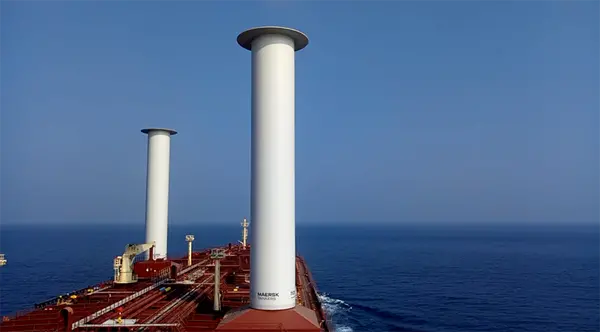
The release of a number of high-profile trial results has led to an increase in interest in wind-assisted propulsion technology. “Something has changed in the last six months,” Jukka Kuukoski, chief sales officer of Flettner Rotor supplier Norsepower, said.
This interest extends beyond a rise in commercial enquiries. Gavin Allwright, secretary-general of the International Windship Association, pointed to a recent increase in the membership of the association, which now includes over 100 members, including classification societies Bureau Veritas and ClassNK, as well as recent additions MOL, Louis Dreyfus Armateurs and Becker Marine Systems as evidence of a fundamental shift.
Optimising vessel designs
As the number of trials reporting results increases, attention is shifting from wind technology in general to the merits of individual wind-propulsion technologies. While naval architects are examining how to optimise ship designs to maximise the benefits of wind propulsion technology, attention is also being paid to retrofitting existing deep-sea vessels with wind-assisted technology. Existing deep-sea bulker and tanker designs that have wider beams and shallow draughts could sustain more wind power, at the expense of generating more drag, without impacting the stability of the vessel.
However, different wind power solutions will perform differently on different routes, with varying impacts on leeway angles, rudder angles, propeller thrust levels and heel angles.
Meanwhile, the integration of real-time wind data into voyage optimisation software is complicated by differences between technologies: Airseas’ kite sail system requires data about prevailing winds at the system’s operational altitude of 150 metres, for instance. Finland-based NAPA began collaborating with C-Job Naval Architects to incorporate wind-assisted propulsion into voyage optimisation software in December 2019.
This is without taking into account second-order effects on cargoes: Simon Rogers of UK-based Wind Ship Technology claimed their 55-metre high hard sail rigs can also reduce roll, with a consequential dampening effect on liquefaction aboard bulkers.
Design considerations should also take into account a vessel’s aerodynamic as well as its hydrodynamic properties. Kuukoski identified the turbulence generated behind funnels as a factor in locating rigs, while the effect of islands on container vessels also complicate installations. More practical considerations also apply: the layout of decktop machinery may need to be optimised to take into account wind-propulsion rigs.
Given shipyards’ reluctance to modify designs for a nascent technology, several suppliers are examining containerised systems suitable for which could be simply lifted off at the end of a voyage. One recent example of such a system is Netherlands-based eConowind, which is offering a containerised version of its fixed wing fan-assisted ventifoil technology to generate thrust.
From push to shove
Meanwhile, engine designers and other OEMs are monitoring the progress of wind-assisted propulsion with interest, and some are adapting EMS to handle it. Wärtsilä has signed an agreement with Norsepower to maintain its commercial installations, for instance.
One of the technical challenges for OEMs and ship designers is how to design systems to respond to the variable thrust generated by passive systems, without inefficient fluctuations in engine loads. While amending EMS to variable amounts of thrust from wind technologies will add an additional layer of complexity to existing vessels’ engine management systems, the amounts of thrust generated are currently comparatively small. Looking forward, some systems under development hold out the promise of significantly higher levels of variable thrust, while looking further ahead some vessel designs under development are expected to generate the majority of their thrust from wind-assisted propulsion. Shifts towards slower vessel speeds for bulkers and ro-ros are changing the economics of such designs.
In the meantime, systems that generate electrical power as well as thrust can feed energy into energy management systems. At present, incorporating this direct thrust and potential electrical energy generation from wind-assisted propulsion systems into a vessel’s power system will allow further greenhouse gas emission reductions and fuel efficiencies, by optimising auxiliary engine operations.
Target segments
The pressures of meeting exacting EEDI targets for Ro-Pax and Ro-Ro vessels means that wind propulsion solutions may find favour in that segment. Consumer pressure for emissions reduction measures is present, but as importantly the ‘split incentives’ of dividing the benefits of retrofits between ship owners and charterers do not apply.
Luc Reinhard of Airbus spin-off Airseas noted that deep-sea vessels, such as tankers or bulkers, are one of the main target segments for his company. Such vessels account for the majority of GHG emissions.
“We have demonstrated we can achieve fuel efficiencies of 30% with our solution, but greater savings could be achieved on windier higher latitude routes, such as the fronthaul iron ore route between Brazil and China, or northerly transpacific routes,” Rogers said.
“We are likely to see the emergence of a variety of funding models to get around this problem, some of which are already in development,” Gavin Allwright concluded. Simon Rogers agreed, noting that a leasing model might be appropriate in the dry bulk sector for retrofitting higher capex products.
Related Articles
 ALTERNATIVE FUELS & LUBRICANTS
 GENERAL NEWS
 GENERAL NEWS