



Wind power rationalised
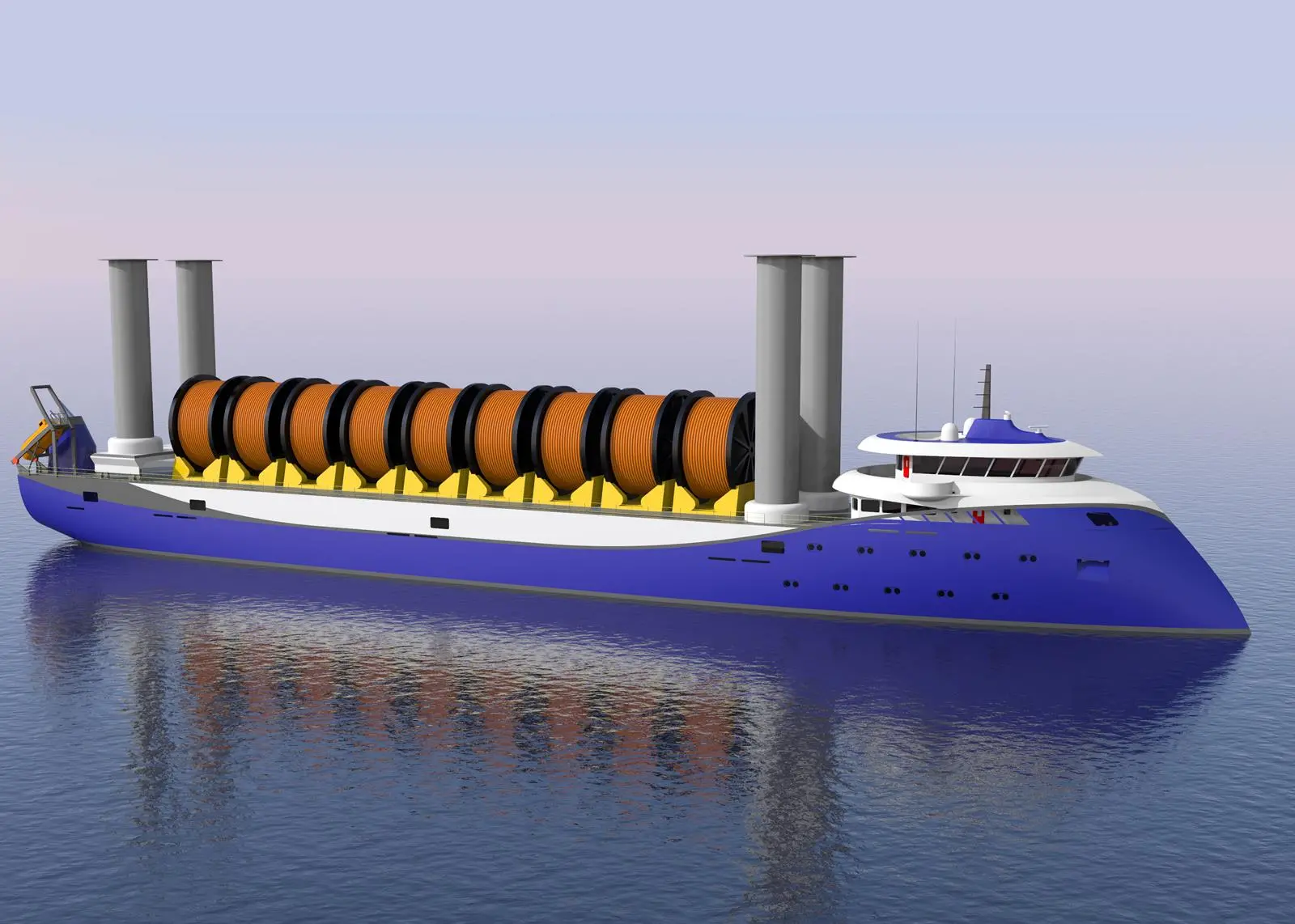
Pioneering Dutch company Fair Transport has operated its shipping business using only sail-driven vessels since 2009. Now, less adventurous ship owners are looking into wind assisted ship propulsion, with some designs offering realistic potential for fuel saving and green operation. From a wealth of options, a European project group has selected a hybrid Flettner ship concept as most realistic wind power for commercial shipping.
Flettner rotors upon the deck of a freighter offer the best business model for wind assisted propulsion in the market today. After a four-year study, the naval architects, universities, ship owners and government policy makers gathered under the ‘SAIL’ project have concluded that a commercial vessel that gets forward thrust from Flettner rotors, in addition to conventional propulsion, is the most likely to succeed in the North European short sea shipping trade. A concept design was presented at the project’s final conference, last February.
Senior naval architect Jelle Grijpstra of C-Job explains why his concept design ‘C-Job Hybrid Flettner Freighter’ has the best chances for real-life realisation.
“Of all systems we studied, Flettner rotors get the best lift per square meter of in-the-wind area,” he says. “So with limited surface in the wind, we would get the most propulsion power for the ship. Of course, the total surface of four Flettner rotors is still less than the total surface of a sailing rig, but this set-up also causes less heel in the wind and is not as much of an obstacle when loading and unloading the ship.”
The C-Job concept design has four vertical rotors, two on the fore deck and two rotors that can move from the aft deck along the bulwarks to about midships. “We got that idea from experience with sailing barges in the Frisian lakes,” Grijpstra smiles.
“With these skûtsjes we change the position of the leeboard at the side of the boat depending on the direction and force of the wind. When the boat wants to turn windward, we trim the leeboard backwards to get a better balance in the boat. This we cannot do with a modern seagoing cargo vessel. By moving the rotors longitudinal over the ship, we can change the position of the centre of wind force, to avoid drift and help get the power of the rotors directly in forward direction as much as possible. Apart from that, having the rotors movable helps to put then out of the way when loading.”
C-Job claims to achieve at least 18% of fuel savings as compared to a conventionally propelled ship, thanks to the Flettner rotors installed. After being presented as the most viable concept at the end of the project, a ship owner from the north of the Netherlands has asked Grijpstra to work out the concept in more detail for a general cargo vessel that should also be larger than the concept as presented at the SAIL project.
“The vessel we are working on right now will have an 8,000 tonne deadweight and will measure about 140 metres in length and 21 metres in width. Of course hold capacity is considered, but in the meantime we want to create a slim ship that will keep its course easier in side winds and get more profit from the Flettner rotors as a propulsion aid.”
CUTTING COST
Once operational, the Hybrid Flettner Freighter should save more than 18% in fuel over the whole operation profile as compared to conventional propulsion. The power plant design that Grijpstra is planning will consist of a series of generator sets, to be engaged according to power demand and so allowing all generators can run at optimum load. End propulsion is electric – like the electric engines that drive the rotors.
“The estimations we made for the power required to drive the rotors at the initial design of the hybrid Flettner freighter seem to be quite conservative. We have contacted Finnish company Norse Power, the manufacturer of the composite vertical rotors. They assure us from experience with the Estraden that the power needed for the continuous rotation of the rotors is less than the 250kW we used for calculations.”
Grijpstra adds: “Based on their experiences with the line connection freight vessel between the Netherlands and Finland, engineers from Norse Power claim average fuel savings of 4% to 5% will be realised for each rotor installed during the whole operational profile. On courses with favourable winds and a steady wind force the Flettner Freighter concept can sail on only the generated lifting force of the rotors. The energy consumption is then reduced to the energy for rotating the Flettner rotors. We think the claim for 18% fuel savings is quite conservative.”
Before deciding on the Flettner freighter concept, several means for using wind to propel a ship were studied. Shipping and ship owning company Fair Transport of Den Helder uses a traditional rig, where square rigged sails and longitudinal sails combine in what is known as the ‘barquentine’ rig. Could a traditional rig, the result of hundreds of years of seamanship, be the most efficient solution in modern transport? The most important drawback is that it needs a big crew to handle the sails.
One other option of a totally different nature is the Kite Sail. The manufacturer of this product, German company SkySails saw an immense amount of publicity when the first commercial vessel started using a kite above the bow to save a claimed 15% of fuel. This vessel, the Beluga, has been using the kite for a couple of years, but no confirmed numbers were published about the actual fuel savings. The crew do not use the kite anymore, as it appeared too hard to effectively handle the big canvas in the air.
The Turbo Sail concept, as seen on the research vessel Alcyone of oceanographic film maker Jaques Cousteau, consists of a two-part rigid wing sail like those used on America’s Cup catamarans. Turbo Sail adds a vertical air flow to that, which is pumped upwards from the deck through the first section of the sail. This should improve lift and reduce drift and heeling force. However, this tyoe of propulsion is more difficult to operate, requires more maintenance and uses more deck space than the Flettner rotor concept.
SUPER YACHT CONFIGURATION
Wind propulsion concepts that have been effectively deployed recently include the Dynarig, a multiple mast sailing ship configuration invented in Germany in the 1960’s to overcome the then looming oil crisis. The concept was sound, but never came to widespread use in shipping as the economy revived and oil price dropped. Dutch yacht designer and sailing rig specialist Gerard Dijkstra refined the Dynarig concept for the sail plan of super yacht Maltese Falcon. It consists of four free standing masts, not supported by guy lines but strong enough to carry the sails by themselves.
The spars are round on this type of rig and are not mounted directly to the mast, but few feet before the mast so the wind may follow the curved shape of the sail freely. Masts and spars rotate to adjust the rig to the wind angle.
GDNP, the naval architecture office Gerard Dijkstra founded but has now retired from, has presented their Ecoliner, a 138 metre long, 18 metre beam general cargo carrier, featuring a Dynarig. In the lay-out with four masts, the cargo hold is divided into at least three parts in between the masts. Loading and unloading requires attention with the curved spars above. The Ecoliner concept is a hybrid design that can sail without engine propulsion, but has enough engine and tank capacity to be engine powered with sail assistance during long range crossings.
Benefiting the trade wind routes as discovered and utilised in the era of sail, fuel savings aboard Ecoliner could be maximal. GDNP have calculated fuel savings to reach over 50% over the whole operational profile as compared to a conventionally powered vessel. Total operational cost, including lower transport fees for cargo that may take longer time, should make Ecoliner a competitive ship in today’s fleet, GDNP estimates. A big advantage for Ecoliner is that, with its clear aesthetic appeal, it relates to seafarers’ warm feelings about cargo holding sailing ships such as clippers from the later sail ship era.
Fair Transport has expressed that it wants to build this ship. The ships they built until now are paid for by equity finance, with shareholders investing parts of €1,000. For the €25 million Ecoliner, a more complex financing scheme would be required.
MAGNUS EFFECT
The rotor ship concept is even older than the Dynarig. German engineer Anton Flettner, together with three colleagues, deployed the ‘Magnus effect’ to install rotors on a ship in order to propel it by wind force. The first rotor ship was built in 1924, following the 1922 patent by Flettner.
The concept worked at sea. If a Flettner rotor is mounted inside a ship below the water line, the gyroscopic effect of the rotating pillar will even increase stability, it was discovered – even if the rotor towers way above the ship from there. In the decades that followed the first few Flettner rotor vessels, ships’ engines got more efficient and the gain of Flettner rotors dampened. The invention was abandoned. In the decades since 1990, some six new vessels with Flettner rotor have been built. But none of the ship owners have yet shared information about the amount of fuel saved.
Like the Flettner freighter, the Dynarig cargo ship concept is ready to proceed from concept to construction. The Ecoliner concept was designed by GDNP and brought in to the SAIL project by Fair Transport. To keep a wide focus the partners of SAIL chose to develop another wind assisted propulsion system within the SAIL project. Which concept provides the best business case depends on the operational profile of the specific trade for which the vessel will be used.
“From all available wind assisted propulsion systems we finally chose the Flettner rotors to further investigate,” Grijpstra recalls. “This choice was based on a comparison of the various systems on practicality of loading and unloading, cost, uptime and downtime with respect to wind direction, weight of the system, automation opportunities, robustness, heel, operation by a limited crew, safety, and impact on stability among other considerations.
“I admit, the view of a Flettner freighter is not as romantic as the four mast Dynarig vessel. But our concept will work and is likely to be built as a ship owner has shown serious interest.”
Related Articles
 PROPULSION
 GENERAL NEWS
 GENERAL NEWS