



Yanmar vies to bring methane oxicat technology to market
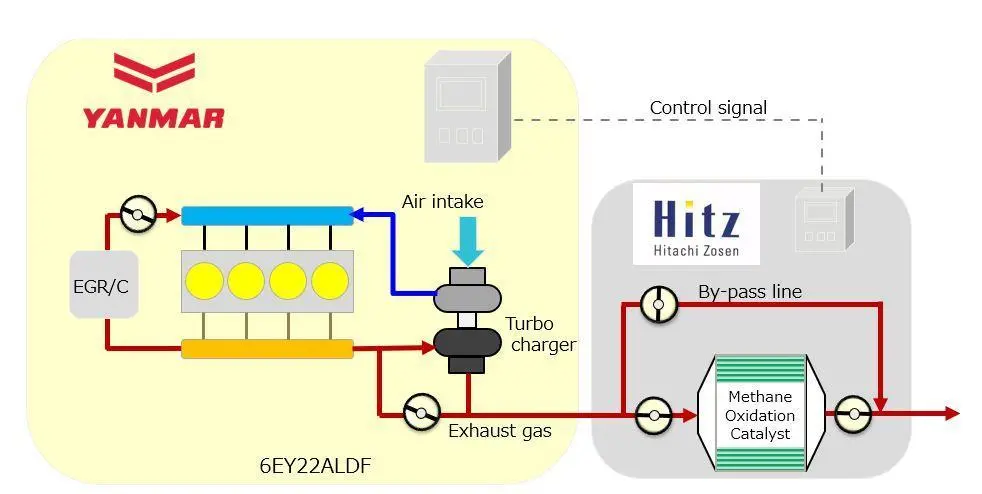
The Japanese 4-stroke engine manufacturer announced that it had received an Approval in Principle from ClassNK for a concept design for a methane oxidation catalyst system for LNG-fuelled engines on 16 March.
The AiP represents the next step in the development of the solution, which the project participants expect will be trialled on board a 94,000dwt coal carrier between 2024 and 2026.
While Yanmar is the first engine developer to receive an AiP for its design, it faces competition from Germany-based competitors to be the first to bring its solution to market, who have also successfully developed concept designs for methane oxidation catalyst systems. Both MAN Energy Solutions’ 4-stroke team in Augsburg and Rolls-Royce Power Systems have been conducting research into methane oxicat technology.
The potential of the methane oxidation catalyst technology to reduce methane emissions from LNG-fuelled engines is assessed at about 70% by all three companies.
Yanmar factors in potential efficiency improvements into the advance. The company previously confirmed plans to optimise the air-fuel ratio to reduce methane slip.
What distinguishes the Japanese project, which is receiving support from Japan’s New Energy and Industrial Technology Development Organization (NEDO) Green Innovation Fund, is the wider consortium of companies involved in the project.
A focus on catalysts
Hitachi Zosen is developing a new catalyst to oxidise fugitive methane emissions for the application. The Motorship notes that the proposed layout of the system released by Yanmar in December 2021 located the catalytic converter after rather than before the turbochargers. Hitachi Zosen has noted that it is developing a novel catalyst for the project, although no details are available as to whether it has developed a catalyst that can react with methane at temperatures well below 500 degrees centigrade.
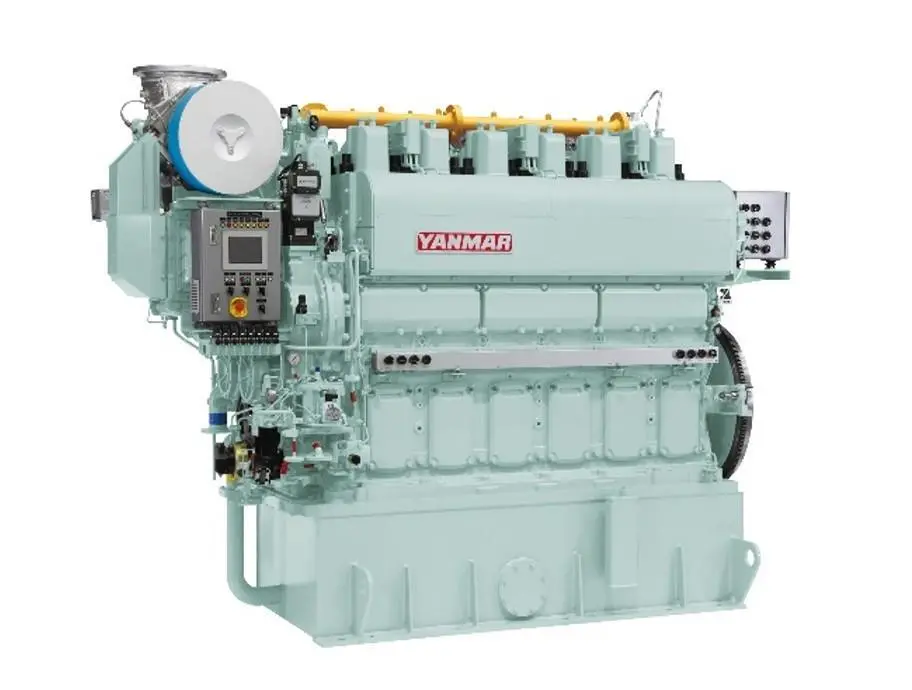
Current catalysts require a high operating temperature to activate methane, while susceptibility to sulphur poisoning represents a separate technical challenge. This means that catalytic converter needs to be located before the turbocharger in order to ensure that the catalysts can maintain operating temperatures above 500 degrees centigrade. The operating temperature requirement is also a barrier to the application of the technology to 2-stroke engines.
German competitors
Both Rolls-Royce Power Systems and MAN Energy Solutions 4-stroke previously confirmed to The Motorship that they were investigating the possibility of introducing methane oxicat solutions into the market.
MAN ES participated in the German IMOKAT project, which was intended to develop a precious metal-free catalyst for the process. The project, which ran between 2017 and 2019, identified a cerium-manganese catalyst as a potential alternative, which would be cheaper to produce than platinum-based alternatives, while offering stable mechanical and physical properties.
Dr. Gunnar Stiesch, Senior Vice President, Head of Engineering Engines at MAN in Augsburg, confirmed in March 2022 that the company continued to plan to bring an oxicat solution to market by 2025. Research into catalyst-engine interactions was ongoing, with plans for a field test system on board a vessel by 2023.
By contrast, Rolls-Royce Power Systems previously highlighted the potential impact of locating the catalytic converter between the engine and the turbocharger as an area of focus. The company confirmed to The Motorship that an electrically supported MTU turbocharging solution, which offered a solution for projects where increased transient response is required, was technically mature in 2021.
Wärtsilä looking into methane oxidation
Meanwhile, Wärtsilä has also been actively conducting research into potential methane oxidation catalyst applications as a way of reducing methane slip. In November 2021, The Motorship reported research as part of the Finnish-led INTENS project achieved methane oxidation rates of 70-80% on a Wärtsilä Vasa 4R32, a four-cylinder medium-speed 4-stroke marine engine retrofitted for dual-fuel operation. Higher methane oxidation rates were achieved after a SOx trap was placed upstream of the catalyst, effectively protecting the catalyst against sulphur poisoning.
Related Articles
 EMISSIONS REDUCTION TECHNOLOGY
 EMISSIONS REDUCTION TECHNOLOGY
 EMISSIONS REDUCTION TECHNOLOGY