



YARD RESTRUCTURE GATHERS PACE IN JAPAN
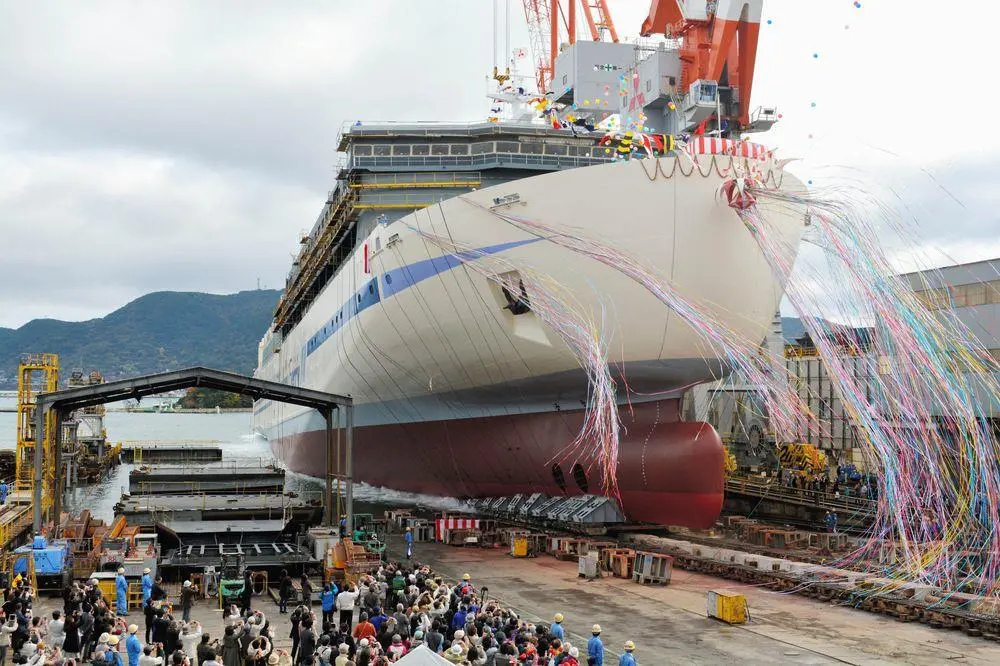
A further stage in the re-drawing of the Japanese shipbuilding map is anticipated through the planned alliance between Imabari Shipbuilding and Japan Marine United Corporation (JMU). However, actual realisation of the agreement has already been deferred on two occasions this year due to foreign concerns over the market implications of the creation of a yet more powerful entity, as Imabari already has a commanding share of Japanese production.
Initially anticipated for 1 October 2020, the deal would see Imabari acquire a stake in JMU and concurrently set up a joint commercial shipbuilding venture under the name Nihon Shipyard. But consecutive postponements, first to 1 November and then to 1 December, have been announced, and attributed to “reviews and approval processes related to competition law that are still ongoing overseas”.
Imabari is a dynamic force in the industry, having accounted for about one-third of Japanese newbuild output in 2019 by the measure of gross tonnage, and just over 8% of the world total. Company acquisitions have consistently formed a key part of its growth strategy, complemented by a vigorous R&D policy and investment in facilities, most significantly expressed in the 2017 opening of the huge No3 building bock at the Marugame complex.
The rationale behind the intended alliance with JMU is to strengthen both companies’ competitiveness in the face of the intensified challenge from abroad, where shipbuilders are becoming more integrated. Recent and prospective such developments in China and South Korea are the main issue, aggravated by the market downturn brought on by the global pandemic.
The terms of the agreement call for Imabari’s acquisition of newly-issued JMU stock and the establishment of the joint marketing and design entity Nihon Shipyard, plus production co-operation in block construction, large-scale outfitting and working to unified specifications. Nihon Shipyard would have 51%/49% respective holdings by Imabari and JMU, with a workforce of 500 assigned from the partners. Its remit will be the marketing, planning and development of all types of merchant ships except LNG carriers. Imabari has indicated that a straight merger is not the immediate consideration.
JMU serves as a microcosm of the passage of restructure of shipbuilding in Japan over the decades. The company was formed in 2013 out of the consolidation of IHI Marine United and Universal Shipbuilding. IHI Marine had been the outcome of the 2002 merger between the IHI/Sumitomo naval joint venture Marine United and one-time commercial shipbuilding industry leader IHI. For its part, Universal had been created in 2002 from the melding of the shipbuilding divisions of Hitachi and NKK. JMU’s wherewithal comprises seven domestic yards at Ariake, Kure, Tsu, Maizuru, Innoshima, Isogo(Yokohama) and Tsurumi(Yokohama), and technical research centres at Tsu and Yokohama.
Imabari’s name derives from the location of its founding shipyard facing the Kurushima Strait on the Seto Inland Sea. Such has been the phenomenal rise of the organisation, which has absorbed many of the country’s medium-sized builders, that the group today controls 10 shipyards. The philosophy of continual reinvestment was highlighted by the commissioning of the No3 drydock at the Marugame headquarters three years ago, hoisting both construction scope (ultra-large boxships of 20,000TEU, very large ore bulkers, VLCCs and LNG carriers) and productivity. During the 2019 fiscal year ending 31 March 2020, the group delivered a record 97 newbuilds.
JMU and Imabari thereby give expression to the much wider process of consolidation that has been taking place in Japan for some years now, and the two groups’ bid for a close relationship has come at a time when commanding figures in the industry elsewhere in eastern Asia are aiming to build global muscle and longer-term resilience through integration.
China’s two state-owned groups CSIC and CSSC are now a single force, while a new South Korean behemoth is sought through the merger of the shipbuilding interests of the Hyundai group with Daewoo Shipbuilding & Marine Engineering. The long-mooted Korean development is facing extended screening by European anti-trust authorities. Hyundai is reported to be discussing concessions with the EU regulators to allay concerns over the potential market impacts of a merger, but the South Korean will to achieve objectives, and its track record in that regard, should not be under-estimated.
In its annual report for the past fiscal year, Mitsui E&S Group(MES) recorded the decision that merchant shipbuilding business at the Chiba yard should end by 31 March 2021, and that discussions were in hand for an eventual transfer of commercial newbuild construction at the Tamano yard to MHI. It was subsequently reported during July that talks had been initiated with a view to Tsuneishi Holding taking a minority stake in Mitsui E&S Shipbuilding (MES-S), following the June 2018 pact on technical and R&D cooperation.
Towards the end of last year, one of the country’s hitherto most prolific constructors of LNG carrier and large LPG tanker tonnage, the Koyagi complex of Mitsubishi Heavy Industries (MHI) at Nagasaki became the subject of formal discussions that could lead to the yard being sold to Oshima Shipbuilding. The latter is pre-eminent in the bulkship category, accounting for 16% of bulker production worldwide as of December 2019.
Although the Koyagi plant has ranked as MHI’s main facility for large newbuilds over a period of more than 40 years, and despite capital investments to raise productivity and streamline the organisation, the move has been precipitated by consideration of long-term market conditions in the sector deemed to necessitate additional fundamental measures, including disposal. At the same time, MHI is looking to strengthen business at the nearby Tategami yard in Nagasaki.
MHI is not seeking a complete withdrawal from shipbuilding, but intends to concentrate resources on what it describes as “ships for which it can provide added value”. To achieve this, the strategy to be pursued by the group plans includes a greater emphasis on engineering capabilities and the development of cutting-edge technologies, competitively differentiated equipment, and diversification of the business model to encompass technology licensing and support in fields such as gas carriers. It also embraces modernisation of the Tategami plant and also the Shimonoseki yard in western Japan, which is a leading light in long-distance coastal ferry and other specialised vessels.
Significantly, and notwithstanding its previous, unprofitable foray into luxury cruiseship construction, MHI is again contemplating a return to the sector in both a repair and newbuild capacity. The new initiative is in the context of a goal to establish Nagasaki as a centre for cruise vessel maintenance, repair and operation, under a project conducted with the Ministry of Land, Infrastructure, Transport and Tourism.
For the Japanese shipbuilding industry as a whole, the LNG carrier orderbook is on the wane, with the contract inflow having dried up this year. The fact that Qatar has reserved building slots in South Korea and China for a huge fleet expansion programme that it is contemplating has further depressed Japanese prospects. However, the completion by Kawasaki Heavy Industries of the prototype liquefied hydrogen carrier Suiso Frontier, as a technology demonstrator with a diminutive 1,250m3 cargo capacity, could prove seminal, in paving the way to a generation of 160,000m3 vessels to transport LH2 from Australia to Japan. This draws on in-depth Japanese expertise in LNG tanker design, construction and operation.
An unerring drive for productivity gains, coupled with a focus on continual refinement of designs crafted for series production has seen Japan’s shipbuilding industry retain a very high profile in bulker construction. Applied across the bulkship spectrum, including Capesize, Newcastlemax, Panamax, Kamsarmax, handymax and handysize types, this approach translates into incremental improvements in ship efficiency and performance at minimal price premium.
Rather than relinquish what some might view as a less sophisticated sphere of the market to China and potentially other low wage-cost shipbuilding countries, Japan has shown its mettle in developing new designs conducive to standardised production while encompassing systems and features that play to heightened environmental standards and efficiency expectations. The raft of LNG-fuelled versions proposed across the bulker categories by all the main players is intended to give an edge over the eastern Asian competition, assuming acceptable price differentials. Imabari has added to the mix by proposing an LPG dual-fuelled Capesize bulker.
The fleet engaged in Japan’s extensive network of long-distance coastal ferry routes has seen constant renewal over the years, fulfilled exclusively by domestic yards. Demand for ro-pax and ro-ro vessels to serve the sector has been given further impetus by other than commercial factors, notably the bid to reduce CO2 and other emissions from national transport by fostering a shift to the seaborne mode coupled with societal changes that have led to a shortage of long-haul truck drivers.
The incoming generation of ships offer increased capacity as well as technological modernity. The various projects yield valuable propulsion system contracts typically entailing twin or multiple medium-speed engine plant and attendant high power concentrations transmitted through twin drivelines, to ensure the high speeds and service reliability demanded of schedules entailing coastwise and inter-island transits. A new technical chapter is unfolding whereby LNG dual-fuel installations based on the Wartsila 31 engine platform have been specified for a pair of 200m ro-pax newbuilds booked by Mitsubishi Shipbuilding from Mitsui OSK subsidiary Ferry Sunflower. Due in 2022 and 2023, the vessels are to be laid down at the Shimonoseki yard fronting the Kanmon Strait.
A comprehensive maritime industrial cluster, an unerring commitment to R&D and to longstanding customers, together with the culture of continuous improvement, remain strong cards in the hands of those Japanese shipbuilders ready to confront the greater-than-ever challenges posed by regional competitors.
Related Articles
 METHANOL
 GENERAL NEWS
 HYDROGEN