



Keeping an eye on scrubber performance
Continuous emission monitoring systems (CEMS) are a critical part of any exhaust gas cleaning system as they prove compliance with IMO regulations. If the CEMS fails it could have a signifi-cant impact on operating cost, requiring the replacement of HFO with low sulphur fuel or lead-ing to fines from port state control.
When scrubber manufacturer Langh Tech started developing its own scrubbers, one of its early steps was to test monitoring systems. The company installed CEMS on two vessels in 2013 – the general cargo ships Laura and Mariatta – and has been using them ever since. The environmen-tal performance monitoring company Afriso selected the Advance Optima analyser from ABB.
Both CO2 and SO2 are infrared-active components, which can be measured with an infrared photometer. The measured effect is the absorption of infrared light, which leads to a reduction of the light intensity received by a detector. This method is highly selective and specific for the measuring components.
The Advance Optima AO2000-Uras26 allows for simultaneous monitoring of multiple measuring points and different measured values. It can be configured for either a single stream, with CO2 and SO2 are measured separately in one cell each, or dual-stream sampling, where CO2 and SO2 are measured simultaneously in one cell.
Two different sample streams can be measured in one system. This reduces installation efforts, saves space and reduces cost of investment. It is an ideal solution for retrofit jobs. In addition to that, new measuring modules for future pollutants can be added at any time.
CUTTING MAINTENANCE
According ABB, in order to reach maximum reliability and availability, maintenance is required but should be reduced to minimum interventions. Self-diagnosing and functionality checks on the Advance Optima provide information when the analyzer system requires maintenance, long time before it fails.
Sample handling is another critical aspect of continuous gas analysis. The CEMS system tested provides special features for these purposes. The probe is equipped with an extra-large filter surface, which keeps filter pores from being clogged for an extended period of time. In order to completely exclude filter clogging, the system uses a dual-stage back-purge.
All elements integrated are designed in such a way that they can be disassembled, cleaned or completely replaced by crew members. These measures keep downtime to a minimum while significantly reducing the maintenance effort.
The compact design of the analyzer cabinet allows installations even in limited space and is ideally suited for retro fit applications as well as for new build. The cabinet contains both, the analyzer and sample conditioning equipment.
Another feature of the ABB analyser which helps to reduce maintenance efforts are gas filled calibration cells, which are used for automatic adjustments. No test gas cylinders are required for adjustments. The stability and tightness of calibration cells has been proven over a 10-year test performed by TUV.
CONNECTIVITY BOOST
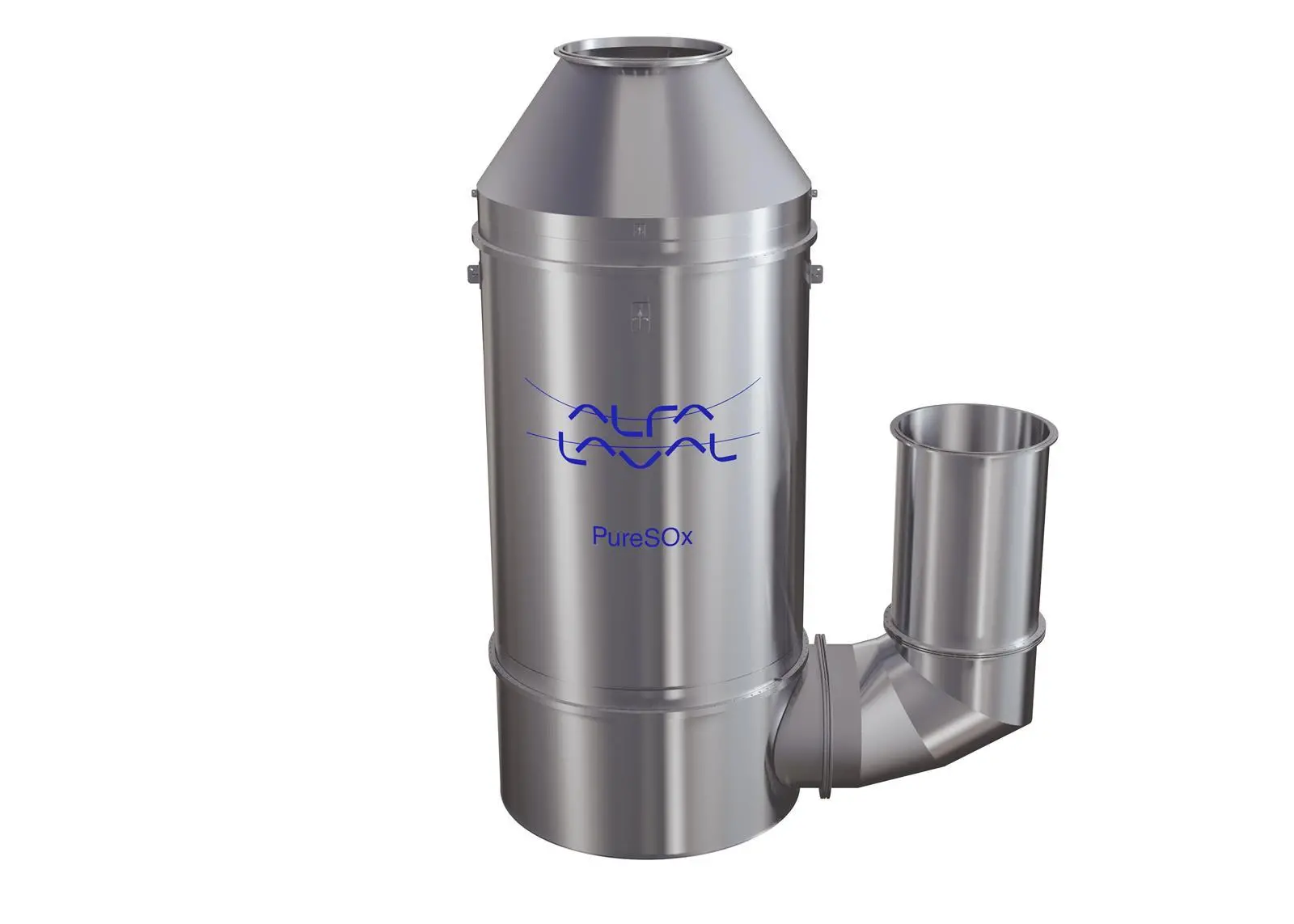
Meanwhile, other system providers are looking at enhancing their existing monitoring services. One example is Alfa Laval, which recently introduced a new connectivity programme for its PureSOx scrubbers. The promises greater simplicity and reliability in SOx compliance.
The programme builds on the new Alfa Laval Remote Emission Monitor (ALREM), a data report-ing and storage device that is part of all new PureSOx orders and also available for retrofit. Alfa Laval has nearly 100 PureSOx systems in operation today.
“Customers want to eliminate hassle and downtime,” says Olaf Van Heerikhuizen, manager ser-vice gas systems. “Connectivity is the key, as we’ve already seen in ALREM projects with major PureSOx customers. The ALREM lays the groundwork for a range of data-driven services that will make compliance – and life on board – much easier.”
The first service to be rolled out in the PureSOx connectivity programme is one that simplifies proof of compliance and is available on all vessels where the ALREM is installed. Rather than analysing scrubber compliance data themselves, customers receive user-friendly, graph-based reports via the Alfa Laval Touch Control system on board.
“This is immediate pain relief for customers, whose scrubbers are legally required to log around 50 data signals every three minutes,” says Van Heerikhuizen. “Instead of interpreting a hundred pages of raw sensor data for just a few days of operation, they get a finished compliance sum-mary that they can hand over directly to authorities.”
ADDED BENEFITS
Operators can also review the data for their vessel or fleet via an online portal. Accessible on a subscription basis for a simple monthly fee, the portal lets them view their vessel’s route and receive a SOx compliance summary for the dates they select.
The capabilities of the ALREM go beyond reporting and pave the way for additional services to come. The system can log not only the required compliance data, but also PureSOx diagnostic and performance data that can be sent to the cloud for processing by Alfa Laval analysts. This provides a foundation for condition-based maintenance services and new levels of scrubber optimization.
“In the course of testing the ALREM, we’ve been able to use the diagnostic information to find the root causes of an alarm and arrive on the vessel with the right parts and information to solve the issue quickly,” says Van Heerikhuizen. “As the system grows more sophisticated, we’ll be able to provide more predictive maintenance and help customers trim their scrubbers for even better performance and energy efficiency.”
Combined with greater connectivity, monitoring systems are evolving from tools for compliance into solutions that can save ship owners money on maintenance. That may help to reduce the sting felt by owners and operators as they ponder heavy investments to meet upcoming regula-tions.
How monitoring works
The majority of sulphur oxides are emitted in the form of sulphur dioxide, which is almost en-tirely derived from fuel’s sulphur content, rather than by the engine’s design or combustion con-ditions. At the same time, CO2 is formed exclusively from fuel. Thus a simple relation between SO2 and CO2 can be used as a measure of SOx emissions relative to the sulphur content of the fuel consumed.
Continuous gas analysis can be used to demonstrate that the measured ratio of sulphur dioxide to CO2 in the cleaned exhaust gas relates to the compliant level of sulphur content in fuel. Using this method, it is not necessary to prove scrubber’s SOx reduction performance, but the moni-toring system must be certified.
Sulphur content in fuel and emissions equivalent
|
Fuel oil sulphur content (% m/m) |
Ratio emissions SO2(ppm)/CO2 (% v/v) |
|
4.50 |
195.0 |
|
3.50 |
151.7 |
|
1.50 |
65.0 |
|
1.00 |
43.3 |
|
0.50 |
21.7 |
|
0.10 |
4.3 |
Related Articles
 EXHAUST GAS CLEANING SYSTEMS
 EXHAUST GAS CLEANING SYSTEMS
 EXHAUST GAS CLEANING SYSTEMS