



IMO faces science-based regulatory test at PPR 13
Although some of that debate focuses on scrubbers themselves, the most consequential issue now facing IMO is more procedural than technical.
At stake at PPR 13 is whether decisions affecting global shipping regulation continue to follow the science-based, risk-assessment framework the organisation has already agreed, or whether regulatory outcomes will run ahead of completed scientific work and established IMO procedures. This matters not only for EGCS, but for the credibility and durability of IMO decision-making in general.
The question this time is not whether environmental protection is necessary, but rather how a potential need for protection is weighed through sound scientific evidence, IMO process integrity and proportionality.
What’s on the table at PPR 13
Agenda Item 7 at PPR 13 addresses the evaluation and harmonisation of rules and guidance on the discharge of washwater from EGCS into the aquatic environment. This work falls under IMO output 1.23, which was extended to PPR 13 by MEPC 83 to allow further consideration of the last remaining open element, regulatory options.
The principal proposal now under discussion, from the EU (PPR 13/7/2), would amend Regulation 4 (Equivalents) of MARPOL Annex VI to create a new legal basis for restricting EGCS discharges through the use of Particularly Sensitive Sea Areas (PSSAs).
The proposal argues, in part, that existing EGCS Guidelines are advisory in nature and that mandatory regulation is required to address perceived environmental risks.
In practical terms, the proposal would enable Parties with designated PSSAs to unilaterally initiate EGCS discharge restrictions through a new associated protective measure (APM), without a requirement for a PSSA-specific submission, the completion of a prior environmental risk and impact assessment, or advance approval by IMO.
This represents a notable shift in approach, in that regulatory restrictions could enter into effect ahead of the completion of established PSSA Guidelines procedural steps, including elements of the scientific assessment work mandated by IMO.
Under existing IMO practice, PSSA designation requires a member state to demonstrate area-specific vulnerability to shipping, supported by scientific evidence and to propose APMs tailored to those risks, which are formally reviewed and approved by IMO before becoming mandatory.
As Regulation 4 is a general provision that applies to MARPOL Annex VI as a whole, any change intended to apply only to EGCS would require a separate regulation, raising broader questions of regulatory consistency. Against this backdrop, it is important to be clear about what the evidence submitted to PPR 13 does, and does not, indicate.
The status of the science
IMO has already established how environmental questions relating to EGCS discharges should be assessed. The 2022 Guidelines for risk and impact assessments (MEPC.1/Circ.899) set out a structured methodology, including two methods of conducting area-specific risk assessments: the development and use of emission factors, and the use of WET (whole effluent toxicity) testing.
The current GESAMP Task Team work related to emission factors has been slowed by funding constraints (see PPR 13/7/1 from the IMO Secretariat), and no final report is expected before PPR 14 next year.
In the meantime, CLIA has made a significant contribution to this effort through the submission of the largest qualified EGCS discharge dataset yet provided to IMO (PPR 13/INF.21), analysed using ISO-accredited laboratories and IMO-aligned methods. With over 1,000 sample sets, a “paired-delta” approach was applied to isolate the contribution of the EGCS itself by accounting for background seawater concentrations, providing a universal foundation for emission-factor development across different operating environments.
Although the IMO’s work on EGCS emission-factor development is ongoing, the alternative assessment method recognised in IMO Guidelines – WET testing, considered by many as the gold standard – remains available for conducting local risk assessments.
This matters because, to date, there are no publicly available examples of EGCS discharge restrictions being preceded by a completed environmental risk assessment carried out in accordance with MEPC.1/Circ.899. This means that restrictions have already been introduced outside the framework set out in IMO guidelines, reflecting a precautionary approach. However, the precautionary principle is intended as a temporary measure until sufficient evidence is available to inform a decision. In the case of EGCS, IMO has already established standardised methodologies for conducting such assessments.
In this context, questions arise around the urgency of sequencing regulatory action prior to risk assessment. Decades of operational data have consistently shown that EGCS discharges typically meet major international discharge water quality standards, including IMO discharge criteria and compliance with national and international benchmarks.
Furthermore, multiple whole-effluent studies, assessed using standard IMO methodologies, have repeatedly shown low risk of harm to the marine environment. In fact, in over 50 years of global operations, no verified evidence of harm to the marine environment attributable to EGCS discharges has been identified through these methods.
In parallel, Liberia has submitted an updated, peer-reviewed well-to-wake life cycle assessment (PPR 13/INF.6), comparing HFO with EGCS to VLSFO and MGO. The study finds that, across most environmental impact categories, HFO with EGCS delivers equal or lower overall impacts, illustrating the importance of system-level assessment alongside single-parameter evaluation.
A further example is provided by a well-known oil refinery in Norway, which unlike ships has had a continuous EGCS discharge into the sea at the same exact location for over 30 years. Every year an extensive benthic survey is conducted, and every year notes the same result: no substantive change to the resident flora and fauna populations.
Why process matters
Several submissions to PPR 13, including those from Liberia, ICS, BIMCO, CLIA and the World Shipping Council, raise concerns about the PSSA proposal and regulatory coherence.
Shipping is global. Fragmentation of MARPOL Annex VI implementation through a patchwork of port, coastal-state, and regional discharge regimes risks creating significant operational complexity, without clear environmental benefit. It also conflicts with the legal architecture underpinning IMO regulation, including established PSSA procedures and the relationship with UNCLOS rights and limits.
Precedent matters. If regulatory decisions affecting international shipping are taken pre-emptively, in advance of completed scientific assessment, without deliberation and approval through established IMO procedures, that approach is unlikely to remain confined to EGCS. It risks becoming a model for future debates involving alternative fuels, emissions abatement technologies and onboard carbon capture. Confidence in IMO’s frameworks depends on predictability, transparency and adherence to agreed processes and methods.
Unintended consequences
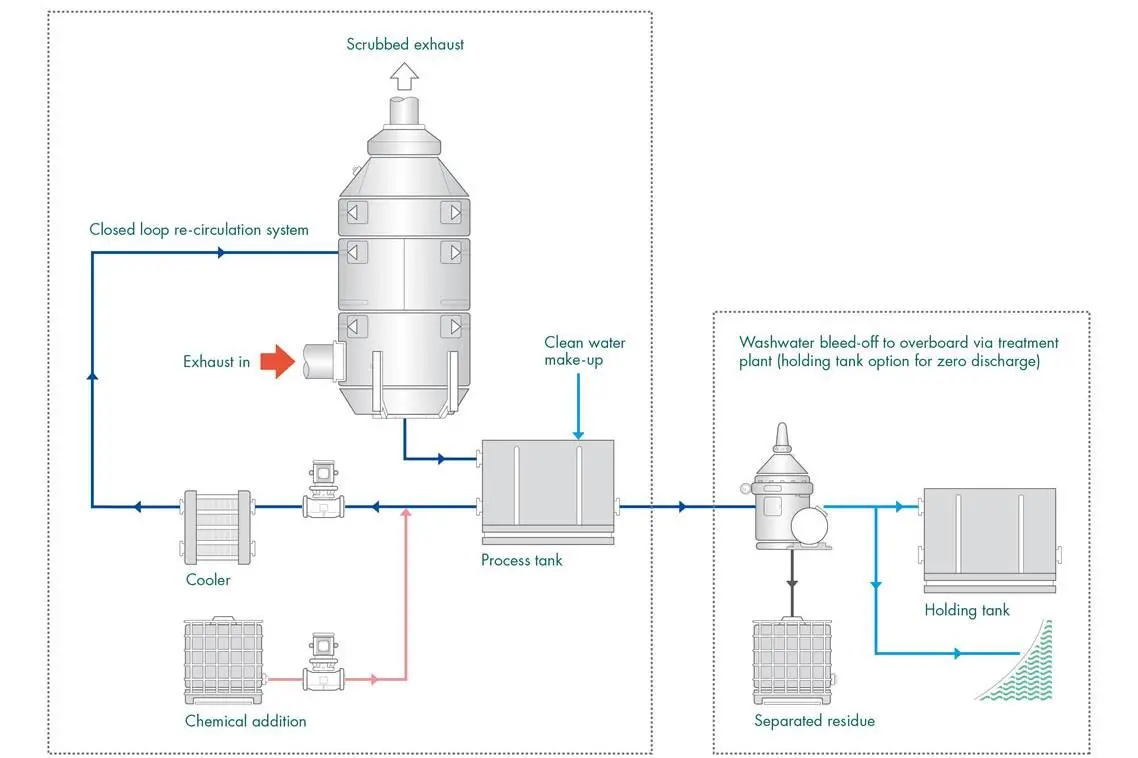
EGCS should not be viewed in isolation. Wet scrubbing is part of a broader exhaust-cleaning architecture that supports multiple environmental objectives, including sulphur removal at levels greater than compliant fuels, particulate reduction and emerging onboard carbon capture concepts. On a life-cycle basis, it can also result in lower CO2 emissions than compliant fuels.
Premature or blanket discharge prohibitions risk constraining innovation within a regulatory framework that has historically favoured goal-based rather than technology-prescriptive solutions. At a time when the industry is being asked to invest in increasingly complex emissions-control solutions, a proportional, goal-based approach – adjusting discharge limits where evidence demonstrates risk, rather than prohibiting technologies outright – preserves flexibility while maintaining environmental protection.
Once a technology pathway is closed by regulation, it is difficult to reopen. That reality should weigh heavily when decisions are taken in advance of completed scientific review.
IMO already has the science-based tools it needs.
A science-based pathway includes supporting completion of the GESAMP Task Team’s work on methods for developing locally applicable emission factors, which will provide an additional approved method for conducting risk assessments. Most importantly, it requires consistent application of the Guidelines for EGCS Risk Assessment (MEPC.1/Circ.899) for any restriction under consideration, including the conduct of area-specific risk assessments using standard IMO procedures. Where credible evidence demonstrates risk, proportionate measures can be taken. Where it does not, regulation should reflect that outcome.
Regulatory readiness at IMO
PPR 13 is a test case for whether IMO’s science-based processes and established MARPOL procedures will be followed, or whether a member state can unilaterally initiate regulatory restrictions in advance of completed scientific assessment.
In the absence of a proven need for environmental protection based on those assessments, this becomes a test of the credibility, durability and integrity of IMO structures and processes.
The long-term credibility of IMO decision-making depends on regulation that is defensible, consistent and grounded in completed scientific assessment. Environmental regulation and scientific discipline should be mutually dependent.
As PPR 13 approaches, the decisions taken, and the processes followed, will signal how IMO intends to navigate the year ahead.
Related Articles
 EXHAUST GAS CLEANING SYSTEMS
 EXHAUST GAS CLEANING SYSTEMS
 EXHAUST GAS CLEANING SYSTEMS